

The world often underestimates the power of a single individual, especially a child. Yet, in the case of Greta Thunberg, one girl’s passion for change became the spark for a global climate movement that has rallied millions. Her story is not just one of an environmental activist, but of a young girl who defied expectations, overcame adversity, and rose to become a powerful voice for our planet. This is the story of how Greta Thunberg, with her determination and courage, has made a monumental impact in the fight against climate change.
A Quiet Start
Greta Thunberg was born on January 3, 2003, in Stockholm, Sweden. From an early age, she exhibited a strong sense of awareness about the world around her. But it wasn’t until the age of 8 that she first became fully aware of the climate crisis. Greta’s parents, Malena Ernman, an opera singer, and Svante Thunberg, an actor, were both deeply involved in environmental issues, but it was Greta’s own curiosity and research that drew her to the facts about the environment.
At the age of 11, Greta was diagnosed with Asperger’s syndrome, ** obsessive-compulsive disorder (OCD)**, and selective mutism, which made her struggle in social situations. However, she always had an intense focus on issues that mattered most to her—namely, the environment. Greta's deep concern for the planet led to her isolation at times, but also fueled her passion to speak out against the world’s leaders and their inaction on climate change.
Her “superpower,” as she calls it, was her ability to stay focused on the issues she cared about, no matter how difficult the situation might be. Greta was determined to understand the science of climate change and speak out about the urgent need for action.
The Spark of the School Strike
In 2018, when Greta was just 15 years old, she decided that she could no longer wait for others to take action. She became increasingly frustrated with the lack of urgency from political leaders regarding climate change. Greta knew that the issue was far more pressing than most people seemed to realize, and she wanted to do something about it.
In August 2018, she made a decision that would change her life and the course of climate activism forever. Greta began skipping school on Fridays and sitting outside the Swedish Parliament with a simple sign that read: “Skolstrejk för klimatet” (School strike for climate). It was a personal protest, a call to action directed at the Swedish government, demanding that they take immediate steps to address the climate crisis.
At first, Greta was alone. She sat there in front of the Parliament building every Friday, enduring rain, snow, and cold temperatures, hoping her message would be heard. But it didn’t take long for her solitary strike to catch the attention of the world. Soon, other students joined her, and the movement began to spread to other cities in Sweden, then around the world. Greta’s “Fridays for Future” campaign was born.
The Rise of Fridays for Future
As Greta continued her school strike outside the Swedish Parliament, she quickly gained recognition, not just in Sweden, but across the globe. People were amazed by her dedication and the courage she showed as a young girl standing up to powerful world leaders. Her message was simple: “Our house is on fire”, a quote from Greta herself, calling for urgent action to protect the planet. She wanted the world to know that climate change was no longer a distant problem—it was an immediate crisis, one that required swift and decisive action.
By the end of 2018, Greta was invited to speak at numerous international climate summits, and her following grew exponentially. But her most powerful moment came in 2019 when she was invited to speak at the United Nations Climate Action Summit in New York City. There, in front of world leaders and media, she delivered an impassioned speech that captured the attention of the world.
Greta’s UN Speech: A Turning Point
Greta’s speech at the United Nations in September 2019 is perhaps one of the most iconic moments of her activism. Standing before heads of state, climate experts, and members of the media, she said:
> “You have stolen my dreams and my childhood with your empty words. And yet, I’m one of the lucky ones. People are suffering. People are dying. Entire ecosystems are collapsing. We are in the beginning of a mass extinction, and all you can talk about is money and fairy tales of eternal economic growth. How dare you!”
Her words were blunt, bold, and deeply moving. They struck a chord with millions of people around the world. Greta wasn’t just advocating for the environment—she was calling on world leaders to recognize the urgency of the situation and take immediate, concrete steps to address the climate crisis. She wasn’t asking for something unrealistic; she was demanding the survival of future generations.
Greta’s speech inspired a new wave of activism, with young people all over the world taking to the streets in support of the Fridays for Future movement. Millions of schoolchildren and students skipped school to protest and demand climate action. Greta had become a symbol of youth-led climate activism, proving that even one person could make a huge difference.
A Global Movement
Greta’s influence continued to grow. She traveled the world, speaking at climate rallies, forums, and summits. She sailed across the Atlantic Ocean in a carbon-neutral boat to attend climate meetings in the United States, as a way to highlight the importance of reducing emissions from air travel. She appeared in major international media outlets, becoming a household name.
But with fame came challenges. Greta faced criticism from politicians, world leaders, and even the media. Many questioned her methods and dismissed her as a naive young girl who didn’t understand the complexities of the world. Yet, Greta remained undeterred. She had one mission: to hold world leaders accountable for their inaction and demand the protection of the planet.
The Legacy of One Girl’s Change
Today, Greta Thunberg is still at the forefront of the global climate movement. Her actions and words have inspired millions of young people to stand up for their future. The Fridays for Future movement continues to grow, with millions of young activists joining the cause every week. Greta’s efforts have also led to greater awareness about the climate crisis in the media and have pressured governments to take more concrete steps toward addressing environmental issues.
Greta’s journey from a solitary protester outside the Swedish Parliament to a global figurehead is a testament to the power of one individual. It shows that age, status, or background does not determine one’s ability to effect change. It demonstrates that even in the face of overwhelming challenges, the courage to speak up, take action, and demand better can spark a revolution.
"One Girl, Big Change" is not just Greta’s story—it is a reminder to all of us that we all have the power to make a difference, no matter how small our actions may seem. Greta Thunberg’s legacy will continue to inspire generations to come, and her fight for the future of our planet is far from over.
About the Creator
Japan Furniture Market Size and Forecast 2025–2033
Introduction Japan’s furniture industry stands at a unique intersection of tradition and innovation. Renowned worldwide for its craftsmanship, minimalist design, and functional aesthetics, Japanese furniture reflects the nation’s cultural emphasis on harmony, efficiency, and simplicity. Today, as Japan’s population becomes increasingly urban, digitally connected, and environmentally conscious, the furniture market is undergoing a quiet but significant transformation.
By Janine Root 7 days ago in Earth
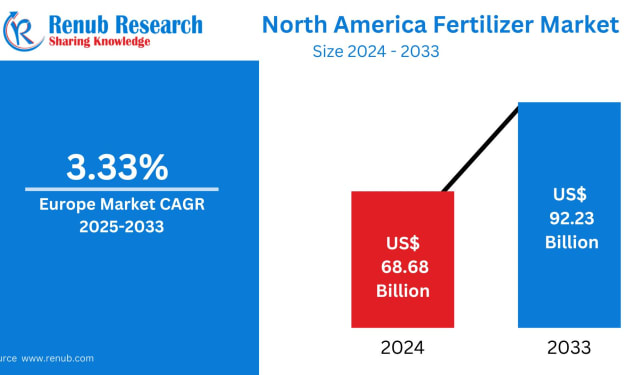
North America Fertilizer Market Size and Forecast 2025–2033
Introduction: Fertilizer as the Backbone of Modern Agriculture The fertilizer industry remains one of the most critical pillars supporting global food production, and in North America, its importance is growing stronger with each passing year. Fertilizers—whether organic or inorganic—play a vital role in replenishing soil nutrients, improving crop yields, and sustaining long-term soil fertility. As the region faces increasing food demand, climate pressure, and the need for sustainable agricultural practices, fertilizers are becoming more advanced, efficient, and environmentally responsible.
By Aaina Oberoiabout 5 hours ago in Earth



Comments
There are no comments for this story
Be the first to respond and start the conversation.