
Old Blue: Black Robins Saved From Extinction by One Woman…and A Man
How human intervention and one tenacious bird saved a species.

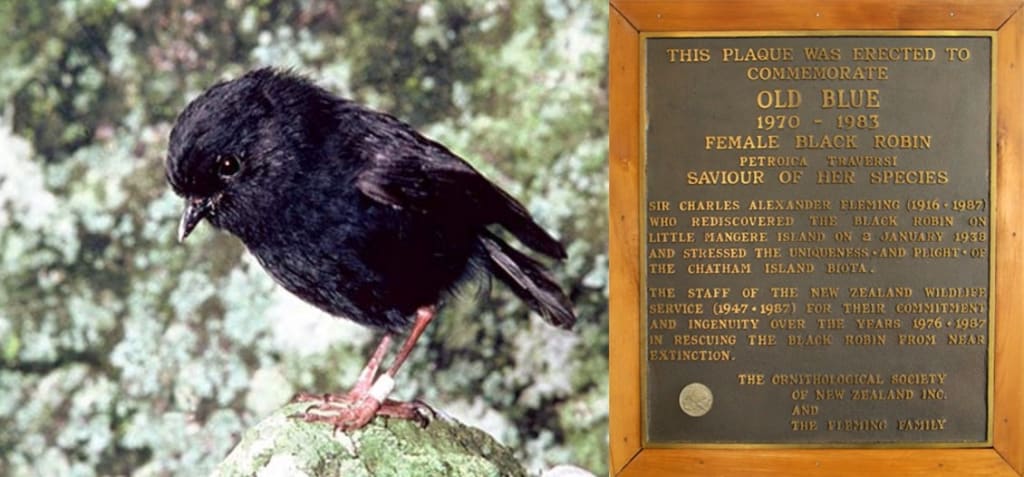
The woman, Old Blue, was the last of two female Black Robin birds on Earth in the 1970s. She lived on a remote island in New Zealand, Little Mangere, basically “…a rock stack rising 600 feet out of the ocean…”
The man, Don Merton, had been watching the numbers of Black Robins decline for years. He knew the remaining robins could not survive the harsh conditions on Little Mangere but it would almost be impossible to move them somewhere safer.
Running out of options, the decision was made to move them to a nearby island, Mangere. The Black Robins would go extinct if they did nothing so there was really nothing to lose and possibly everything to gain.
Cliffs, wind, and weather were against them. A climber helped install a ladder on the cliff’s face to make scaling the almost vertical accent possible.
Five robins were transported across a short, but treacherous stretch of rough water between Little Mangere and Mangere islands. Two couples and one fifth wheel.
Robins mate for life. One mating couple managed to hatch a chick but it did not survive. When the chick was removed from the nest, Don and his team noticed that the Robin couple immediately set about re-nesting. This gave them an idea, albeit a risky one.
Old Blue and her mate failed to fertilize an egg. In an unprecedented move, Old Blue dropped her mate for the fifth wheel.
The clock was ticking as Old Blue was already 8 years old, which is more than twice the lifespan of robins. They typically live 5–6 years. At 8 years old, Old Blue was well into her geriatric years, but she was far from finished.
Robins lay two eggs at a time. When Old Blue and her new fella, Old Yellow, fertilized their first two eggs, they would take them to be fostered by another bird species. They would do this twice, allowing them to keep the third set of eggs.
First, they choose the warbler. Even though the eggs hatched, they didn’t survive past 11 days. Apparently, warblers do not keep a tidy enough nest to accomodate Black Robin babies.
Then they tried the tomtits. Tomtits were successful in fostering Black Robin chicks.
Once the chicks were established enough, they returned them to Old Blue and Old Yellow. With such a large brood, they needed help. The team expanded the nest to accommodate the six chicks and they supplemented their food by tossing them worms and other delectables.
Old Blue saved her species from extinction in her geriatric years. Every Black Robin alive today is her descendant. She lived to the age of 14 years old and bore 11 chicks.
You may be wondering about inbreeding since all Black Robins are directly related to Old Blue and Old Yellow. An unwanted gene did pass down through the generations.
Some Black Robins lay their eggs on the rim of the nest resulting in the eggs falling out and thereby, not surviving. With numbers so small, Merton and his team would push the eggs back into the nest which eventually resulted in an increase of this unwanted trait.
Today there are over 230 Black Robins thriving off the coast of New Zealand. With this increase in number, people have stopped pushing rim-laid eggs back into the nests and the unwanted gene is slowly disappearing.
Meet the man himself in this short video.
References:
Remembering Don Merton and a bird called ‘Old Blue’
The incredible story of the Black Robin
The Black Robin Conundrum: What Happens When Humans Move Eggs in the Nest
About the Creator
Denise Darby
I am a mom of two wonderful children. A life partner of 28 years. I am interested in the common thread that runs within and between all living creatures, including humans. Trying to find that sweet spot where joy meets living.
Keep reading
More stories from Denise Darby and writers in Earth and other communities.
Top Australian Writers’ Festival Cancelled After Palestinian Author Barred
One of Australia’s most respected literary festivals has been cancelled following a fierce backlash over the decision to bar a Palestinian author from participating. What began as a programming dispute quickly escalated into a national debate about free speech, cultural inclusion, and political pressure in the arts. The cancellation has sent shockwaves through Australia’s literary community, raising urgent questions about whose voices are allowed on public platforms and at what cost.
By Aarif Lashari5 days ago in Earth
The Trans Youth Athletes in the US Fighting for Their Rights: ‘Playing Is an Act of Resistance’
Across the United States, sports have become an unexpected front line in the fight over transgender rights. For many trans youth athletes, simply stepping onto a field, track, or court is no longer just about competition—it is an act of resistance. As state legislatures debate and pass laws restricting transgender participation in school sports, young athletes are finding themselves at the center of a national culture war that reaches far beyond the locker room.
By Aarif Lashari5 days ago in Earth




Comments
There are no comments for this story
Be the first to respond and start the conversation.