
Oceanic Horrors: 12 Reasons the Deep Sea Terrifies More Than the Cosmos
Unveiling the Terrifying Secrets of Earth's Mysterious Abyss


The vastness of space has always captivated the human imagination with its countless stars, galaxies, and enigmatic black holes. However, there is another realm right here on Earth that harbors a level of terror far beyond what we can fathom in the cosmos—the deep, dark oceans. From deadly black holes to monstrous creatures and impending climate disasters, the ocean conceals mysteries that make space exploration seem like child's play. In this article, we will delve into 12 chilling reasons why the ocean is far scarier than space.
1. Oceanic Black Holes - Eddies:
Did you know that there are black holes in the ocean? Known as Eddies, these marine vortexes exhibit similar characteristics to their cosmic counterparts. These whirlpools, formed by a complex interplay of water temperatures, winds, and Earth's rotation, can be as massive as 150 kilometers in diameter and are so powerful that nothing can escape their pull. Unlike distant black holes, these abyssal voids exist right beneath our feet, adding an eerie element of fear.
2. Menagerie of Terrifying Wildlife:
Our oceans are teeming with a horrifying assortment of creatures, some of which appear like they belong in science fiction movies. From the fearsome sharks and killer whales to the grotesque red octopuses and proboscis worms, the marine world is rife with dangerous inhabitants that won't hesitate to engage in deadly confrontations.
3. The Uncharted Depths:
Much of our ocean's floor remains shrouded in mystery. We have better maps of distant celestial bodies than we do of the ocean depths. While NASA explores distant planets, we have yet to fully uncover the secrets lurking in the ocean's abyss. Mapping the ocean floor could unveil clues about extraterrestrial oceans and aid space missions.
4. Akin to Space:
Surprisingly, the ocean and outer space share many similarities, including extreme temperatures, high pressure, and a lack of breathable air. However, what sets the ocean apart is the abundance of life that poses real threats. Unlike space, where dangers are mostly passive, the ocean's denizens actively seek their prey.
5. Rising Sea Levels:
As the consequences of climate change become increasingly apparent, the rising sea levels are a menacing reality. Coastal communities face severe floods, risking displacement and destruction of cities like Venice, Bangkok, and New York City.
6. Darkness and the Creatures Within:
In the absence of sunlight, the deep ocean is a realm of perpetual darkness. Adapted to this environment, the eerie creatures lurking in the depths are equipped with nightmarish features that make them perfectly suited for survival in such a foreboding habitat.
7. Wrath of Hurricanes and Tsunamis:
While space occasionally throws solar flares our way, the ocean is home to far more immediate threats. Hurricanes and tsunamis, born from the powerful forces of nature, can wreak havoc on coastal regions, leaving devastation and loss of life in their wake.
8. Getting Lost in the Vastness:
In space, astronauts are meticulously monitored, ensuring their safety. In contrast, getting lost at sea is a very real danger. Straying too far from the shore can leave even experienced swimmers stranded and disoriented, contributing to the over three million shipwrecks that lie beneath the ocean's surface.
9. Lightning Strikes:
Lightning is another peril unique to the ocean, posing a threat to vessels, swimmers, and marine life. Due to its colossal size, the ocean acts as a natural lightning magnet, making strikes a relatively common occurrence.
10. Deadly Bacteria:
The ocean harbors various harmful bacteria, including flesh-eating strains that inhabit warm regions like the Gulf of Mexico. Swimmers with open wounds risk contracting these dangerous infections, which, in severe cases, may necessitate amputation.
11. Great Pacific Garbage Patch:
While space debris may be a concern, the vast accumulation of plastic waste in the Great Pacific Garbage Patch poses a far greater threat to marine ecosystems. Breaking down this plastic monstrosity is an arduous task, with long-lasting repercussions for ocean life.
12. Endless Challenges Ahead:
As we continue to explore space, we must not forget that our own planet holds a sea of mysteries that deserve attention. Understanding and preserving our oceans are crucial for humanity's survival, as they shape our climate, ecosystems, and ultimately, our future.
In conclusion, the ocean is undoubtedly a more terrifying place than the vast expanse of space. While space may be mysterious and awe-inspiring, the ocean's real dangers are both tangible and imminent, demanding our utmost respect and care. As we gaze at the stars, we must also remember to cherish and protect the vast enigma beneath the waves.
About the Creator
Keep reading
More stories from WanderLUST and writers in Earth and other communities.
The Legend of the Eternal Flame
In a realm where magic intertwined with reality, there existed a wondrous land known as Arcadia. Here, the elements of earth, air, water, and light coexisted in perfect harmony, creating a paradise of enchantment and beauty. Each element was personified by wise and benevolent beings, who ensured that the delicate balance of nature was maintained.
By WanderLUST2 years ago in Earth
Landscape Beneath Antarctica's Icy Surface Revealed in Unprecedented Detail
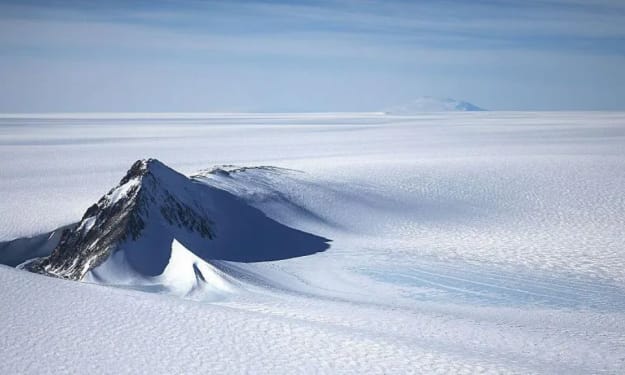
For decades, Antarctica has been the Earth’s ultimate mystery — a vast expanse of ice covering almost 14 million square kilometers, hiding secrets beneath its frozen surface. Now, thanks to advanced radar technology and satellite mapping, scientists have produced the most detailed map yet of the continent’s hidden landscape, revealing mountains, valleys, subglacial lakes, and river systems that were previously invisible. This discovery is more than just a scientific curiosity. Understanding Antarctica’s topography beneath the ice is critical for predicting ice sheet stability, global sea-level rise, and climate change impacts. The new data could also shed light on Earth’s geological history and the ways in which life may survive in extreme environments. How Scientists Mapped the Hidden Terrain For years, researchers have relied on a combination of methods to peek beneath the ice: Ice-penetrating radar: Devices mounted on aircraft or satellites send radio waves through ice layers, which bounce back when they hit bedrock, revealing contours beneath kilometers of frozen water. Satellite gravimetry: Small variations in Earth’s gravitational field help infer the presence of mountains, valleys, and subglacial lakes. Seismic surveys: Explosions or controlled vibrations allow scientists to detect underground structures by measuring the way seismic waves travel through different materials. Using these techniques, a consortium of international researchers created a high-resolution map of Antarctica’s sub-ice topography, revealing features that rival the landscapes of continents that have been visible for millions of years. What’s Beneath the Ice? The map reveals a striking variety of features: Mountain ranges: Peaks rise more than 4,000 meters above the surrounding terrain, hidden beneath miles of ice. Some of these ranges may be older than the Rockies or the Alps. Deep valleys: Vast troughs and gorges, carved by ancient rivers or tectonic activity, provide clues about how the continent evolved over millions of years. Subglacial lakes: Scientists have identified hundreds of liquid water lakes trapped beneath the ice, including the famous Lake Vostok. These lakes remain liquid due to pressure and geothermal heat and may host microbial life isolated for millions of years. Subglacial river networks: Surprisingly, water flows beneath the ice in channels and rivers, slowly carving pathways that affect ice sheet movement. This intricate landscape challenges the perception of Antarctica as a flat, featureless ice sheet. Instead, it is a dynamic and complex environment, where hidden topography influences everything from ice flow to global sea levels. Why This Discovery Matters The importance of understanding what lies beneath Antarctica’s ice cannot be overstated: Predicting Ice Sheet Stability: Ice sheets move more quickly over smooth surfaces than over rugged terrain. Knowing where mountains and valleys lie helps scientists predict which areas of ice may collapse first, potentially raising sea levels faster than anticipated. Climate Change Models: Subglacial lakes and water channels lubricate the ice from below, influencing melting rates. Incorporating these features into models improves accuracy in forecasting future sea-level rise. Earth’s Geological History: The newly revealed landscape offers a window into Antarctica’s past — from tectonic shifts to ancient rivers and climates. This data helps reconstruct how continents drifted and climates evolved over millions of years. Search for Extreme Life: Subglacial lakes may harbor microbial life isolated for millions of years, providing insights into life in extreme environments, potentially even on other planets. Global Implications Antarctica may feel distant, but its ice sheets hold the key to global sea-level stability. Even small changes beneath the ice can have profound consequences for coastal cities around the world. With melting accelerated by climate change, understanding the terrain under the ice is crucial for planning and mitigation. Governments, scientists, and environmental organizations are now using this information to: Improve climate models for sea-level rise predictions Identify vulnerable regions of the ice sheet Guide future research missions to subglacial lakes and mountains The discovery also strengthens the case for continued international collaboration in Antarctica, where research and environmental protection are governed by treaties emphasizing peaceful scientific study. Challenges Ahead Mapping Antarctica is far from complete. Extreme weather, thick ice sheets, and logistical difficulties make the continent one of the hardest places to study. While radar and satellite technologies have advanced, field validation and deeper exploration remain difficult and expensive. Researchers also face ethical and environmental concerns. Drilling into subglacial lakes to sample microbial life, for instance, must be done carefully to avoid contamination. Antarctica’s fragile ecosystem demands that scientific progress balances discovery with protection. Looking to the Future The detailed map of Antarctica’s hidden landscape opens new possibilities for exploration and understanding: Ice Flow Predictions: With accurate topography, scientists can model how ice sheets will respond to warming climates more precisely. Resource Insights: While exploitation is restricted by international agreements, understanding subglacial mineral deposits can inform potential future uses. Extreme Environment Biology: Studying subglacial lakes could reveal new species adapted to cold, dark, and high-pressure environments, broadening our understanding of life on Earth. The data also strengthens international scientific cooperation, as multiple countries share findings and resources to better understand a continent that belongs to no single nation. Final Thoughts Antarctica’s ice may appear static and endless, but beneath it lies a vibrant and rugged landscape filled with mountains, valleys, lakes, and rivers. The new detailed mapping of this hidden world is a landmark achievement in Earth science, combining advanced technology, international collaboration, and the human drive to explore. By uncovering what lies beneath the ice, scientists are not just satisfying curiosity — they are equipping humanity with the knowledge to protect our planet, anticipate climate challenges, and understand the deep history of Earth itself. Antarctica’s secrets, once locked beneath kilometers of ice, are finally being revealed, and what we learn could reshape our understanding of the planet and our place within it.
By Muhammad Hassan3 days ago in Earth
The Devil's Cut
“Comrade, finally you’re awake.” The voice was smooth, sensual. A flickering incandescent bar was all that lit the white, sterile room. All Vladimir remembered was everything going black. He tried to move his arms and found them strapped to the gurney.
By Matthew J. Fromm4 days ago in Fiction



Comments
There are no comments for this story
Be the first to respond and start the conversation.