
Ocean acidification
Ocean Acidification: A Growing Environmental Concern

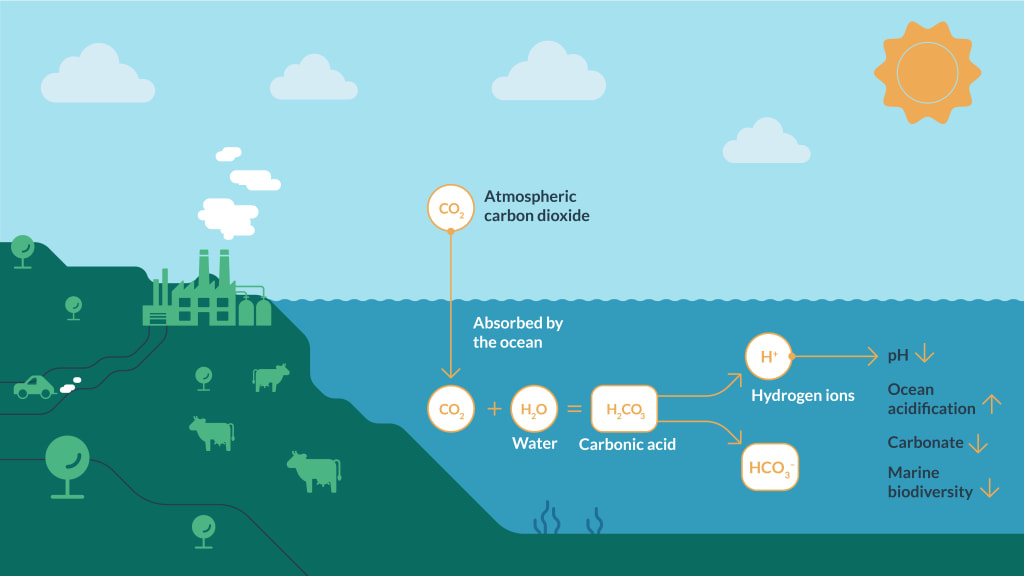
Ocean acidification is a process where the oceans become more acidic due to the increased absorption of carbon dioxide (CO₂) from the atmosphere. The burning of fossil fuels, deforestation, and other human activities release excess CO₂ into the atmosphere, a significant portion of which is absorbed by the oceans. This increased level of carbon dioxide reacts with seawater to form carbonic acid, which lowers the pH of the water, making it more acidic. Ocean acidification has emerged as a major environmental concern in recent decades, with far-reaching implications for marine ecosystems, biodiversity, and even human communities reliant on ocean resources.
The Science of Ocean Acidification
The process begins when carbon dioxide is absorbed by the ocean's surface waters. Once CO₂ enters the ocean, it dissolves in water and reacts with water molecules to form carbonic acid (H₂CO₃). This carbonic acid then dissociates into bicarbonate ions (HCO₃⁻) and hydrogen ions (H⁺). It is the increase in hydrogen ions that lowers the pH of the water, making it more acidic.
Over the last century, human activities have significantly increased the concentration of CO₂ in the atmosphere. The oceans have absorbed approximately one-quarter of the CO₂ emissions caused by human activity, leading to a steady decline in ocean pH. The average pH of seawater has dropped from approximately 8.2 to 8.1, which may seem small, but it represents a significant increase in acidity (about a 30% increase in acidity). This shift in ocean chemistry can have profound effects on marine life.
Impacts on Marine Life
One of the primary concerns with ocean acidification is its impact on marine organisms that rely on calcium carbonate to build their shells and skeletons, such as corals, mollusks, and certain types of plankton. As the ocean becomes more acidic, the availability of carbonate ions (CO₃²⁻) decreases, making it harder for these organisms to form and maintain their calcium carbonate structures. This can lead to weaker shells and skeletons, making these organisms more vulnerable to predation, environmental stressors, and disease.
Coral reefs, which are some of the most biodiverse ecosystems on the planet, are particularly vulnerable to ocean acidification. Coral polyps rely on calcium carbonate to build their hard skeletons, and as acidification reduces the availability of carbonate ions, coral growth slows down. In addition, ocean acidification can weaken the corals' natural defenses against other threats, such as rising sea temperatures and bleaching events. Coral reefs provide essential ecosystem services, including habitat for fish, protection from storm surges, and supporting the livelihoods of millions of people through fishing and tourism. Therefore, the decline of coral reefs due to acidification would have wide-ranging consequences for both marine biodiversity and human communities.
Fish and other marine organisms also face challenges due to ocean acidification. Changes in the behavior, physiology, and survival rates of marine species are being observed, particularly in fish larvae. For example, research has shown that increased CO₂ levels can impair the ability of fish to detect predators, navigate their environment, and communicate with each other. This could result in reduced survival rates and disrupted ecosystems. The alteration of food webs due to these behavioral changes has the potential to cause cascading effects throughout the marine environment.
Consequences for Human Populations
The impacts of ocean acidification also extend to human communities. Many coastal and island nations rely heavily on fishing, both for food and as an economic resource. As acidification threatens marine life, particularly shellfish and fish populations, it puts the livelihoods of millions of people at risk. The global seafood industry is worth billions of dollars annually, and any disruption to fish stocks or shellfish harvests could have severe economic consequences.
In addition to direct economic impacts, ocean acidification could have broader effects on food security. Marine species such as shellfish, crustaceans, and fish are a primary source of protein for many populations around the world. The decline of these species due to acidification could exacerbate global food insecurity, particularly in regions where people rely on marine-based diets.
Mitigation and Adaptation
Addressing ocean acidification requires a multi-faceted approach, with a primary focus on reducing carbon emissions globally. The reduction of greenhouse gas emissions is essential to slowing the pace of ocean acidification and mitigating its effects on marine ecosystems. Transitioning to renewable energy sources, improving energy efficiency, and adopting sustainable agricultural practices are key strategies in this effort.
Additionally, there are ongoing efforts to protect and restore marine ecosystems, such as coral reefs, through conservation and restoration programs. These efforts focus on reducing local stressors, such as pollution and overfishing, to help ecosystems better cope with the impacts of acidification. Furthermore, researchers are exploring methods to increase the resilience of marine species to acidification, including selective breeding, genetic modification, and habitat restoration.
IN THE END
Ocean acidification is a complex and growing environmental issue that has the potential to cause significant harm to marine ecosystems, biodiversity, and human populations. Its effects on marine life, particularly organisms that rely on calcium carbonate, could disrupt entire food webs and lead to the loss of critical ecosystem services. To mitigate the impacts of ocean acidification, it is essential to take action to reduce carbon emissions, protect marine ecosystems, and explore adaptive strategies for vulnerable species. The health of the oceans is inextricably linked to the health of the planet, and addressing ocean acidification is a critical step in ensuring a sustainable future for both marine life and human societies.
About the Creator
Badhan Sen
Myself Badhan, I am a professional writer.I like to share some stories with my friends.
Keep reading
More stories from Badhan Sen and writers in Earth and other communities.
Marine food chains (plankton to whales)
They start with tiny organisms seem plankton and extend all the way to large marine animals seem whales. Understanding how energy flows through these chains can provide insight into the interconnectedness of ocean ecosystems.
By Badhan Senabout a year ago in Earth
Rape Trial Puts Norway's Royal Family in Unwelcome Glare of Public
Norway’s royal family, long regarded as one of Europe’s most respected and low-profile monarchies, has recently found itself under intense public scrutiny following a high-profile rape trial connected to individuals within its extended social and public circle. The case has triggered widespread media attention, national debate, and renewed discussion about how institutions — even symbolic ones like monarchies — navigate crises involving criminal allegations.
By Aarif Lashari8 days ago in Earth
Lately, I'm empty
Lately, I feel an emptiness inside of me that doesn’t make any sense. I was fine a week ago and now I’m numb to the pain that I’ve been carrying around. Numb to the idea of me existing. I wish I could go to a place where I can hear happy positive thoughts and surround myself with joy. The medication I’m on doesn’t seem to work anymore. I still feel pain from existing, why am I here anyways? Merely to exist. I don’t feel like I’m making any differences being here.
By Cerina Galvan5 days ago in Confessions


Comments (1)
Nice work