
"Not Your Average Job"
For all the brave firefighters battling blazes across the country.

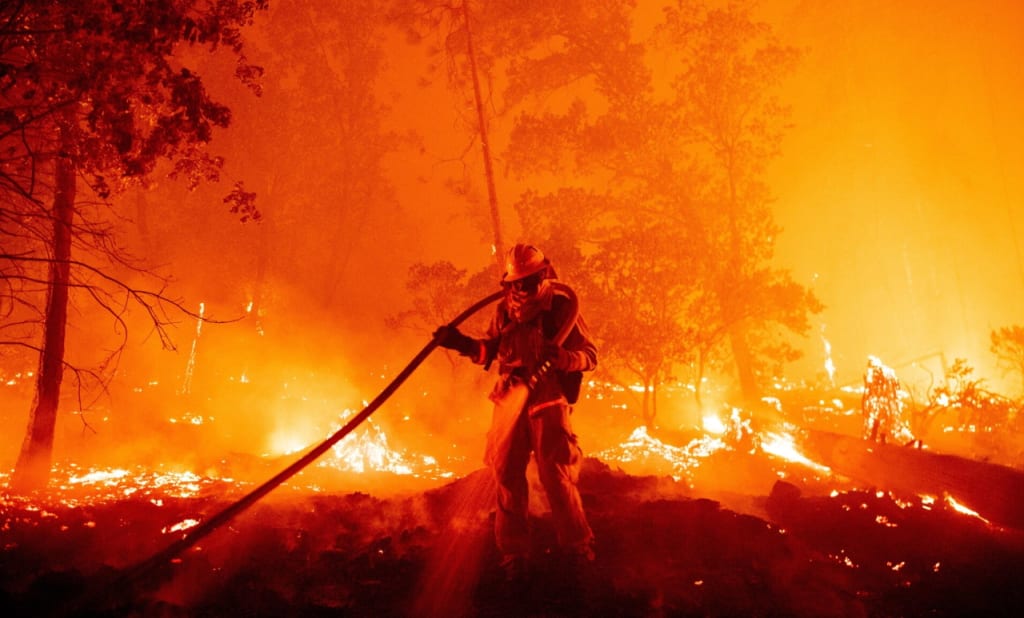
I love my job because, at the end of each day, I know I’m still alive. And that puts all other jobs to shame.
When an average person gets up to go to work, they lay out their clothes, maybe take a shower and spend some time in front of the mirror, have a bowl of cereal alongside toast and juice, gather the items they’ll need for work, and kiss their family goodbye.
When I get up for work, it could be in the dead of night, or the middle of the afternoon. I have no alarm clock. My wakeup call is usually someone kicking my booted feet with their own boot, accompanied by a gruff, “Get up. Time to go.” Yes, I sleep in my boots, and in heavy fire-proof pants, and a tee-shirt so grimy you probably wouldn’t use it as a shop rag.
I don’t sleep on a bed in a nice comfy bedroom. If I’m lucky, I may catch a few hours on a cot, but usually, it’s as little as a couple of towels thrown on the hard ground. But after the kind of day I usually have, I’m glad to have it.
I don’t have a normal breakfast: it’s usually a couple of pieces of stale bread with some rather unappetizing meat of dubious age stuck in between. If I’m lucky, there may be a juice box, but more often than not, it’s a couple of bottles of water.
I never say no to a bottle of water. It’s as precious as gold, and more valuable than life itself, up where we’re headed.
An average person drives to work, with their lunch and maybe a briefcase on the seat next to them. If they have what they consider a tough life, they may have their gear stowed in a backpack, and have to walk to a bus or a train. Some will take a bike and weave their way through city traffic. They may consider their commute to be a tiring but necessary component of their job.
My trip to work is usually on the back of a three-ton truck that saw better days in the National Guard. Sometimes, my job is so close I can walk to it, though that walk might be over ash-covered ravines that only last week were filled with magnificent pines and glorious meadows. I can often see the fire line as soon as I open my eyes. But even if it’s a few miles away, I can always smell it. That acrid, pungent smell never leaves your nostrils, not when you’re gasping for air, nor when you’re ducking close to the ground to escape a barreling wind filled with embers so hot they’ll stick in your fire-proof clothing and singe the material.
An average person has a set time schedule: arrive at such-and-such a time, work until your break, have lunch at this scheduled time, another afternoon break, and then home to the family, a nice dinner, and maybe an hour or two for a movie or a sports game.
My day, such as it is, is calculated by only two things: how bad the nearest fire is raging, and how much energy I have to fight it. There are no other parameters. We work until we contain a fire, or until we drop from exhaustion. I remember a moment two weeks ago where I was shoveling dirt on a still-burning tree trunk, and I realized I’d been piling dirt on it while I was asleep on my feet. I’d loaded that trunk with enough dirt for ten trees, all in the same spot, like a small pyramid of earth and ash. I shook myself awake and kept on working, but in a different location.
An average person frets when they lose a piece of jewelry at work, or they put down their phone and can’t remember where they put it. They might lose a file they were just working on, and consider it a horrible day if they have to start over and recreate the file from scratch.
We lose gear on occasion. Not very often, since losing your shovel might mean you have to kick out a fire with your boots, which is not the easiest thing to do.
But the term “losing” to us really hits home when we lose comrades, fellow firefighters. It happens, and damn too often, too. It was only a few years ago that an entire unit of firefighters in Arizona were caught in a steep valley when a fire raged past a containment line and roared up that valley. Nineteen fighters died that day, with the only surviving member being one that was stationed far enough away that he outran that horrendous blaze.
But that’s the monster we deal with, day in and day out. We don’t worry over parking places in the company lot, or whether the copier will run out of toner before that big report gets printed. We worry about the big things, like making it back to base camp alive.
At the end of the week, most people look forward to their pay day. They enjoy the luxury of having enough money to catch up on bills, with maybe enough left over for a trip to the theatre, or a night out, or a few gifts for loved ones.
My payday isn’t really worth celebrating. We get paid surprisingly little, about on the same scale as a starting fast food worker. It doesn’t seem to matter to the Powers That Be that we’re risking our lives on a daily basis, nor that we’re hundreds of miles away from our loved ones, nor that we work twelve- and fourteen-hour shifts, and even longer when we’re in the middle of a true emergency.
But when the average worker looks back on the day they’ve spent, few of them have the appreciation for what they’ve accomplished the way I have. They may consider their job satisfaction to be high if their skills match up with the work they do, and if they feel they have the promise of a future with more responsibility and better pay.
I look back at how my efforts, combined with the rest of my team on the ground and a few dozen air flights overhead, helped divert a raging firestorm away from a town of twenty thousand souls.
I remember all the times I helped save a home by stomping out an approaching brush fire, or by felling a tree at the last minute, or hosing down a wooden shingled roof that had already begun smoldering from the heat of a blaze hundreds of yards away, distant but roaring forward, and even at that distance still hot enough to burn your face if you looked straight at it.
I recall the moments when the wind helped us by suddenly switching from the west to the north, pushing an approaching blaze away from a cluster of buildings, and sending it down the hill in a way that we could contain it, and limit its destructive force.
I still feel the relief of knowing we’d caught a possible firestorm in the making, snuffing out a whirlwind that was just beginning to build up and threaten areas miles away with the embers it was preparing to carry.
And I’d need three more sets of hands to count all the times I helped lead a family with crying children out of the fire zone, a family who stayed too long and was about to be trapped on a road with massive flames bearing down on them from all sides. I’ll never forget the looks of gratitude on their parents' faces, and those of awe their children bore, thinking of us firefighters as Immortals who were impervious to the heat and the smoke and the flames.
We aren’t immortal. We aren’t impervious. We’re just good at what we do. Sometimes, that even includes surviving to fight another fire on another day.
About the Creator
David White
Author of six novels, twelve screenplays and numerous short scripts. Two decades as a professional writer, creating TV/radio spots for niche companies (Paul Prudhomme, Wolverine Boots) up to major corporations (Citibank, The TBS Network).
Keep reading
More stories from David White and writers in Earth and other communities.
"The Lessons of the Pair Tree"
A young Boy wandered away from his home, and his chores, one clear sunny morning. The warming Day whispered to him and implored him, saying, “Come and explore the distant lands with me, and I promise you an adventure worthy of any punishment your Elders might inflict for such a dalliance.”
By David White5 years ago in Fiction


Comments
There are no comments for this story
Be the first to respond and start the conversation.