
New discoveries are bringing the world of pterosaurs to life
The latest clues hint at where the flying reptiles came from, how they evolved, what they ate and more

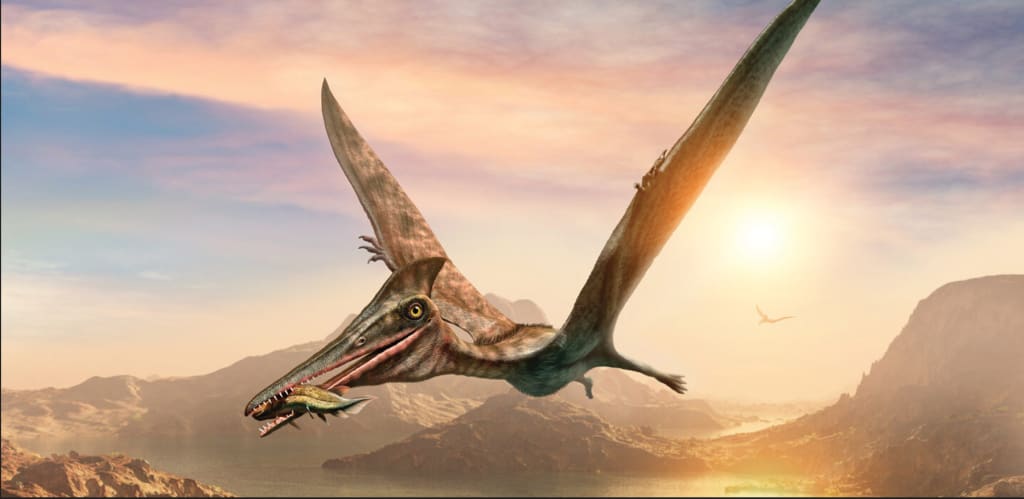
n an eat-or-be-eaten world, flight conveys a bevy of benefits. A creature that takes to the third dimension can more easily escape earthbound predators, dine off a much broader menu or drop down on unsuspecting victims from above. Flying also allows an animal to cover distance more quickly, forage more efficiently and find mates more easily.
So it’s perhaps surprising that only three groups of vertebrates have ever evolved sustained, muscle-powered flight. Pterosaurs, Greek for “wing lizards,” arrived on the scene in the Triassic Period, perhaps as early as around 237 million years ago. These original vertebrate fliers preceded birds by at least 70 million years and bats by more than twice that.
What caused pterosaurs’ demise is clear: The same asteroid that wiped out the non-avian dinosaurs about 66 million years ago also took them out — along with more than 75 percent of all life on Earth (SN: 7/4/20 & 7/18/20, p. 10). But how pterosaurs took to the air in the first place remains a big mystery. “We don’t have any properly transitional fossils for pterosaurs, or at least ones that we recognize,” says Matthew Baron, a freelance vertebrate paleontologist.
Despite the gap in the early fossil record, recent research offers clues to who pterosaurs’ earliest cousins were and what they looked like, and how pterosaurs evolved from small, flitting creatures into an incredibly varied group. They eventually occupied ecosystems worldwide and consumed a wide variety of prey — getting bigger and spreading farther earlier than previously thought, recent studies reveal. Some grew bizarre crests atop their heads, while others sported mouths full of teeth that projected threateningly at various angles.
“Some pterosaurs looked like creatures from your nightmares,” says Brian Andres, a vertebrate paleontologist at the University of Sheffield in England.
During their lengthy reign of the skies, pterosaurs ranged in size from creatures that could sit in the palm of your hand to soaring behemoths with wingspans that rivaled those of an F-16 fighter jet. In fact, the largest animal that ever took flight — an iconic species discovered more than half a century ago but only recently described in great detail — was a pterosaur.Where did pterosaurs come from?
Pterosaur fossils were first unearthed in the late 1700s — coincidentally, from the same limestone formation in Germany that later yielded the earliest known bird, Archaeopteryx. Scientists didn’t quite know what to make of the fossils. One scientist proposed they belonged to a weird sea creature, and another thought they represented a transitional form between birds and bats. But soon, experts settled on the fact that pterosaurs were flying reptiles, distinct from dinosaurs.
The first discovered species was named Pterodactylus antiquus, the genus name stemming from the Greek words for “wing finger.” (Although this species and many discovered soon after were commonly referred to as pterodactyls, that term officially applies only to this species and a small group of related species within the broader pterosaur lineage.) Unlike in bats, whose wing membranes are stretched between four elongated fingers of the hand, a pterosaur’s wing is supported by only one hyperelongated finger, a hallmark that helps distinguish pterosaurs from other creatures.The oldest known pterosaur fossils date to about 219 million years ago, though paleontologists suspect pterosaurs originated as early as 237 million years ago, Baron notes. That’s when the oldest and closest relatives of pterosaurs lived, and thus probably around the time that pterosaurs would have split off and formed their own lineage. The gap in the fossil record is in part due to the fact that rocks from this period are scarce worldwide. And many pterosaur bones were hollow, so they were vulnerable to being crushed soon after death or during fossilization. “Often, pterosaur remains are just a jumble of bones,” Baron says.
But there are indirect clues to what a proto-pterosaur might have looked like and whether pterosaur flight evolved from the ground up — in terrestrial creatures that flapped and leaped into the air — or from the trees down — in tree-living animals that glided.
About the Creator
Keep reading
More stories from BURN BRIGHT and writers in Earth and other communities.
"Seraphina" by Rachel Hartman
"Seraphina" is a young adult fantasy novel that follows the adventures of a young woman named Seraphina Dombegh. Set in the kingdom of Goredd, where humans and dragons have an uneasy truce, Seraphina is a gifted musician who also has a dangerous secret: she is half-dragon. In a world where dragons are despised and feared by humans, Seraphina must keep her true nature hidden in order to avoid persecution and danger.
By BURN BRIGHT3 years ago in Earth
Heavy Snow Warning: When Winter Turns Dangerous Overnight
A quiet winter evening can quickly turn into something far more serious. The sky grows darker, the wind sharpens, and snow begins falling faster than anyone expected. What starts as a peaceful snowfall can suddenly lead to closed roads, power outages, and difficult travel conditions. This is when a heavy snow warning becomes more than just a weather alert. It becomes a signal that daily life may soon slow down or even stop. For many communities, these warnings bring both beauty and concern. Snow can cover the world in silence, but it can also create dangerous conditions if people are not prepared. Understanding what a heavy snow warning means and how it affects daily life can help individuals and families stay safe when winter becomes unpredictable.
By Muqadas khan7 days ago in Earth


Comments
There are no comments for this story
Be the first to respond and start the conversation.