
National Hurricane Center: Tropical Storm Bret Forms, impact on Hurricane
Tropical Storm Bret forms impact on Hurricane

The National Hurricane Center (NHC) is once again at the forefront of weather monitoring and prediction as Tropical Storm Bret, the latest tropical disturbance, emerges in the Atlantic Ocean. With a potential to intensify into a hurricane in the coming days, meteorologists and emergency response agencies are closely monitoring its progress. In this article, we will explore the formation of Tropical Storm Bret, delve into the factors that influence its development, and analyze the potential impact it may have on coastal regions. With the NHC playing a pivotal role in tracking and providing timely updates on such weather systems, we will also shed light on the Center's operations and its contributions to public safety.
Formation of Tropical Storm Bret:
Tropical Storm Bret originated from a tropical disturbance that began to develop near the Caribbean Sea. As warm ocean waters provided the necessary energy, the disturbance gradually organized, leading to the formation of a well-defined circulation and a lowering of central pressure. Once sustained winds reached 39 miles per hour (63 kilometers per hour), the system was classified as a tropical storm and named Bret.
Factors Affecting Development:
Several factors influence the development and potential intensification of tropical storms and hurricanes. One of the primary factors is sea surface temperature, as warm waters serve as a fuel source for these systems. Another crucial factor is atmospheric instability, which allows thunderstorms to strengthen and develop into a well-structured cyclone. Additionally, wind shear, the change in wind direction and speed with height, plays a significant role in determining a storm's structure and intensity. By analyzing these factors and more, meteorologists at the NHC can provide accurate forecasts and warnings to vulnerable areas.
NHC's Monitoring and Predictive Capabilities:
The NHC, a division of the National Oceanic and Atmospheric Administration (NOAA), has been at the forefront of tropical weather forecasting for decades. Equipped with state-of-the-art technology, an array of satellite systems, radar, and reconnaissance aircraft, the Center continuously monitors tropical disturbances and storms. Through a combination of data analysis, computer models, and expert interpretation, the NHC issues advisories, watches, and warnings to areas potentially impacted by these weather systems. These timely alerts help communities prepare and take necessary precautions to mitigate potential risks.
Potential Impact on Coastal Regions:
As Tropical Storm Bret intensifies and potentially transforms into a hurricane, coastal regions need to remain vigilant. The NHC closely monitors the storm's track, size, and intensity, providing regular updates and guidance to emergency management agencies and the public. Depending on the storm's trajectory, coastal areas might experience high winds, heavy rainfall, storm surge, and even the possibility of tornadoes. Local authorities often issue evacuation orders and implement emergency response plans based on the NHC's forecasts to safeguard lives and property.
Public Safety and Preparedness:
In the face of an approaching tropical storm or hurricane, public safety and preparedness are of utmost importance. The NHC, in collaboration with local and state emergency management agencies, disseminates critical information to the public through various channels, including television, radio, and online platforms. These resources enable individuals and communities to stay informed, understand the potential risks, and take necessary precautions such as securing property, stocking up on essential supplies, and developing evacuation plans. The NHC's efforts contribute significantly to minimizing the impact of tropical storms and hurricanes on affected areas.
Tropical Storm Bret's formation and potential intensification into a hurricane highlight the critical role played by the National Hurricane Center in tracking and predicting such weather systems. With its advanced technology, expertise, and collaboration with various agencies, the NHC serves as the nation's primary authority on tropical weather forecasting. As we continue to advance in understanding and predicting these formidable storms,
About the Creator
Keep reading
More stories from Ekwulo john and writers in Earth and other communities.
The Mysterious Disappearance of Hamish Harding: A British Adventurer Lost in the Depths of Titanic Sub
The tale of the ill-fated RMS Titanic continues to captivate the imaginations of people worldwide, even over a century after its tragic sinking. The maritime disaster claimed the lives of over 1,500 individuals, leaving behind a haunting legacy. In recent years, another enigma has emerged from the depths of history, as British adventurer Hamish Harding, who embarked on a daring expedition to explore the iconic vessel's remains, mysteriously disappeared. This article delves into the story of Hamish Harding, his remarkable journey, and the unanswered questions surrounding his vanishing act.
By Ekwulo john3 years ago in History
The Reality of the Illusion of Time
Recently, as I strolled along the short stretch to my strength training session, I aimlessly took in the row of tatty shops and shabby buildings along the route and passed an off-street, in which one of my sisters used to live, around thirteen years ago.
By Chantal Christie Weiss3 days ago in Earth
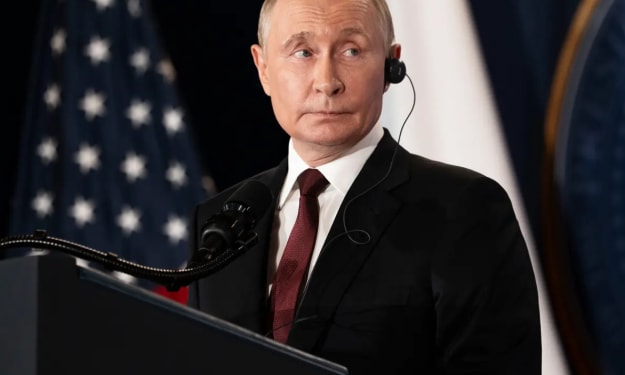
Why Putin Went Quiet When Challenged by Trump Over Venezuela
When U.S. forces captured Venezuelan President Nicolás Maduro in early January 2026, the world was stunned. Venezuela has long been a Russian ally, yet Russian President Vladimir Putin remained almost completely silent when challenged directly by U.S. President Donald Trump. Why would a leader so often outspoken on the world stage hold back in such a dramatic moment? Let’s unpack the story and explore what it means for global politics. A Bold Move That Shocked the World On January 3, U.S. forces executed a daring operation in Venezuela, taking Maduro into custody in New York to face charges including drug trafficking and narco‑terrorism. The operation was framed by the U.S. as a step to enforce justice, but critics saw it as an extraordinary overreach of power. Venezuela is no ordinary country for Russia. Since the days of Hugo Chávez, Moscow has cultivated close ties with Caracas, offering military support, energy deals, and diplomatic backing on the global stage. Past actions included Russian bombers visiting Venezuela and high-profile defense agreements. Given this history, many expected a fiery response from Putin. Yet, the Kremlin remained calm, issuing measured statements rather than sharp threats. Why Silence Was Strategic Experts suggest there are several reasons for Putin’s muted reaction, each revealing the careful calculation behind the Kremlin’s foreign policy. 1. Focus on the War in Ukraine Russia’s primary priority remains Ukraine. Engaged in a high-stakes military and diplomatic battle, Putin cannot afford distractions or new confrontations far from home. Escalating tensions with the United States over Venezuela could jeopardize Moscow’s position in Europe. A New York Times report highlighted that Russia is “subordinating all other interests to the war in Ukraine,” suggesting that even a high-profile ally like Venezuela takes a back seat to Moscow’s strategic goals. 2. Limited Military Options While Russia’s alliance with Venezuela is longstanding, much of the support has been symbolic rather than operational. Defense systems and military cooperation exist on paper, but Russia lacks the immediate ability to counter a U.S. operation thousands of miles away. Putin may have recognized that responding aggressively would be both ineffective and costly, potentially risking military and economic consequences that Moscow cannot afford. 3. Maintaining Diplomatic Channels with Washington With Donald Trump back in the White House since 2025, there has been cautious optimism in Moscow about recalibrating U.S.–Russia relations. Avoiding a dramatic confrontation over Venezuela keeps diplomatic channels open, allowing Russia to negotiate on other high-priority issues like Ukraine and sanctions relief. In other words, silence can be a calculated strategy, signaling restraint rather than weakness. 4. Russia’s Global Influence Is Waning The Maduro episode also highlights a broader geopolitical reality: Russia’s global reach has limits. Since the 2022 invasion of Ukraine, Moscow’s influence in regions like the Middle East and parts of the former Soviet Union has weakened. Venezuela remains one of its few high-profile allies outside Europe, but even there, Russia’s power is largely symbolic. By not escalating, Putin is acknowledging a practical truth: Russia cannot be everywhere at once, and some battles are not worth fighting. 5. Choosing Battles Wisely Some analysts emphasize that Putin’s quiet response is more about strategic prioritization than capitulation. In a world dominated by nuclear powers and volatile global politics, direct confrontation with the United States over Venezuela could spiral into a far larger crisis. By staying silent, the Kremlin may be signaling that it picks its battles carefully, focusing resources on Ukraine, where the stakes are highest. What This Means for the World Putin’s silence sends several messages: Russia is currently stretched, economically and militarily. Moscow is prioritizing Ukraine over symbolic allies. Strategic restraint is sometimes more powerful than public confrontation. The limits of Russian influence are becoming more visible to the world. This episode reflects a new reality in geopolitics: power is as much about choosing when not to act as when to assert force. The Bigger Picture The capture of Maduro is a defining moment not just for Venezuela, but for global politics. It shows the United States asserting power in a way not seen for decades, while Russia’s quiet reaction underscores its current limits and priorities. For observers, Putin’s silence is a lesson in modern geopolitics: even the most assertive leaders exercise restraint when stakes are high and risks are global. In the end, the Maduro affair reminds us that in today’s world, the loudest response is not always the most effective one — sometimes, quiet calculation speaks volumes. Sources and Further Reading The US capture of Maduro reveals Russia’s weakness – Atlantic Council ‘It sends a horrible signal’: US politicians react to capture of Nicolás Maduro – The Guardian Russia slams 'neocolonial threats' against Venezuela – Reuters
By Muhammad Hassan6 days ago in Earth



Comments
There are no comments for this story
Be the first to respond and start the conversation.