
NASA next big Project
NASA next big Project working on Earth System Observatry

The Earth System Observatory of NASA Keeps an Eye on Our Changing Planet As climate change accelerates and natural disasters grow more frequent, the need for accurate, real-time data about our planet has never been more critical. In response to this growing demand, NASA has launched the Earth System Observatory, a bold and comprehensive initiative that aims to revolutionize the way we observe and understand Earth’s interconnected systems.
Announced in 2021, the Earth System Observatory is not just a single satellite or mission. It is a collection of cutting-edge Earth-observation missions, each of which aims to observe distinct aspects of the planet's biosphere, land, ocean, and atmosphere. The Observatory gives scientists, policymakers, and the general public a picture of Earth that is more complete and dynamic than ever before by combining data from multiple sources. A New Generation of Earth Observation
NASA has been a leader in Earth science for a long time thanks to missions like Landsat, Aqua, Terra, and GRACE, which have provided crucial data for decades. In addition to building on this legacy, the Earth System Observatory represents a significant technological, scope, and integration advancement. Each mission within the Observatory is designed to focus on a particular domain of Earth science, including:
Aerosols and Atmospheric Composition: Monitoring pollutants and particles in the atmosphere to better understand their impact on climate and human health.
Clouds, Convection, and Precipitation: Studying how clouds form and behave, and how precipitation patterns are shifting in a warming climate.
Surface Biology and Geology: Observing vegetation, ecosystems, wildfires, and geological changes such as landslides and erosion.
Mass Change: Tracking the movement of water and ice, including the melting of glaciers and changes in groundwater, by measuring changes in the gravity field of the Earth. Surface Deformation and Change: Using radar, small movements in the Earth's surface brought on by subsidence, volcanoes, or earthquakes are detected. Together, these missions will offer a 3D, real-time view of Earth’s systems, revealing how they interact and evolve over time.
Technology Behind the Vision
At the heart of the Earth System Observatory is a suite of cutting-edge technologies. These include synthetic aperture radar for high-resolution imaging of the Earth's surface, LIDAR for measuring surface elevation and vegetation structure, hyperspectral imaging for detailed analysis of surface composition, and advanced radiometers and spectrometers for monitoring atmospheric gases and energy flow.
In addition, NASA is making use of cloud computing and artificial intelligence to process and analyze the enormous amounts of data that these instruments will produce. By using machine learning algorithms, scientists can identify patterns, detect anomalies, and predict future changes with greater speed and accuracy.
Collaboration and Global Impact
The success of the Earth System Observatory depends not only on NASA but also on strong partnerships with other agencies and organizations around the world. The United States Geological Survey (USGS), the National Oceanic and Atmospheric Administration (NOAA), and international partners like the European Space Agency (ESA) and the Japan Aerospace Exploration Agency (JAXA) are all part of NASA's close collaboration. These collaborations ensure that data is shared freely and used to support a wide range of global needs, from climate modeling and weather forecasting to disaster response and environmental management.
The Observatory is also designed to align with and support major international goals, including the United Nations Sustainable Development Goals (SDGs). Data from the missions will help track progress on issues such as clean water access, sustainable agriculture, and climate resilience.
Applications and Benefits
The data collected by the Earth System Observatory will have far-reaching applications across many sectors:
Disaster Preparedness: Early detection of hurricanes, wildfires, floods, and earthquakes can save lives and reduce economic losses.
Climate Research: Improved data on greenhouse gases, ocean temperatures, and ice melt will enhance climate models and inform mitigation strategies.
Agriculture and Food Security: Monitoring soil moisture, crop health, and land use helps farmers make better decisions and governments plan for food security.
Public Health: Air quality and heat index data can help communities respond to pollution and extreme weather events that affect human health.
Urban Planning: Understanding land deformation, sea level rise, and natural hazards helps cities adapt and build resilience for the future.
Looking Ahead
NASA’s Earth System Observatory is still in development, with individual missions rolling out over the next decade. The first mission, NISAR (NASA-ISRO Synthetic Aperture Radar), a joint project with India’s space agency ISRO, is expected to launch soon and will play a critical role in observing land changes, ice sheet dynamics, and natural disasters.
As more missions join the Observatory, NASA envisions a future where Earth observation is not just about collecting data, but about understanding the story of our planet in real time. This initiative, which combines technology, collaboration, and vision to address some of humanity's most pressing issues, is a paradigm-shifting step in Earth science. In a world shaped increasingly by environmental change, the Earth System Observatory will serve as a guardian in orbit—watching, recording, and helping us make informed decisions to protect our only home.
About the Creator
Keep reading
More stories from Supriya Patra and writers in Earth and other communities.
Dhoni back as CSK captain
After Ruturaj Gaikwad was ruled out of the tournament due to a hairline fracture in his elbow, the Chennai Super Kings (CSK) have reinstated the legendary MS Dhoni as captain in a dramatic mid-season twist during IPL 2025. This marks yet another chapter in the storied legacy of Dhoni and CSK — a relationship built on trust, trophies, and tenacity.
By Supriya Patra 10 months ago in Journal
Malted Wheat Flour Market Size and Forecast 2025
Malted Wheat Flour Market Overview Malted wheat flour is produced by germinating wheat grains, drying them, and grinding them into flour. This natural malting process activates enzymes—particularly amylase—that convert starch into fermentable sugars during baking. The result is improved dough fermentation, enhanced texture, increased loaf volume, and a richer, more consistent flavor profile in baked goods.
By Aaina Oberoi6 days ago in Earth
Neutraceutical Packaging Market Size and Forecast 2025–2033
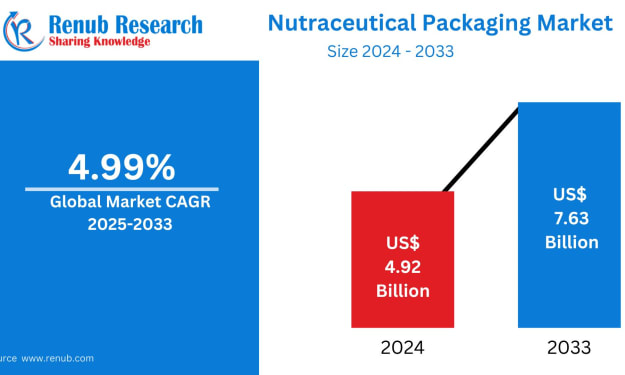
Neutraceutical Packaging Market at a Glance The Neutraceutical Packaging Market is projected to expand from US$ 4.92 billion in 2024 to US$ 7.63 billion by 2033, growing at a CAGR of 4.99% from 2025 to 2033. This steady growth reflects the accelerating global demand for dietary supplements, functional foods, herbal products, and wellness beverages. Rising health awareness, aging populations, sustainability expectations, the rapid growth of e-commerce, and evolving regulatory frameworks are reshaping how nutraceutical products are packaged, protected, and presented.
By jaiklin Fanandish6 days ago in Earth



Comments
There are no comments for this story
Be the first to respond and start the conversation.