
NASA Astronauts Create Fake Moon on Earth to Master Lunar Photography for Upcoming Missions
An inside look at how astronauts are using a realistic Moon replica on Earth to perfect lunar photography ahead of NASA’s next giant leap.

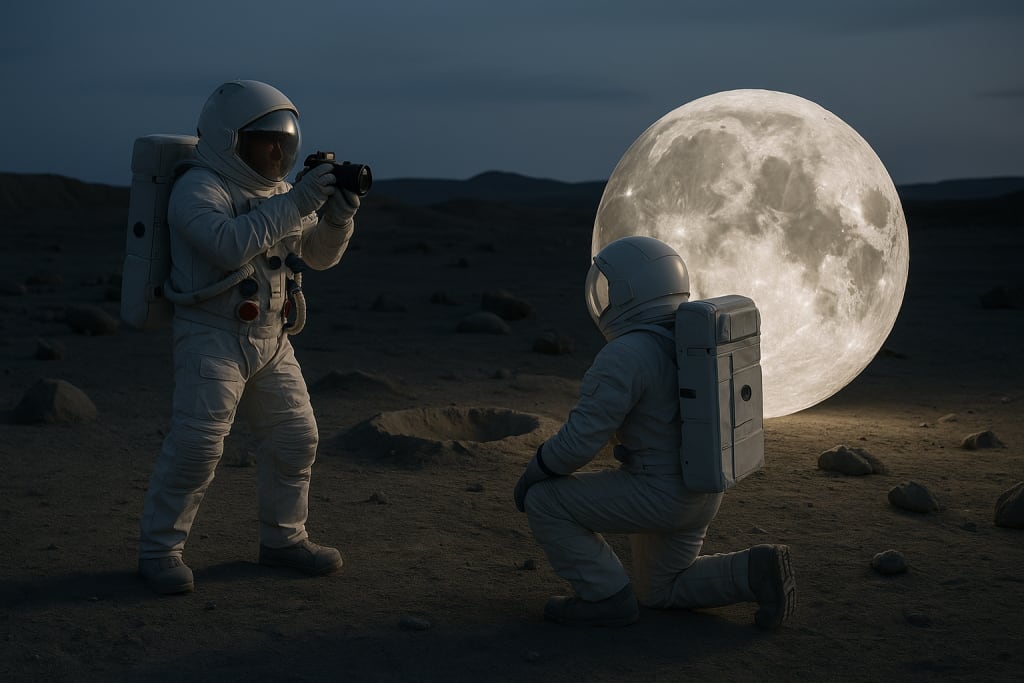
NASA Astronauts Create Fake Moon on Earth to Master Lunar Photography for Upcoming Missions
In a world increasingly fascinated by the cosmos few stories remind us of the deep humanity behind space exploration. Among them is a quietly captivating initiative astronauts building a “fake Moon” here on Earth not for science experiments or lunar landings but to perfect the art of moon photography. It might sound simple even whimsical but this project unveils layers of human emotion creativity and an unbreakable bond with the stars.
A Dream Lit by the Moon
Since the beginning of time the Moon has inspired awe poetry and a longing to reach beyond. For astronauts that longing becomes a profession one full of discipline danger and the surreal realization that one day you might walk where no human has before. But now a group of astronauts is turning their attention to not just visiting the Moon but capturing it through a lens in all its silent glory. To achieve this NASA and several international space agencies have recreated a mock lunar surface on Earth. Not just dust and rocks but intricate terrains shadows and lighting conditions that mirror the actual Moon as closely as possible. Why? Because the Moon doesn’t just challenge human bodies it tests the limits of how we perceive and remember what we see.
The Art and Science of Moon Photography
You might wonder why is moon photography such a big deal for astronauts? Isn’t it just point and shoot?
Far from it.
Photographing the Moon from its surface is uniquely challenging. The lighting conditions are extreme pitch black skies blindingly bright sunlight and harsh shadows that swallow detail. The equipment must be handled in bulky space suits. The framing must be perfect often with limited time. These aren’t just pretty pictures they are scientific documentation emotional records and the visual history of humanity’s presence in space. Hence the fake Moon. This terrestrial duplicate allows astronauts to practice composition adjust camera settings in simulated lunar lighting and learn how to balance technical precision with creative intuition.
Simulating the Lunar Landscape Not Just a Sandbox
The fake Moon is no ordinary training ground. Built in isolated desert locations or inside massive space training hangars these mock lunar fields include. Crater fields mimicking real lunar formations. Lighting rigs simulating the sun’s low angle light on the Moon. Dust simulants that reflect light similarly to regolith (lunar dust). Scaled landmarks for depth and spatial awareness. Walking through the terrain feels eerily like walking on another world. For astronauts it’s more than technical it becomes emotional. Sometimes I just pause look around and feel something ancient stir in me said one astronaut involved in the project. It’s like you’re rehearsing for a dream you’ve had since childhood.
A Deeply Human Pursuit
There’s something profoundly human about taking pictures. We capture moments to remember to feel and to share. Astronauts, trained to measure calculate and execute with machine like precision suddenly find themselves using photography to express wonder curiosity and vulnerability. Veteran spacefarer Chris Hadfield once said. When you look at Earth from space, you don't see borders. What you see is beauty and fragility. I wanted to share that. The fake Moon project taps into this very spirit. It’s not just about science or documentation it’s about storytelling. Through their lenses astronauts become our eyes and hearts in space. Their photos are windows into the surreal a footprint on alien soil a flag caught in the stillness Earth rising over a gray horizon.
The project is backed by credible authorities NASA ESA and leading astrophotographers. Equipment used includes modified Hasselblad cameras similar to those used in Apollo missions paired with modern DSLR and mirrorless systems adapted for low gravity use. This isn’t just clickbait. It’s a layered nuanced narrative that showcases real training, real emotion, and real preparation for a future where humanity might live work and create art on the Moon.
The Future: A Lunar Renaissance
With NASA's Artemis program and private space ventures like SpaceX and Blue Origin gearing up for the next chapter in lunar exploration this kind of preparation is more relevant than ever. Moon bases long term stays and even lunar tourism may soon become reality. And what will we do there?
We will photograph.
Not just for science but for connection. For beauty. For memory.
This fake Moon built on Earth might be made of foam sand and lights but what it represents is infinitely more. It stands for the human desire to understand to express and to leave behind traces of meaning wherever we go even 238855 miles away from home. In the end the fake Moon isn’t just a tool it’s a canvas. A rehearsal space for humanity’s next big leap. And through the eyes of the astronauts who train there we are reminded that the universe is not just something to conquer but something to feel. Photography from the Moon will not only show us the distant terrain it will reflect our hopes our stories and our shared journey across time and space.
And that perhaps is the most human mission of all.
About the Creator
Adnan Rasheed
Author & Creator | Writing News , Science Fiction, and Worldwide Update| Digital Product Designer | Sharing life-changing strategies for success.
Keep reading
More stories from Adnan Rasheed and writers in Earth and other communities.
1,000 Foot Mega Tsunami Could Devastate U.S Coastline Experts Warn of 3 Danger Zones
1,000 Foot Mega Tsunami Could Devastate U.S Coastline Experts Warn of 3 Danger Zones In a chilling revelation scientists and disaster preparedness experts are sounding alarms over a potentially catastrophic event that could reshape parts of the U.S coastline a 1,000 foot tall mega tsunami. Though it may sound like a plot from a Hollywood thriller the danger is rooted in real science with three specific regions of concern identified the Canary Islands in the Atlantic the Aleutian Islands in Alaska and the unstable volcanic slopes of Hawaii. The implications for millions of Americans living along the coast are sobering.
By Adnan Rasheed8 months ago in Earth
Without Democracy, Donald Trump’s Venezuelan Oil Quest Will Fail
Donald Trump’s renewed interest in Venezuelan oil may seem, on the surface, like a hard-nosed geopolitical calculation. Venezuela holds the world’s largest proven oil reserves, and amid global energy uncertainty, access to those resources is undeniably tempting. But history, economics, and politics all point to the same conclusion: without democratic reform in Venezuela, any attempt by a Trump-led US administration to secure reliable Venezuelan oil will ultimately fail.
By Aarif Lashari5 days ago in Earth



Comments (1)
This fake Moon project is really interesting. It makes sense that photographing the real Moon is so tough. I remember when we were working on some tricky photography setups here on Earth. We had to deal with all sorts of lighting issues. So, I can only imagine how much more challenging it is on the Moon. How do you think this practice on the fake Moon will translate to better photos during actual lunar missions?