

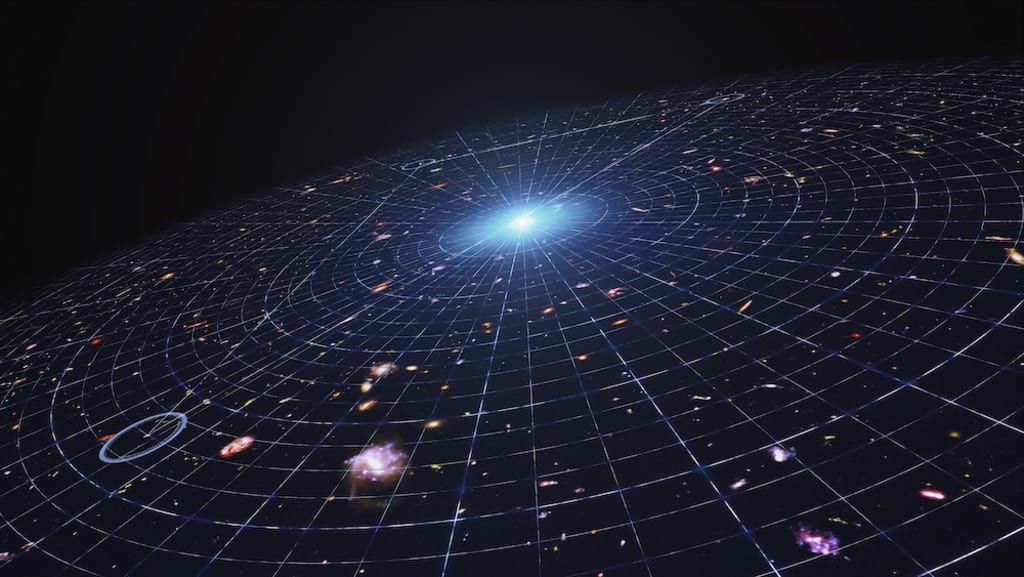
The universe is vast and complex, and there is much that we still do not know about it. Some of the biggest mysteries of the universe include:
1.Dark Matter:
This is a form of matter that does not interact with light or other forms of electromagnetic radiation, making it invisible to telescopes. It is estimated to make up around 85% of the matter in the universe, yet we still do not know what it is made of.
i) Yes, that's correct. Dark matter is a type of matter that does not emit, absorb, or reflect light or other forms of electromagnetic radiation, which makes it invisible to telescopes and other instruments that detect light. Its existence was first inferred in the 1930s by Swiss astronomer Fritz Zwicky, who noticed that the observed mass of galaxy clusters did not account for the gravitational forces that were holding them together.
ii)Since then, numerous observations and experiments have supported the idea that dark matter exists, and it is now thought to make up about 85% of the matter in the universe. However, its exact nature and composition are still a mystery. Scientists have proposed various theories and particles that could make up dark matter, but so far, there is no direct evidence to support any of them.
iii)The search for dark matter continues, with many experiments being conducted around the world to detect its presence indirectly through its gravitational effects or other possible interactions with regular matter. Understanding the nature of dark matter is crucial to our understanding of the universe and its evolution, as well as the fundamental laws of physics.
2.Dark Energy:
This is an unknown form of energy that is causing the expansion of the universe to accelerate. It is estimated to make up around 68% of the total energy in the universe, yet we do not know what it is or how it works.
i)Yes, that's correct. Dark energy is an unknown form of energy that is causing the expansion of the universe to accelerate. This was first discovered in the late 1990s, when two independent teams of astronomers observed distant supernovae and found that their brightness was weaker than expected. This led them to conclude that the expansion of the universe was accelerating, rather than slowing down as previously thought.
ii)Since then, other observations and experiments have confirmed the existence of dark energy, and it is now estimated to make up about 68% of the total energy in the universe. However, its nature and origin remain a mystery. Unlike dark matter, which exerts a gravitational pull on regular matter, dark energy appears to have a repulsive effect, driving galaxies and other structures in the universe apart.
iii)Scientists have proposed various theories to explain dark energy, such as the cosmological constant or vacuum energy, but so far, there is no direct evidence to support any of them. The study of dark energy is an active area of research in astrophysics and cosmology, as it holds the key to understanding the ultimate fate and structure of the universe.
3.The Origin of the Universe:
The universe began with the Big Bang, but we still do not know what caused it or what existed before it. There are also many unanswered questions about the early universe, such as how the first galaxies formed.
i)Yes, that's correct. The origin of the universe is still a mystery. The prevailing theory is that the universe began with the Big Bang, a massive explosion that occurred about 13.8 billion years ago. This theory is supported by numerous observations and experiments, such as the cosmic microwave background radiation, the abundance of light elements, and the large-scale structure of the universe.
ii)However, the exact cause or trigger of the Big Bang is not known. Some theories suggest that the universe originated from a quantum fluctuation, while others propose the existence of a multiverse or cyclic universe. These ideas are still speculative and require further evidence to support them.
iii)Moreover, there are many unanswered questions about the early universe, such as how the first galaxies and stars formed, and how the universe transitioned from a hot, dense state to its current state of large-scale structure and complexity. Scientists are studying these questions through observations with powerful telescopes, simulations with supercomputers, and experiments with particle accelerators and detectors.
iv)Understanding the origin and evolution of the universe is one of the most profound and challenging questions in science, with implications for our understanding of physics, astronomy, and cosmology.
4.The Nature of Black Holes:
Black holes are extremely dense objects with such strong gravity that nothing, not even light, can escape from them. We still do not fully understand how they form or what happens inside them.
i)Yes, that's correct. Black holes are one of the most mysterious objects in the universe. They are formed when a massive star runs out of fuel and collapses under the force of its own gravity, creating a region of space where the gravitational pull is so strong that nothing, not even light, can escape from it. This region is called the event horizon.
ii)Despite their fascinating properties, we still do not fully understand how black holes form or what happens inside them. One of the biggest challenges in studying black holes is that their extreme gravity makes it difficult to observe them directly. Instead, scientists rely on indirect observations of their effects on nearby matter, such as gas and stars.
iii)Scientists have proposed various theories about what happens inside black holes, such as the possibility of a singularity, a point of infinite density where the laws of physics break down. However, the true nature of black holes remains a mystery, and there is much that we still do not know about these enigmatic objects.
iv)The study of black holes is an active area of research in astrophysics, with new discoveries and insights being made all the time. Understanding the nature of black holes is not only important for our understanding of the universe, but also for testing the fundamental laws of physics, such as Einstein's theory of general relativity.
5.The Search for Extraterrestrial Life:
With billions of potentially habitable planets in our galaxy alone, it seems likely that there could be other forms of life out there. However, we have not yet found any conclusive evidence of extraterrestrial life.
i)Yes, that's correct. The search for extraterrestrial life, also known as astrobiology, is an active field of research in science. With billions of potentially habitable planets in our galaxy alone, it seems plausible that there could be other forms of life out there.
ii)However, despite decades of searching, we have not yet found any conclusive evidence of extraterrestrial life. The search for extraterrestrial life involves looking for signs of life, such as the presence of water or organic molecules, on other planets and moons in our solar system and beyond. Scientists also search for signals from intelligent civilizations, such as radio transmissions or laser signals.
iii)Recent discoveries have shown that there is a significant possibility that life may exist elsewhere in our solar system, such as on Mars or one of Jupiter's moons, Europa. Moreover, the discovery of exoplanets, planets orbiting other stars, has greatly increased the number of potential targets for the search for life.
iv)The study of extraterrestrial life is a multidisciplinary field that involves astronomy, biology, chemistry, geology, and physics. While we have not yet found conclusive evidence of extraterrestrial life, the search continues, and new discoveries are being made all the time. The discovery of life beyond Earth would have profound implications for our understanding of the universe and our place in it.
About the Creator
Keep reading
More stories from writers in Earth and other communities.
Beckhams Spotted Together in Paris After Brooklyn Row
A Family Reunion in the City of Light David and Victoria Beckham were recently spotted together in Paris, drawing attention from fans and media alike. The appearance comes shortly after reports of a disagreement between the famous couple and their eldest son, Brooklyn Beckham, who has been navigating his own professional and personal endeavors.
By Aarif Lashari4 days ago in Earth
No 1 for Nuns! Níall McLaughlin Is Architecture’s Discreet Daredevil
Níall McLaughlin: Redefining Architectural Boundaries Níall McLaughlin has long been known as a master of understated yet daring design. From residential homes to cultural landmarks, McLaughlin’s work demonstrates a unique ability to merge functionality with artistry, creating spaces that are both practical and visually arresting.
By Aarif Lashari2 days ago in Earth




Comments
There are no comments for this story
Be the first to respond and start the conversation.