
My Octopus Teacher
A real-life, Oscar-winning, and a moving tale of how a man in crisis found joy and purpose through immersion in nature and a remarkable relationship with an octopus.

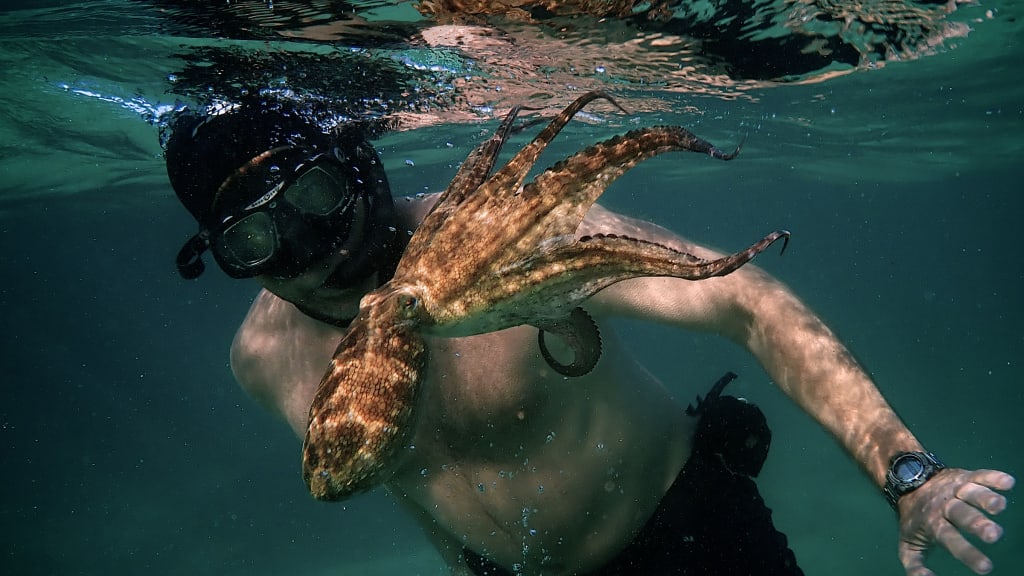
An octopus swims overhead in the Netflix documentary "My Octopus Teacher," which won an Oscar for best documentary feature in 2021, while filmmaker Craig Foster's calming voice says, “A lot of people say that an octopus is like an alien. But the strange thing is, as you get closer to them, you realize you’re very similar in a lot of ways. You’re stepping into this completely different world, such an incredible feeling, and you feel as though you’re on the brink of something extraordinary.”
Foster spent a year free diving in the chilly waters near Cape Town, without a wetsuit or scuba gear, to see an octopus, with water temperatures as low as 46 degrees Fahrenheit. He desired to be "more like an aquatic animal," with no obstacles between him and the ocean.
Foster never named her because "she was not a pet and I appreciate her wildness," he told TODAY in an email. Watching trust develop over time between a man and a curious, creative octopus referred to just as "her" is spellbinding.
Foster's perspective on "this personal connection" with an animal known for being antisocial intrigued Alex Schnell, a researcher in the University of Cambridge's psychology department who researches intelligence in cephalopods. "You can't help but feel really emotional throughout the entire film, and I think that makes it really special, the intimacy of the whole interaction," Schnell said. Foster brings a "new perspective to this animal without a backbone that one might think you wouldn't normally relate to... you can't help but feel really emotional throughout the entire film," Schnell said.
The weird beauty of their relationship is nicely evoked in the first scene. A slow aerial tracking view of an ethereally illuminated coastal shore opens the film. The music's flowing chants, the sound of surf crashing against stones, and the faint voices of seagulls immediately soothe us. The camera then follows an aquamarine dreamland of swaying kelp forward. We eventually come across Foster, who is dressed just in trunks, scuba fins, a diving hood, and goggles as he roams the seafloor.
Foster serves as both our protagonist and narrator. He discusses two formative events that prepared him for his time with the octopus early in the film. Growing up in a wooden cottage on the infamously perilous Cape of Good Hope was the first. Waves smashed the bungalow's doors and filled the ground level, according to Foster. As a child, this piqued his interest, and it's part of what motivated his desire to explore the ocean. The film makes excellent use of reenactments to keep the storey visually compelling as he recounts these childhood recollections.
The film brilliantly portrays Foster's awe and interest with the octopus during his first encounter. She's wearing one of her many disguises when he first encounters her. "To my left," he says, "there was this odd thing." The camera then pans to a jumble of seashells that defies gravity in its arrangement. The shells crumble a split second later as the octopus that had been hidden beneath them takes off into the distance. She then wraps herself inside a giant frond of seaweed, nervously peering out at Foster, before retreating once more. During their brief eye contact, Foster senses a connection, which prompts him to come up with a "crazy notion." "What happens if I don't?"
As a result, he makes it a practise to go to the same spot every day. He takes his time establishing a rapport with the animal, as he can sense she is both fascinated and apprehensive around him. He simply leaves his camera outside her den at first. We see her approach it with caution, probing it with one tentacle while covering herself with a seashell securely gripped in the other. It takes her 26 days to reach out to Foster for the first time, and even longer to fully emerge from her den in his presence. When she starts to trust Foster, a whole new universe of possibilities opens up for them both. Foster captures breathtaking close-ups of the various forms and colours.
When he isn't underwater with his new friend, Foster is scouring the scientific literature for whatever he can learn about her. We learn a lot about her species, the common octopus (or octopus vulgaris), as he describes his results, including the fact that most of her cognition happens outside her brain. "Her entire being is thinking, feeling, discovering," Foster exclaims. The octopus, for her part, is busy studying Foster, even incorporating him into her hunting tactics at one point.
Foster accidentally spooks her one day, forcing her to abandon her den and seek out another. He had given any hope of ever finding her. To find her, he must learn to detect octopus predation marks, distinguish octopus footprints from those of other animals, and think like an octopus. He makes intricate maps and detective pinboards at home. In other words, he transforms into a bushman of the entire kelp forest habitat where the octopus dwells.
The octopus' struggles to elude predators provide a few truly suspenseful moments. We, like Foster, are amazed at how she avoids being devoured by a pyjama shark by first camouflaging herself—and then, when that fails, climbing across his back where he can't reach her. Another shark attack leaves her injured, and Foster feels bad about his possible role in the incident. He tortures himself with the thought that by distracting her from her surroundings, he rendered her exposed to attack. But she recovers from her injuries, and her recovery coincides with a time in Foster's life when he is going through personal growth. "In a bizarre way, our lives were reflecting each other," he adds.
The title of the film is not a misnomer: We're astounded by how much the octopus has taught Foster by the end of the movie. His time with her reawakened his dormant interests for photography and the ocean; made him feel sympathetic about animals for the first time; and transformed him into a passionate conservationist and amateur zoologist, leading him to cofound the Sea Change Project, an ocean preservation NGO. Furthermore, every element of his life has been revitalised, from his physical health to his interpersonal relationships.
The emotion, technical proficiency, and subtle storytelling talent that went into this film make it eminently deserving of its Academy Award for Best Documentary Feature triumph in 2020.
About the Creator
Nesalatha
Hi, I am Nesa, a biomedical science student from Malaysia. I have deep interest in crypto, natural medicine, scientific research and also online internet marketing.
Without Democracy, Donald Trump’s Venezuelan Oil Quest Will Fail
Donald Trump’s renewed interest in Venezuelan oil may seem, on the surface, like a hard-nosed geopolitical calculation. Venezuela holds the world’s largest proven oil reserves, and amid global energy uncertainty, access to those resources is undeniably tempting. But history, economics, and politics all point to the same conclusion: without democratic reform in Venezuela, any attempt by a Trump-led US administration to secure reliable Venezuelan oil will ultimately fail.
By Aarif Lashari5 days ago in Earth
So You Decided To Become a Nurse Practitioner:
So you decided to become an "Advanced Practice" nurse. Congratulations!... is what I would say if this was a good idea. Grad school? In this economy? What were you thinking? Likely it was something along the lines of either 1) “I've seen these other chucklefucks do it— Why can't I?” or even 2) “I've got a nice career, I should shake it up. I miss feeling like I have no clue what I'm doing.”
By Sandor Szabo2 days ago in Fiction


Comments
There are no comments for this story
Be the first to respond and start the conversation.