


Imagine drinking your morning coffee in the company of your pets. What would be the appropriate routine? Do you grind your coffee first or open a can of wet food? What would be the breakfast gossip? Assume the kitty meows, complaining about the wretched dog barking at five AM. And the puppy wiggles his little tail, playing the “favorite,” and quietly whining, "You know I love you more than anyone else?”
As a cat lover, I have four kitties, each of whom stands out in their own way. Lala acts as if she is Queen Cleopatra, who cannot tolerate any male competition. Valentino is our Italian Godfather, Padrino Valentino, who comforts his loved ones with the loudest purrs but will fiercely protect his family from anyone who dares to upset them. Ksyun is a lifelong hooligan, living in starvation mode despite being served three meals a day with snacks in between. And then there’s Coco. Coco is different. We understand him, so we forgive him.
I had mixed feelings when I learned that artificial intelligence (AI) has been working on decoding animal language and that a potential breakthrough could be near. At first, I got excited! It meant I could have a real dialogue with my fur babies. On the other hand, I wondered: do I really want to know the truth? Those dirty looks and demanding tones could be meows of love and affection or harsh judgments and disagreements. I suppose I prefer to stay in the dark, believing my cats admire me as their favorite person in the whole universe.
As a cat-crazy owner, I never tire of talking, writing, or bragging about my feline “monsters.” Others may have a stronger appreciation for dogs, but despite our differences, we can all agree that our pets are intelligent, affectionate, emotional, and unique in their characters. They play an important role in our lives and capture a big part of our hearts.
Of course, the animal kingdom is not limited to cats and dogs. Human-animal connections can be developed with many creatures. Some love fluffy tails, while others adore cold-bodied reptiles. People learn their personalities, love languages, and create strong bonds, like my cat family.
The same goes for farm animals. I follow a few animal sanctuaries, where the cows, pigs, horses, and other kinds were rescued from lifelong captivity and inhumane death. As someone who admires fluffy kitties, I was surprised to learn how smart those animals are. Big cows love to be hugged, and Thanksgiving turkeys can rest their heads in the arms of those they trust. A mama cow will chase humans taking her babies. She has a poor understanding that her calf is someone’s veal. Pigs love to run and play and not only in a dirty pen. They also enjoy green grass and clean water. Little piglets run together with puppies, and both look equally adorable.
Most people consider farm animals as food. Pigs are the baby ribs and bacon. Cows are the perfect expensive steak. A mama cow is “milk and butter” we like to put on everything. Lamb is a more expensive meat and challenging to cook, but it is still on the menu, especially for certain cuisines. Then there’s seafood; often, we don’t even know what we’re eating because it’s simply a skillet of seafood mix. We’ve been told seafood is a healthier option, and while it may cost more, we might indulge in crab that was still alive in a small glass prison when we bought it.
There are plenty of small farmers who use their animals for food. Nevertheless, they treat them with love and respect, providing pastures, allowing fresh air, and natural foods. When the time comes, farmers make the death of those animals as quick and as less stressful as possible. Of course, none of this describes industrial farming. Industrial farming is a place of misery and torture that ends in a slaughterhouse. It is a place no living being deserves, but… industrial farming feeds us, humans.
Statistically, forty percent—yes, FORTY PERCENT—of food in the USA goes to waste. And I know my numbers; forty percent is almost half. This is a problem that requires a solution, and fortunately, the solution is quite simple: we humans must be mindful of how much we buy and how much we eat. Overeating is a one-way argument: overeating is bad for our health. Overbuying and throwing food away is more challenging because it requires discipline.
Every change begins with a thought. Think about who you eat. Or about who you put in your wastebasket. The chicken breast you bought on sale, cooked, and did not finish because you bought too much was once a live being. A bird who never moved because she was locked in the cage. She never had a chance to see her little chicks cracking from the eggshells or to cover them with her wings. A half-gallon of spoiled milk was from a female cow who was impregnated artificially just to give birth to a baby she wanted to touch, but the newborn was taken away immediately. The impregnation happened repeatedly because she was a milk cow; her purpose was to support the dairy business. The farm-raised salmon rotted on a salmon farm without a way to escape. And the delicacy menu option, an ugly octopus, was statistically smarter than AI. There is nothing natural when it comes to industrial farming. Those animals have no choice and no chance. Just because they were born in the industrial environment does not make them less capable of understanding, feeling, and fearing. They cry and fight for their lives the same way as wild animals, home pets, or we humans do.
Just the idea of some cultures consuming cats and dogs makes me nauseous. I feel like screaming out loud and telling those people, “If you keep the kitty’s life in captivity and then slaughter it, at least use it all to feed your family and do not put it to waste. You have already taken away their joy and purpose and made their death unnatural and dreadful.”
It is not my place to comment on people’s dietary choices. Instead, I do desire to plant a seed of mindfulness and thoughtfulness. "Kindness and compassion to ALL living things is the mark of a civilized society," Cesar Chavez. Animals are not things; animals are beings. They are not for us; they are with us. And every bite of them deserves to be treated accordingly. Please grocery shop mindfully.
About the Creator
Keep reading
More stories from Nina Domricheva and writers in Earth and other communities.
War in Ukraine: the beginning
After a long workday, it is very relaxing to sit on the couch and mindlessly watch a TV show. That was what we did on the evening of February 23rd. Later on, ready for a goodnight sleep, I went to check my phone. The phone was exploding with notifications of missed calls and messages from Ukraine. Everyone was informing me of the same situation: “the war has started” or “we are getting bombed by Russia.” My heart dropped as I turned the news on and started returning the phone calls. I did not go to bed as planned that night.
By Nina Domricheva2 years ago in Humans
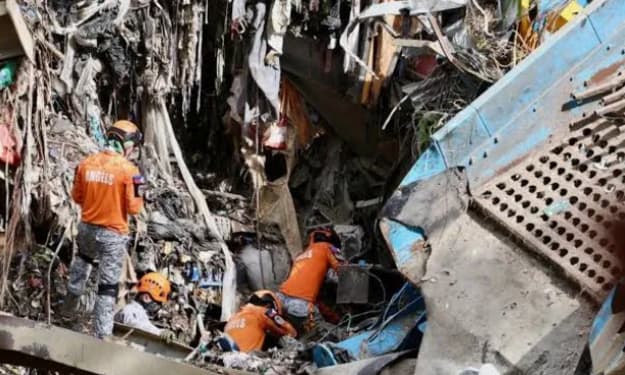
Filipino Rescuers Detect “Signs of Life” in Garbage Avalanche That Killed 4 and Left Dozens Missing
In the early hours following a devastating garbage avalanche in the Philippines, rescuers reported detecting “signs of life” beneath tons of waste, igniting a fragile sense of hope amid widespread grief and uncertainty. The deadly incident, which claimed at least four lives and left dozens missing, has drawn national attention to the dangers faced by communities living near massive waste disposal sites.
By Aqib Hussain4 days ago in Earth
Cement's Quiet Pivot
Why this is under-the-radar progress Cement and concrete account for a sizable slice of global CO₂, but the fastest cuts right now aren’t headline-grabbing moonshots — they’re practical shifts already filtering through specifications, standards, and procurement. Three forces are converging: (1) modern cement standards that enable big clinker reductions with reliable performance; (2) rapid market adoption of Portland-limestone cement (PLC) and new ternary blends such as limestone–calcined clay cements (LC3); and (3) public buyers setting embodied-carbon requirements that move the market. Together, these are driving real-world emission declines from the most-used construction material on earth — often without changing how structures are designed or built [8].
By Futoshi Tachino2 days ago in Earth



Comments
There are no comments for this story
Be the first to respond and start the conversation.