
Metals Found in Soil Hidden Elements Beneath the Earth’s Surface
Soil is not just dirt; it is a complex mixture of minerals, organic matter, water, air, and living organisms. One of the most important components of soil is metal elements. Metals found in soil play a vital role in agriculture, industry, construction, and the natural environment. Some metals are essential for plant and human life, while others can be harmful if present in large amounts. This article explores the types of metals found in soil, how they get there, their importance, and their effects.

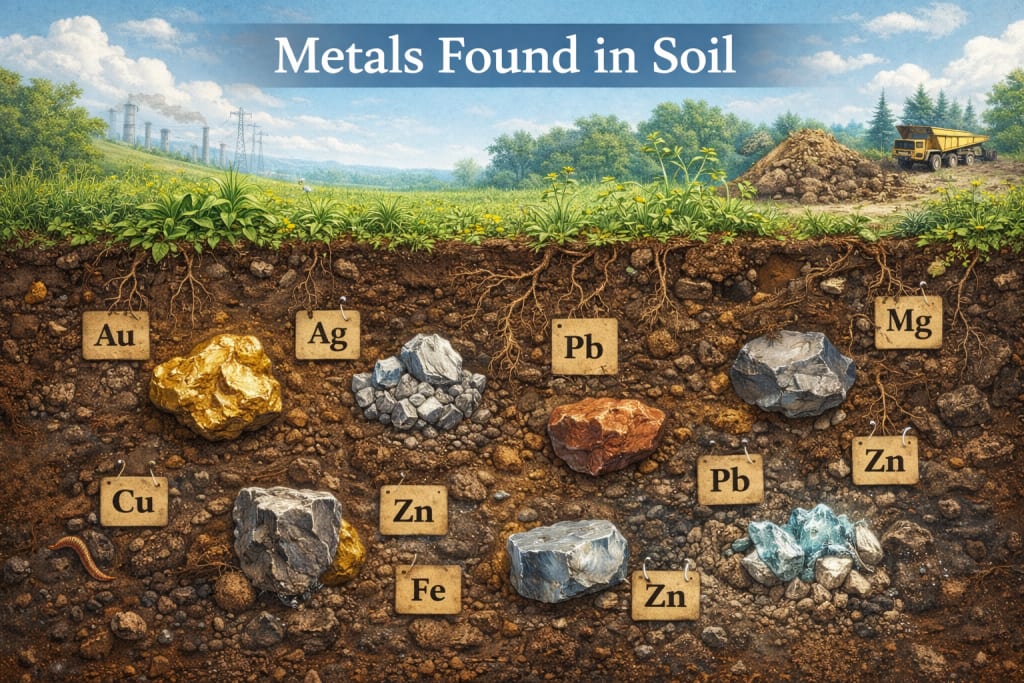
How Metals Enter the Soil
Metals enter soil through both natural and human-made processes.
Natural Sources
Weathering of rocks releases metals into the soil over millions of years
Volcanic activity adds metal-rich ash
River deposits spread metal particles across land
Human Activities
Mining and smelting
Industrial waste disposal
Use of fertilizers and pesticides
Vehicle emissions and urban pollution
Over time, these processes increase the concentration of metals in soil.
Common Metals Found in Soil
1. Iron (Fe)
Iron is one of the most abundant metals in soil. It gives soil its red or brown color.
Importance:
Essential for plant growth
Helps in chlorophyll formation
Improves soil structure
Iron-rich soils are commonly found in tropical and subtropical regions.
2. Aluminum (Al)
Aluminum is naturally present in most soils.
Characteristics:
Not essential for plants
Can become toxic in acidic soils
Affects root growth
High aluminum levels can reduce crop productivity.
3. Calcium (Ca)
Calcium is a beneficial metal found in soil.
Role:
Improves soil fertility
Helps plant cell wall development
Reduces soil acidity
Lime is often added to soil to increase calcium content.
4. Magnesium (Mg)
Magnesium is an essential nutrient.
Importance:
Part of chlorophyll molecule
Helps enzyme activity in plants
Improves photosynthesis
Magnesium-deficient soils lead to poor plant growth.
5. Potassium (K)
Potassium is widely found in soil minerals.
Uses:
Enhances plant resistance to disease
Improves crop yield
Regulates water balance in plants
It is commonly added through fertilizers.
Trace Metals in Soil
Trace metals are present in very small amounts but are extremely important.
6. Zinc (Zn)
Essential for plant enzymes
Helps seed development
Deficiency causes stunted growth
7. Copper (Cu)
Required for photosynthesis
Supports plant respiration
Excess copper can be toxic
8. Manganese (Mn)
Aids plant metabolism
Helps nitrogen use
High levels cause leaf damage
9. Nickel (Ni)
Needed in very small quantities
Supports enzyme activity
Toxic at higher concentrations
Heavy Metals in Soil
Heavy metals are a serious concern because they can be toxic.
10. Lead (Pb)
Comes from industrial waste and old paints
Affects human nervous system
Dangerous for children
11. Cadmium (Cd)
Found near mining areas
Accumulates in crops
Causes kidney and bone damage
12. Mercury (Hg)
Released from coal burning and industries
Highly toxic
Can enter food chains
Benefits of Metals in Soil
Not all metals are harmful. Many are essential for life.
Positive roles include:
Supporting plant nutrition
Improving crop yield
Maintaining soil structure
Supporting microorganisms
Healthy soil contains a balanced mix of metals.
Negative Effects of Excess Metals
Excessive metal concentration can cause:
Reduced plant growth
Soil pollution
Contaminated groundwater
Health risks to humans and animals
Crops grown in contaminated soil may absorb toxic metals.
Metal Absorption by Plants
Plants absorb metals through their roots. Some plants, called hyperaccumulators, can absorb large amounts of metals.
These plants are used in phytoremediation, a method to clean polluted soils naturally.
Managing Metal Levels in Soil
To maintain healthy soil:
Test soil regularly
Use fertilizers carefully
Add organic matter
Avoid industrial waste dumping
Practice crop rotation
These methods help control metal concentration.
Importance for Human Life
Metals in soil indirectly affect human health through food. Balanced metal levels ensure:
Nutritious crops
Safe drinking water
Healthy ecosystems
Soil management is crucial for sustainable agriculture.
Role of Soil pH in Metal Availability
Soil pH strongly affects how metals behave in soil. In acidic soils, metals like aluminum, iron, and manganese become more soluble and easily absorbed by plants. In alkaline soils, many metals become less available, which can cause nutrient deficiencies in crops.
Effect of Organic Matter on Metals
Organic matter binds with metals and controls their movement. High organic content reduces metal toxicity by holding harmful metals like lead and cadmium, preventing them from entering plants and groundwater.
Metals and Soil Microorganisms
Soil microbes depend on trace metals for enzyme activity. Metals such as iron, zinc, and copper support microbial metabolism, while excessive heavy metals can kill beneficial microorganisms and disturb soil fertility.
Metal Leaching and Groundwater Pollution
Some metals dissolve in water and move downward through soil layers. This process, called leaching, can contaminate groundwater, making drinking water unsafe.
Impact of Metals on Crop Quality
Metal imbalance affects not only crop yield but also nutritional quality. For example, zinc-deficient soils produce grains with low nutritional value, while heavy metal contamination makes crops unsafe for consumption.
Climate Change and Metal Mobility
Changes in rainfall, temperature, and flooding due to climate change increase metal movement in soil. Flooding can release trapped metals, increasing soil and water contamination.
Soil Remediation Techniques
To reduce metal pollution:
Phytoremediation using metal-absorbing plants
Soil washing to remove contaminants
Adding biochar or lime to reduce metal toxicity
Removing contaminated topsoil
Legal Standards and Soil Safety
Governments set safe limits for metals in agricultural soil to protect food safety. Regular monitoring helps prevent long-term environmental damage.
Importance in Sustainable Agriculture
Managing metal levels ensures long-term soil productivity. Balanced metal nutrition supports healthy crops, protects ecosystems, and ensures food security.
Future Research and Technology
Modern technologies like remote sensing, nanotechnology, and AI-based soil analysis help detect metal concentrations accurately and support sustainable soil management.
Exam Tip (Optional Section)
You can add a concluding sentence such as:
“Understanding metals in soil is essential for agriculture, environmental protection, and human health.”
Conclusion
Metals found in soil are essential components of the Earth’s ecosystem. While metals like iron, calcium, magnesium, and zinc support plant growth and human life, heavy metals such as lead, cadmium, and mercury pose serious risks when present in excess. Understanding the types of metals in soil, their sources, and their effects helps us protect the environment and ensure food safety. Proper soil management is the key to balancing benefits and preventing harm, making soil a valuable and living resource beneath our feet.
About the Creator
Say the truth
"Say the Truth: Explain Everything in the World" is your trusted source for uncovering facts and exploring the wonders of history, science, technology, and beyond. We simplify complex ideas and reveal truths to inspire curiosity .
Keep reading
More stories from Say the truth and writers in Earth and other communities.
The Green Heart of Africa: Uncovering the Rich History of the African Rainforest
Echoes of Green: The Ancient History of the African Rainforest This article examines the extensive, vibrant history of the African rainforesthome to ancient civilizations, unparalleled biodiversity on the planet, and secrets concealed deep within its dense canopy. From its prehistoric origins and significance in early human evolution to its cultural relevance for African societies and global ecological importance today, the African rainforest continues to be one of Earth’s most essential and enigmatic natural treasures.
By Say the truth 10 months ago in Earth
Prudence or backsliding? China’s new climate target mirrors shifting realities
China, the world’s largest emitter of greenhouse gases, recently announced a revised climate target that has drawn attention from policymakers, environmentalists, and energy analysts worldwide. While officials describe the adjustments as “prudent and realistic,” critics warn that the changes could signal a slowdown in Beijing’s commitment to achieving net-zero emissions and meeting the goals of the Paris Agreement. The new targets, unveiled at a high-level government briefing, suggest that China will slightly delay the peak of its carbon dioxide emissions and extend timelines for reducing reliance on coal-fired power plants. These adjustments are being framed as responses to complex economic realities, including slower-than-expected industrial growth, energy security concerns, and global market volatility. “China is balancing its climate ambitions with the practical need to maintain stable economic growth,” said Li Wei, a senior policy analyst at the China Development Research Foundation. “The government wants to avoid sudden shocks to energy supply or employment in sectors that are heavily reliant on fossil fuels.” Coal remains a cornerstone of China’s energy system, accounting for roughly 60% of electricity generation. Recent spikes in global energy prices, coupled with domestic electricity demand surges, have made Beijing cautious about implementing aggressive coal phase-out plans too quickly. Policymakers fear that rapid cuts could trigger power shortages, industrial slowdowns, and public discontent. Despite these challenges, China has continued to invest heavily in renewable energy. Wind, solar, and hydroelectric capacity have expanded rapidly over the past decade, and the country remains the world leader in renewable energy installations. Analysts note that the revised targets do not halt progress but recalibrate timelines to accommodate economic and geopolitical realities. “The question is whether this adjustment reflects prudence or a subtle form of backsliding,” said Rachel Wong, climate policy director at Green Future International. “It may be a temporary compromise, but it also risks sending the wrong signal internationally, especially to countries relying on China’s commitments to reduce global emissions.” International reactions have been mixed. Some governments and climate advocates view the revised targets as a practical acknowledgment of real-world constraints, emphasizing that flexibility may be necessary to avoid economic disruptions. Others warn that delays in emission reductions could make it more difficult for the global community to limit warming to 1.5°C, potentially undermining multilateral climate efforts. Analysts also point out that China’s energy strategy is increasingly influenced by geopolitics. Tensions over trade, supply chains, and global energy markets have heightened the country’s focus on energy self-sufficiency. Expanding renewable capacity is part of the long-term plan, but in the short term, reliance on coal and natural gas remains a central feature of Beijing’s approach. Domestic messaging has emphasized that China remains committed to sustainability and environmental stewardship. Government statements highlight ongoing investments in electric vehicles, clean manufacturing, and carbon capture technologies. However, environmental watchdogs caution that the credibility of these commitments depends on transparent implementation and measurable outcomes. “The next five years will be critical,” said Wong. “We need to see concrete action, not just revised targets on paper, if China is to maintain its leadership role in global climate policy.” China’s recalibrated climate target reflects the delicate balance Beijing must maintain between environmental responsibility, economic stability, and energy security. Whether this approach represents prudent realism or a retreat from global expectations will be closely watched by governments, investors, and environmental groups worldwide.China’s revised climate target also reflects domestic political considerations. Leaders are keen to maintain public confidence by avoiding sudden energy price hikes or industrial disruptions that could spark social unrest. At the same time, international observers are closely monitoring China’s carbon trajectory, as any delay in emission reductions could influence global markets and climate negotiations. Experts emphasize that Beijing’s approach highlights the tension between short-term economic priorities and long-term environmental commitments. How China balances these competing pressures will be pivotal—not only for its own sustainable development but also for global efforts to curb climate change and meet Paris Agreement goals.
By Fiaz Ahmed 7 days ago in Earth




Comments
There are no comments for this story
Be the first to respond and start the conversation.