
Major Portions of Interstate 40 Closed Due to Catastrophic Flooding in North Carolina
"Severe Flooding Shuts Down Major Highway, Strands Drivers, and Prompts Emergency Rescues in Western North Carolina"
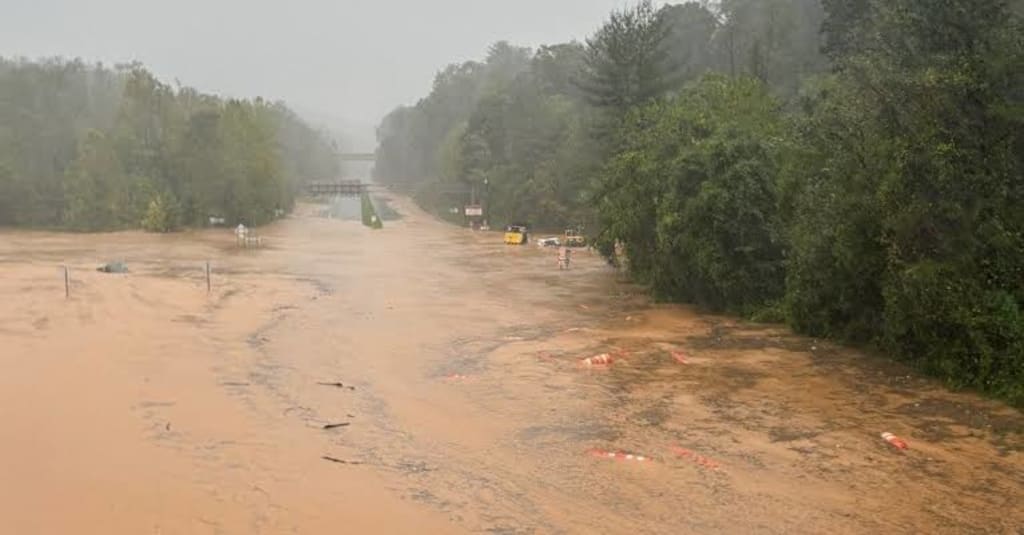
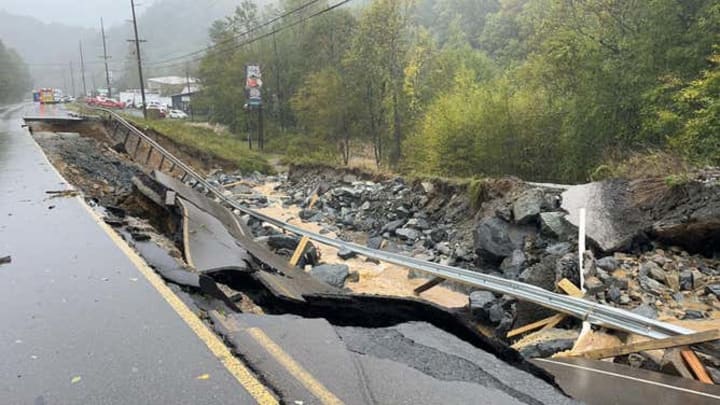
In a dramatic turn of events, a section of Interstate 40, a vital highway linking western North Carolina to eastern Tennessee, has partially collapsed due to devastating flooding caused by the remnants of Hurricane Helene. This natural disaster has left local authorities scrambling to assess the damage and provide assistance to affected residents.
The Impact of Heavy Rainfall
Recent reports indicate that western North Carolina faced unprecedented rainfall, with many areas receiving between one to two feet of rain. This extreme weather led to significant washouts on roads and flooding in several towns. Photos from the scene depict a chaotic situation, with multiple lanes of Interstate 40 completely washed away amidst the mountainous terrain. Drivers found themselves stuck in bumper-to-bumper traffic as officials worked to manage the crisis.

The North Carolina Department of Transportation (NCDOT) announced that Interstate 40 is closed in several locations between Asheville and the eastern Tennessee border. The closure is not only affecting commuters but also those who rely on this major thoroughfare for transporting goods and services. As of now, officials have not provided a timeline for when the highway might reopen, leaving many drivers frustrated and unsure of how long they might be affected by this situation.
Rescue Operations Amid Flooding
The flooding has not only disrupted transportation but also posed significant dangers to public safety. In nearby Erwin, Tennessee, floodwaters surged around a local hospital, forcing both patients and staff to seek refuge on the roof. In a remarkable display of bravery and quick thinking, rescue teams utilized helicopters to airlift those trapped, ensuring their safety. Such incidents highlight the urgency of the situation as communities work to protect their residents from the rising waters.
In addition to the road closures and rescue operations, local authorities have reported at least two fatalities in North Carolina, with fears that the number may rise as assessments continue in the hardest-hit areas. This situation has turned into a tragic reminder of the power of nature and the importance of community support in times of crisis.
Alternative Routes and Travel Concerns
With Interstate 40 out of commission, transportation officials are advising drivers to consider alternative routes. According to Google Maps, the best detour options involve taking Interstates 81 and 26, which adds approximately 50 miles to trips. This significant detour not only increases travel time but also puts additional strain on other roadways that were not designed to handle such heavy traffic.
The NCDOT has issued a stern warning for all drivers: "All roads in Western North Carolina should be considered closed." This cautionary note underscores the seriousness of the situation and the need for residents to stay informed about changing conditions.
Federal Response and Support
As the situation unfolds, federal officials are also closely monitoring the damage. Transportation Secretary Pete Buttigieg confirmed that he is receiving regular updates regarding the impact of Hurricane Helene on infrastructure and the challenges faced by airports in the region. The U.S. Department of Transportation has yet to publicly announce what resources might be allocated to help with repairs, but the federal government is aware of the critical needs arising from this natural disaster.
The damage seen on Interstate 40 has been likened to a landslide incident that occurred over the summer, which affected State Highway 22 in Jackson, Wyoming. That event caused significant delays and detours that lasted nearly three weeks while emergency repairs were undertaken. The current situation in North Carolina may result in similar challenges as communities begin to pick up the pieces.
Looking Ahead
As residents and officials work to recover from the flooding, the focus will undoubtedly shift to restoring transportation and ensuring the safety of those affected. The community's resilience will be tested as they navigate the challenges ahead. Support from local and federal agencies will be crucial in helping these communities rebuild and recover.
In conclusion, the partial collapse of Interstate 40 serves as a stark reminder of the unpredictable nature of severe weather and its potential to disrupt lives. As North Carolina grapples with the aftermath of Hurricane Helene, it is clear that the road to recovery will be long, but the spirit of the community will endure. With teamwork, determination, and support, residents can hope to overcome this challenging time and emerge stronger than before.
About the Creator
China’s Ambitious Satellite Plan: 200,000 Satellites and Counting
China has submitted an astonishing application to the International Telecommunication Union (ITU) to launch 200,000 satellites over the coming years. To put this into perspective, the entire world currently operates far fewer than this number. Even SpaceX’s Starlink project, one of the largest satellite networks globally, has plans for around 42,000 satellites. China’s proposal signals an unprecedented escalation in space activity and raises important questions: what are these satellites for, and what implications do they hold for global technology, security, and the environment? The Purpose Behind the Numbers At first glance, launching 200,000 satellites may seem excessive, but China’s goals are strategic and multifaceted. Experts suggest that these satellites could serve several purposes: 1. Global Internet Coverage China is aiming to build a massive low-Earth orbit (LEO) satellite network, similar to Starlink and OneWeb. By positioning thousands of satellites closer to Earth, they can provide high-speed internet to remote regions, rural areas, and even ships or aircraft in the oceans. This could help China expand its digital influence globally, offering connectivity in areas where traditional internet infrastructure is weak or non-existent. 2. Enhanced Military and Surveillance Capabilities A satellite network of this scale is also a game-changer for defense and surveillance. Satellites can monitor troop movements, track ships, and provide early warning systems. China’s military has been investing heavily in space-based technology, and these satellites could be a crucial part of modernizing its intelligence, surveillance, and reconnaissance (ISR) capabilities. 3. Scientific Research and Earth Observation Some of these satellites may be dedicated to Earth observation, collecting data on climate, agriculture, natural disasters, and urban development. With thousands of satellites constantly orbiting the planet, China could achieve near real-time monitoring of environmental changes and resource management, giving scientists and policymakers an unprecedented level of insight. 4. Competition in the Commercial Space Sector China’s plan is not purely for government use. The commercial potential of satellite networks is massive, from providing satellite internet services to supporting the burgeoning space economy. Companies under Chinese state and private ownership could leverage this infrastructure to offer services domestically and internationally, challenging Western tech giants in global space markets. The Scale of the Ambition Launching 200,000 satellites is not just ambitious; it’s historic. If approved and executed, China would operate more satellites than all other countries combined, fundamentally reshaping how space is utilized. However, there are serious logistical challenges. Manufacturing, launching, and maintaining hundreds of thousands of satellites requires enormous resources, advanced technology, and careful orbital planning to avoid collisions. China has made major progress in its space launch capacity, with frequent missions through the Long March rocket family and ongoing developments at the Wenchang and Jiuquan Spaceports. Yet, sustaining such a colossal fleet will test even the most advanced space programs. Global Implications The potential consequences of China’s satellite plan are profound, both technologically and geopolitically. 1. Space Traffic Management A network of 200,000 satellites could drastically increase the risk of collisions in orbit. Space debris is already a growing concern, and introducing tens of thousands of new satellites may exacerbate this problem. International cooperation and sophisticated traffic management systems will be essential to prevent catastrophic accidents in space. 2. Geopolitical Tensions China’s space ambitions may intensify global rivalry in space technology, particularly with the United States, Europe, and other spacefaring nations. Control over satellite networks can translate into strategic advantages, from military surveillance to dominance in global communications infrastructure. This may lead to a new phase of space competition reminiscent of the Cold War’s space race. 3. Impact on Astronomy Astronomers have already expressed concern over satellite mega-constellations interfering with observations. Thousands of bright satellites moving across the night sky can distort telescope images and hinder research into deep space phenomena. If China proceeds with 200,000 satellites, the challenge to professional and amateur astronomers will be enormous. 4. Global Connectivity Revolution On the positive side, if managed responsibly, China’s satellite network could revolutionize global connectivity, bringing internet access to millions of people who currently have none. It could accelerate digital development in underserved regions, support education, and foster global commerce in unprecedented ways. Regulatory Hurdles The ITU regulates global satellite usage, including frequency allocation and orbital slots. For China to launch 200,000 satellites, it must secure approval from the ITU, which evaluates whether such an immense network could interfere with other countries’ satellites or violate international agreements. This is not a mere formality—approval for a project of this scale could take years and may require negotiations with multiple nations. Conclusion: A Bold Step Toward the Future China’s application to launch 200,000 satellites is a bold statement about the future of space and global technology. It reflects the country’s ambition to dominate in digital infrastructure, military capability, and commercial space enterprise. While challenges abound—from space debris and regulatory hurdles to geopolitical tensions—the potential benefits are significant, particularly for connectivity and scientific advancement. As the world watches China’s next steps, one thing is clear: the age of satellite mega-constellations is here. How humanity navigates the risks and rewards of this new frontier will shape the future of communication, security, and our presence in space for decades to come.
By Muhammad Hassan4 days ago in Earth




Comments
There are no comments for this story
Be the first to respond and start the conversation.