
Living on the Wild Side
Some of the most unusual animals in the world


Living on Land and in Trees
Aye-Ayes have large eyes and are rare lemurs native to Madagascar. They are the largest nocturnal primates in the world. These creatures have rodent-like teeth that grow perpetually. They have special middle fingers that are long and thin. These fingers are needed for their unusual feeding ritual known as “percussive foraging”. The aye-ayes tap on trees to locate grubs, chew a hole into the wood, and with their long middle fingers pull the grubs out.
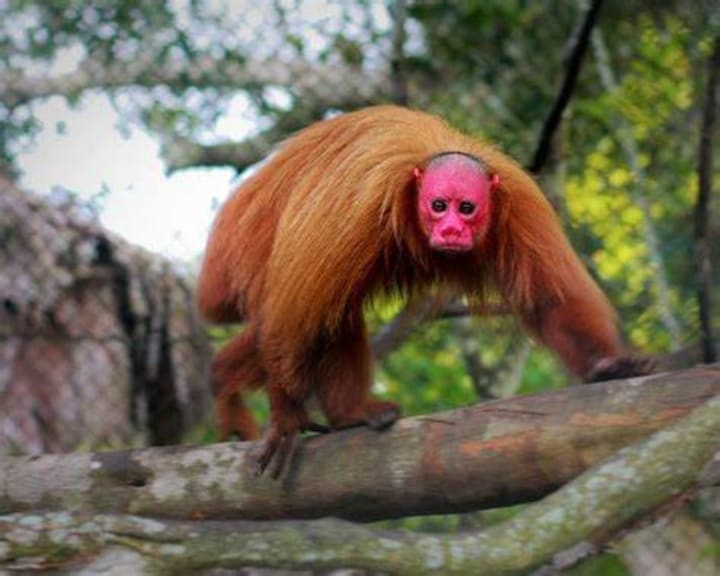
Bald Uakaris (pronounced ‘wakari’) are small monkeys living in the Amazon basin. They have long ginger-colored shaggy coats with hairless bright red faces and heads. They are one of four species of uakaris. They make their homes in the varzea forests (seasonal floodplain forests) of Brazil and Peru. They live in large groups of up to 200 individuals but "troops” of around 30 are more common. Bald Uakaris enjoy thick rainforests and climb and leap through trees searching for seeds, fruit, and caterpillars. To find food they use color vision and smell and then sit down on branches to enjoy their meal. When not searching for food they can be seen lying belly-down on branches.

Babirusas are referred to as “deer pigs” or “prehistoric pigs” due to their appearance. They have stocky bodies and curved teeth. They are part of the swine family. They are native to the Indonesian island of Sulawesi. Barbirusas are mostly herbivores enjoying fruit and leaves. When food sources are scarce they’ll eat meat. Males are solitary creatures but females live in small groups of 3 or 4 individuals. Unfortunately, they are a threatened species and protected in Indonesia, where killing them is illegal.

Bat-eared foxes look so cute with their huge dish-like ears. They make their home on the plains of Eastern and Southern Africa. Their ears can pick up the sounds of subterranean termites and insects which are part of their diet. They will also eat wild fruit. Bat-eared foxes are nocturnal creatures in the summer and diurnal (active during the day but inactive at night) in the winter.

Blue-tongued skinks are lizards and some of the largest members of the skink family. They use their blue tongues to scare off predators. Their diets consist of insects, gastropods, flowers, fruit, and berries. They inhabit most of the world’s continents.

Dasypeltidae are an African family of egg-eating snakes. They are on a steady diet of bird eggs. These snakes are native to sub-Saharan Africa as well as Saudi Arabia and Yemen. There are 18 species of egg-eating snakes. They are nocturnal and spend their days in holes underground or in trees. Bird eggs are the only food they prefer to consume but if bird eggs are scarce they’ll eat eggs from lizards, other snakes, and snails.

Fossas are strange creatures known as cat-dog-mongoose. They are native to Madagascar. They’re carnivorous and their diets include lemurs, birds, reptiles, and other small mammals. Fossas are medium-sized, slender, with short, strong legs, large catlike paws with sharp claws, round ears, canine-like snouts, and very long tails. They prefer forested areas and will hunt prey up in the trees or down on the ground, They’re active both during the day and at night.

Gerenuks are among the lesser-known antelope species. They have very long necks and are referred to as giraffe gazelles. They make their homes in Africa. Their diets include leaves and shoots from prickly bushes and trees as well as flowers, fruit, and buds. The moisture from the plants lets them survive in dry deserts and scrublands. They live in small herds of two to six members and spend their days foraging and feeding.

Helmeted hornbills are large birds from Southeast Asia. They have solid casques or “helmets” on their beaks. Their calls sound like maniacal laughter. They live in dense, tropical forests and are shy birds. These birds have very long tails. They like to dine on fruits, lizards, squirrels, nesting birds, and snakes. Male helmeted hornbills are striking with the bright red, bare patch of skin on their throats. Females are of a light, turquoise coloring.

Kakapos are a species of large, nocturnal, flightless, and ground-dwelling parrots. These birds are native to New Zealand. They are also called owl parrots and are largely nocturnal, Kakapos are the only flightless and longest-living parrots in the world. They have large gray beaks, short legs, large feet, shot wings, and short tails, They make their homes on forest floors, scrublands, and coastal areas. They eat rimu fruit, supplejack vines, seeds, fruits, pollen, orchard tubers, and tree sapwood. Kakapos are endangered and there are only 252 living parrots and in 2015 the Kakapo 125 Project began and is aimed to sequence the genome of all living kakapo birds.

Kinkajous are a species of mammals that are related to raccoons and lemurs. They are known for their unusual tails and their intelligence. They make their homes in the Amazon rainforest. These creatures are nocturnal and sleep in the tall branches of trees during the day. What is unusual about them is that they have prehensile tails and feet that can turn backward. Kinkajous enjoy eating fruit, particularly figs.
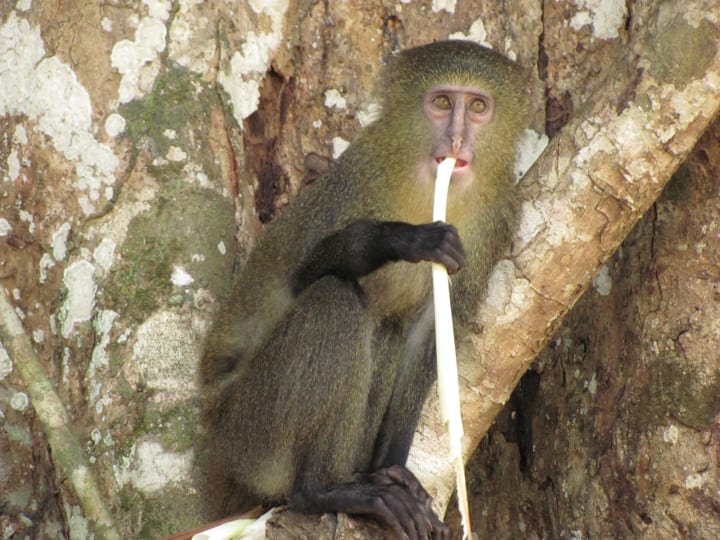
Lesulas are a monkey species that live deep in the jungles of the Lomani Basin in the Congo in Africa. They have human-looking eyes and are mysterious and unusual animals, These creatures are only found west of the Lomami River. They are interesting with their owl-like faces and human-like facial appearance. They are herbivores and enjoy eating fruit and vegetation, They prefer leaves, ripe and unripe fruit, and flowers of the arrowroot plant family, sometimes called the “prayer-plant family”.

Pangolins are shy, nocturnal mammals. Their bodies are covered by plate-like scales. They are also referred to as “scaly anteaters”. They live in the woodlands and savannas of East, Central, and South Africa and Asia. Their coloring ranges from dark brown to olive. Their diets consist of insects mostly ants and termites which they capture with their very long and sticky tongues. These creatures are on the IUCN red list of threatened species.
Gliding Through the Air with the Greatest of Ease
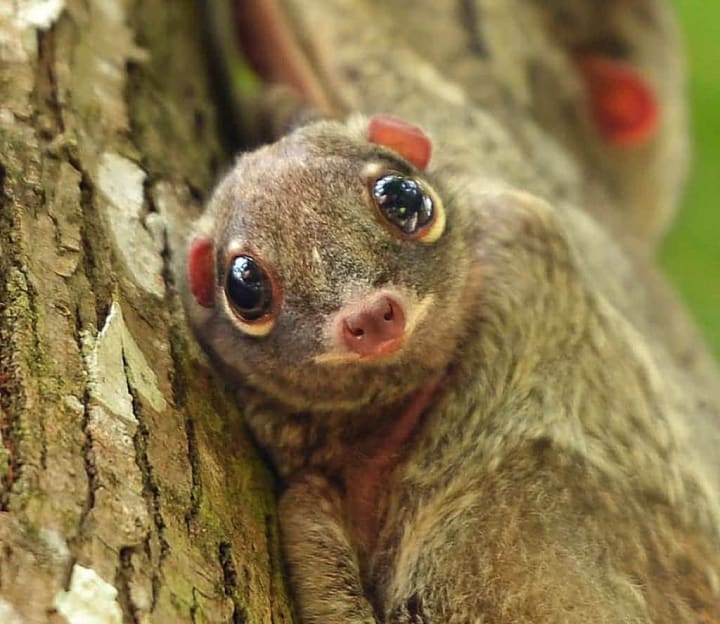
Colugos are tree-dwelling gliding mammals. They live in Southeast Asia. They are also known as flying lemurs and are solitary and shy. These creatures don’t really fly they glide. What makes them glide are large membranes connecting all four limbs and their tails let them “fly” for up to 200 meters between trees. Colugos are herbivores and enjoy leaves, flowers, shoots, and fruit, They are nocturnal.

Flying foxes are actually enormous “megabats” with heads resembling foxes. They have small ears and large eyes. They live in the tropical forests and caves of Southeast and South Asia. They’re also referred to as “fruit bats” and enjoy dining on fruit, flowers, nectar, and some insects. They are nocturnal and forage at night. These are the largest bats in the world.

Chrysopeleas are also known as flying or gliding snakes. They can glide up to 100 meters. There are five species. They live in the jungles, forests, and woodlands of Southeast and South Asia. These creatures are diurnals so they hunt during the day. Chrysopeleas are carnivores and eat lizards, birds, bats, frogs, and rodents. They rarely leave the tree canopy where they live.

Hammer-headed bats are also known as hammer-headed fruit bats and big-lipped bats, They are a type of megabat. These creatures are frugivorous and their diet mostly includes fruit. They make loud honking noises and are considered to be the largest bat in all of mainland Africa. Hammer-headed bats sleep during the day on tree roots individually or in small groups of 4 or 5. They forage for food at night.

Honduran white bats are also referred to as Caribbean white tent-making bats. They are a pygmy species of bat with white fur and leaf-shaped noses and ears. They make their homes in Honduras, Nicaragua, Costa Rica, and the western parts of Panama. These creatures are frugivorous and feed mostly on fruit. They prefer one single variety of fig and see fig trees close to their roosts. Honduran white bats build “tents” out of plant leaves. They are nocturnal and stay in their tents during the day. These bats are listed by the IUCN as near-threatened.

Potoos are neotropical birds known for their camouflage skills. They are funny looking with enormous googly yellow eyes, There are seven species. They make their homes in every Central and South American country, on Caribbean islands, and have the greatest diversity in the Amazon. These creatures are both insectivorous and nocturnal. During the day they perch on the ends of dead branches or tree stumps with their eyes closed. At night they hunt for flying insects and have huge mouths to grab beetles, moths, termites, and others.

Water Creatures
The Axolotl is known as the Mexican Walking Fish. Of course, fish don’t walk but even though these creatures are referred to as fish they are actually amphibians. Their gills are branches that extend from the sides of their heads. Axolotls are neotenic salamanders and are considered to be the most unique species of salamanders. They make their homes in Mexico in freshwater lakes and ponds. Their diets consist of smaller species of aquatic life like tiny fish, mollusks, and arthropods. They might also indulge in terrestrial worms, salmon eggs, and zooplankton. Unfortunately, they are classified as a critically endangered species.

Barreleyes are small deep-sea fish. They have dome-shaped transparent heads with glowing green eyes seen through the dome. In fact, you can see their eyes, brains, and nerves. They live in the Bering Sea ( a marginal sea in the Northern Pacific Ocean) and off the coast of Baja California. They are capable of rotating their eyes forward to search for prey. Their diet mostly consists of zooplankton.

Blobfish are deep-sea fish known as the ugliest fish in the world. They can be found off the coasts of mainland Australia, New Zealand, and Tasmania. It is believed that these fish have experienced considerable deformity due to decompression, They are pinkish-gray gelatinous masses. Blobfish float above the sea floor, their mouths open and suck up prey that floats or swims by like urchins, shellfish, mollusks, crabs, lobsters, and sea pens.

Colossal squids live in some of the coldest, darkest parts of the Southern Ocean (Antarctic Ocean). These creatures are intelligent predators with the largest eyes in the animal kingdom, They have eight arms, two tentacles, a head, a beak, and fins. Their diet consists of Antarctic toothfish but they might also consume other large fish and smaller squids.

Dugongs are plump in appearance. They have dolphin tails, round heads, and downward snouts. They are also called “sea cows”. They were first discovered in Australia. They can also be found in the Persian Gulf, the eastern Red Sea, and in the Indian Ocean, Their diets include seagrass. They’re the only members of the Sirenia order to live exclusively in saltwater environments.

Dumbo octopuses are so named because of their Dumbo the elephant-like ear fins protruding from the sides of their heads. They can be seen in waters all over the globe particularly in Australia, the Philippines, New Guinea, and California in the US. These creatures are bell-shaped, pale in color, and have short stubby arms. They are carnivores and enjoy dining on crustaceans, bivalves, worms, and copepods.

Fangtooths are also called the Ogre Fish. They live deep in the sea. These fish have the biggest teeth in the ocean. They make their homes in the depth of the Atlantic, Pacific, and Indian Oceans. Their diets consist of other fish, shrimp, and crustaceans.

Fried egg jellyfish are free-swimming ocean creatures. They have bright yellow domes and trailing tentacles. They look just like what they are called – swimming fried eggs. They can be found in the warm waters of the Atlantic Ocean and the Mediterranean Sea and some prefer the deep basins of the Pacific Ocean. They drift through the ocean catching prey with their tentacles which are adapted to sting prey and predators like turtles and sea birds.

Gharials are one of two crocodiles from the Gavialidae family. They have narrow elongated snouts and sharp, interlocking teeth. These creatures are located in isolated areas of northern India. They enjoy dining on fish. Gharials have webbed feet to help them swim and flattened muscular tails.

Goblin sharks are deep-sea sharks with elongated, flattened snouts. These creatures have strange protruding jaws with teeth that look like nails. They can be seen in all three major oceans. In the Atlantic Ocean, they have been seen from the northern Gulf of Mexico, Suriname, French Guiana, and southern Brazil in the west, and France, Portugal, Madeira, and Senegal in the east. These creatures are carnivores and feed on teleost fish like rattails and dragonfish. They will also dine on cephalopods and crustaceans.

Japanese spider crabs are giant crustaceans found on the Pacific Ocean side of Japan. They are a species of marine crabs inhabiting holes and pits on the ocean floor. They are covered in a thorny protective exoskeleton with ten giant legs. These creatures are omnivores feeding on dead and decaying animals and plant matter on the sea bed. They are categorized as an endangered species.

Mantis shrimps are small and aggressive marine crustaceans. They are capable of clubbing their prey with the force of a bullet or spiking them with their sharp claws. These creatures are found in the tropical and subtropical water of the Indian and Pacific Oceans between Eastern Africa and Hawaii. They are lovely and vibrant with color. Their diets include fish, crabs, clams, snails, worms, shrimp, and squid.

Sarcastic fringeheads are aggressively temperamental and have huge mouths. They make their homes on the seafloor of the Northwest Pacific Ocean. They spend a lot of their time in their ocean floor dens. When they swim they use short, dart-like movements. Their diet includes small crustaceans.

Capybaras are the largest rodents in the world. They are semi-aquatic. They make their homes in the dense forests and savannas of South America and like to be near bodies of water. They are inhabitants of the Amazon and can be seen along river edges. These rodents are herbivores and enjoy grass and aquatic plants, fruit, and tree bark. Being semi-aquatic they adapt well both on land and in water. Their fur is fast-drying and they have webbed feet but can run at 35 MPH on land. Capybaras are social creatures and live in groups as big as 100 members with average group sizes being from 10 t0 20 individuals.

Platypuses are semi-aquatic mammals native to Eastern Australia making their homes from the colder highlands to the tropical rainforests. They have an odd appearance with duck-shaped bills, beaver-like tails, and the feet of an otter. They are egg-laying mammals. They inhabit small streams and spend a lot of time in the water but will burrow on riverbanks. Their diets include fresh-water crustaceans like shrimp and crayfish. These creatures are nocturnal. They are a legally protected species in Australia.
About the Creator
Rasma Raisters
My passions are writing and creating poetry. I write for several sites online and have four themed blogs on Wordpress. Please follow me on Twitter.
Keep reading
More stories from Rasma Raisters and writers in Earth and other communities.
Creatures of the Deep
Mimic octopuses can imitate the appearance and mannerisms of fifteen different species. This makes them the ultimate imposters in the animal world. This octopus was discovered twelve years ago. Mimic octopuses make their home in the tropical waters of South East Asia. They exist on a diet of small fish and crabs. They have the ability to change color and texture so they can match their surroundings. The most amazing thing is that mimic octopuses can take on the appearance of other creatures like lionfish, jellyfish, sea snakes, flounders, stingrays and others.
By Rasma Raisters3 years ago in Earth
65% of Workers Are Interested in ‘Microshifting’ Their Schedules as an Alternative to the Strict 9-to-5
The traditional 9-to-5 workday has long been considered the standard, but recent research suggests that employees are seeking more flexibility than ever before. A striking 65% of workers report interest in ‘microshifting’ their schedules, a concept that allows them to adjust their work hours in smaller increments rather than sticking to a rigid daily routine. For many, this is more than just a scheduling preference — it’s a way to reclaim control over their time, reduce stress, and boost productivity.
By Muhammad Hassana day ago in Earth
How Much Do You Need in an ISA for a Passive Income That Beats the State Pension?
For many people in the UK, the State Pension is expected to form the backbone of retirement income. But with rising living costs and growing uncertainty about the future, more savers are asking a crucial question: Can I build a passive income that beats the State Pension — and how much would I need in an ISA to do it?
By Aarif Lashari3 days ago in Earth




Comments
There are no comments for this story
Be the first to respond and start the conversation.