
Lightning - One of Nature's Most Striking Phenomena
1.4 billion strikes a year!

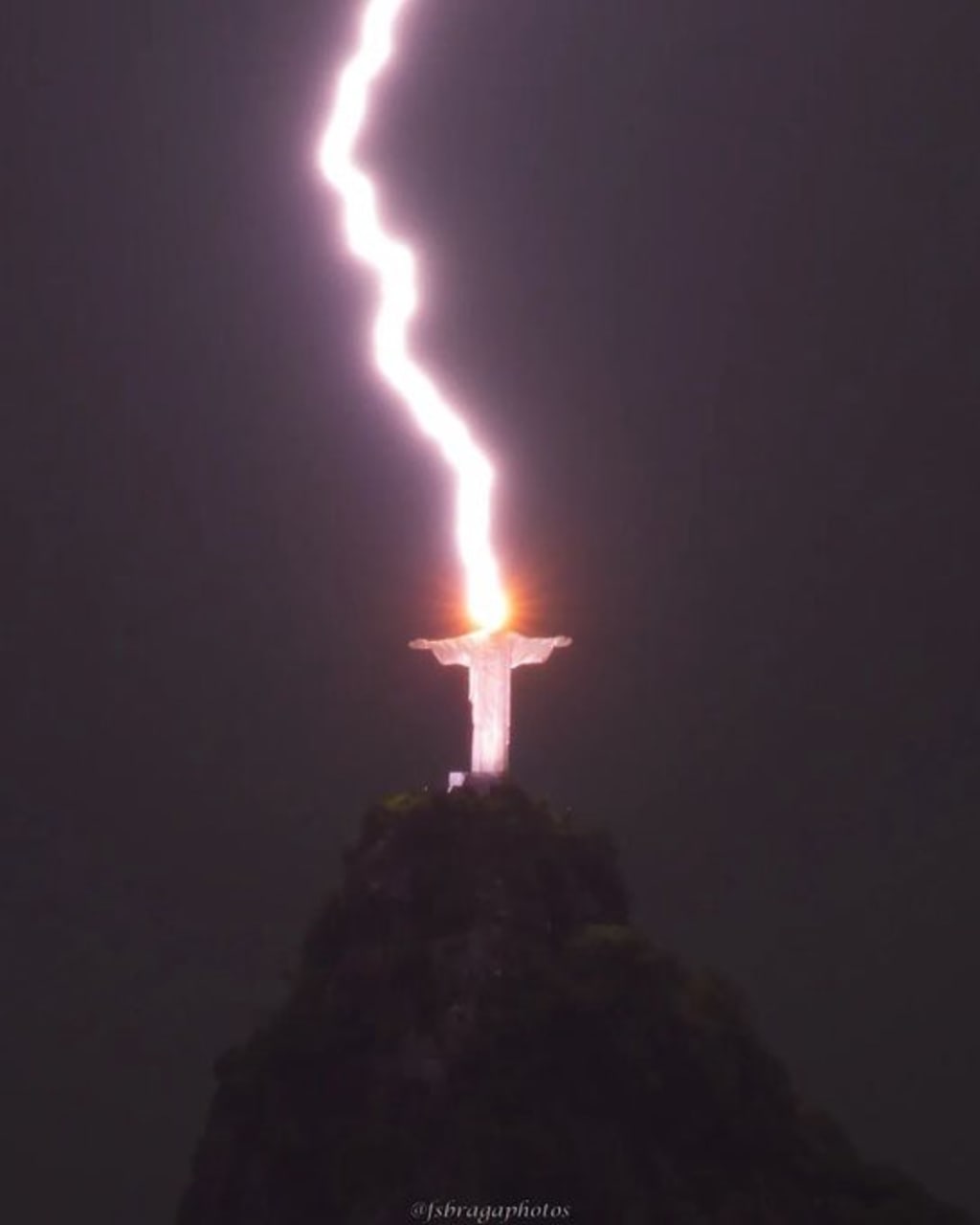
That image of lightning struck me this morning and triggered this story. The picture has gone viral this week and brought back memories of my two visits to Rio de Janeiro. I sailed into the harbour at Rio in my own boat (I live on a boat) in 2006. I took a different picture of Christ the Redeemer as I entered at sunset.
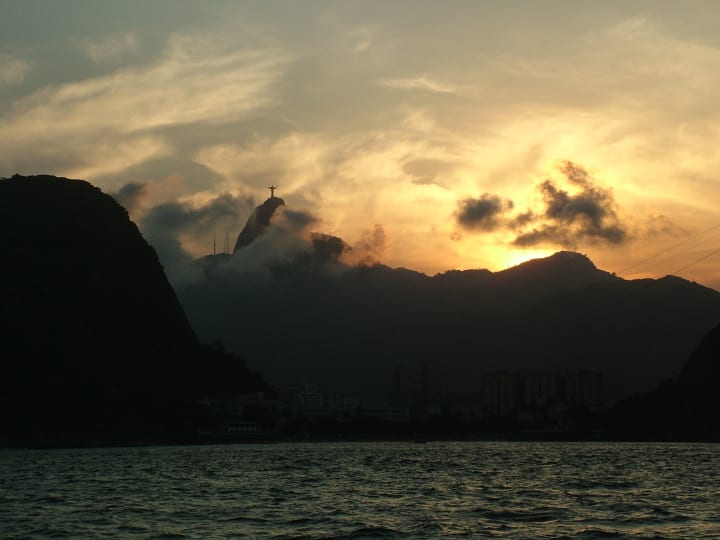
Okay, it's not as spectacular as the lightning shot but it's still pretty cool, I think.
Anyway, lightning.
It's a frightening thing if you're out at sea and there's lightning hitting all around you. I've been lucky not to be hit, and, as my boat is steel it's a bit safer that a fibreglass yacht in a thunderstorm. A steel boat is like a 'Faraday Cage' and shields what's within it - like me. But still, the electrics would probably get fried if it was struck and the engine probably ruined..
Lightning is one of the most fascinating and powerful natural phenomena that occurs on Earth. It is an electrical discharge that occurs in the atmosphere, usually within thunderclouds, and can strike the ground or other objects transmitting huge amounts of electrical energy in a fraction of a second.
By the way, the statue of Christ the Redeemer has a massive lightning conductor to keep it safe from damage, although one lightning bolt did once blow off a thumb - now repaired.
Here's a picture of the crown of thorns lightning conductor - there are others on the fingers:

There are several types of lightning - not just the amazing displays of forked lightning you may have seen.
Types of Lightning
- Cloud-to-ground lightning (CG): This is the most well-known type of lightning, where a discharge occurs between the negatively charged base of a thundercloud and a positively charged object on the ground. CG lightning can be incredibly dangerous and can cause significant damage to property and human life. Many people are killed every year by it, and golfers in particular.
- Intra-cloud lightning (IC): This type of lightning occurs entirely within a thundercloud, where different regions of the cloud become electrically charged. The discharge can jump between these regions, creating spectacular lightning displays within the cloud itself.
- Cloud-to-cloud lightning (CC): This type of lightning occurs when a discharge travels between two different thunderclouds. CC lightning can be seen as a bright flash within the clouds, and it is not typically associated with thunder.
- Ball lightning: Ball lightning is a rare and poorly understood phenomenon that is often described as a floating, glowing ball of light. Scientists are still trying to understand what causes ball lightning, but it is thought to be related to the ionization of air molecules. People have seen ball lightning float in to their homes.
- St. Elmo's Fire: This is a rare type of lightning that occurs in the presence of strong electric fields, such as near the mast of a ship or the wings of an aircraft. It appears as a bluish glow around objects and is not typically associated with thunder or lightning strikes. I haven't seen this one yet on my boat. Here's a lab demo of what it looks like.
- Sprite lightning: Sprites or red sprites are large-scale electric discharges that occur in the mesosphere, high above thunderstorm clouds, or cumulonimbus, giving rise to a varied range of visual shapes flickering in the night sky. They are usually triggered by the discharges of positive lightning between an underlying thundercloud and the ground. (Wikipedia)
Make your own lightning
It's easy enough to do in a school physics lab - I've done it myself. But you will need a Wimshurst Machine. And you'll need to turn the handle.
Or you could try the St Elmo's demo. These are high voltages so unless you are a physics grad, then don't try them.
Science of lightning
Lightning is an electrical discharge that occurs when there is a buildup of electric charge within a thundercloud (or two plates in a Wimshurst Machine). Or even between you and your car if it's a dry day and you are wearing polyester clothes.
Thunderclouds are formed when moist, warm air rises and cools, and the water vapor within the air condenses into clouds. Thunderclouds can grow to great heights - 69,000 feet has been known - and as they do so, they can create a separation of electric charge within the cloud. This separation of charge results in the buildup of negative charge at the base of the cloud and positive charge at the top of the cloud.
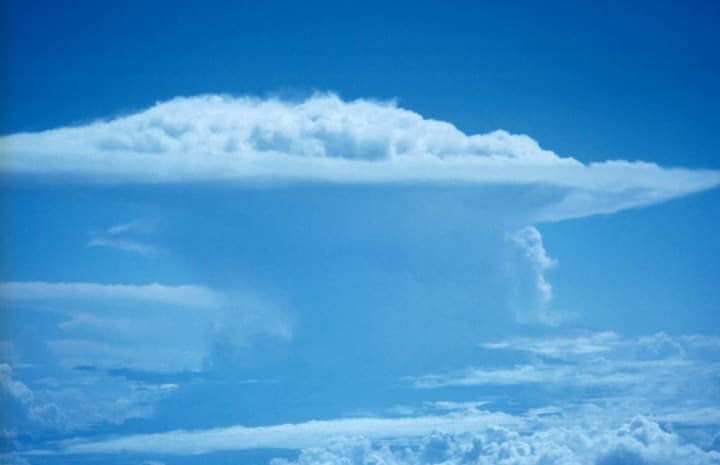
When the electric field within the cloud becomes strong enough, it can ionise the air around it, creating a pathway for the electric charge to flow. This flow of electric charge can occur within the cloud itself, between different regions of the cloud, or between the cloud and the ground.
Once the voltage reaches a certain strength, the air between the base of the cloud and the ground becomes ionised developing electrical conductivity. At first a channel, known as a stepped leader, is formed. Although invisible to the naked eye, this allows electrons to move from the cloud to the ground.
It is called a stepped leader because it travels in 50 to 100 m sections, with a slight pause in between, to the ground. It is called a stepped leader because it travels in 50 to 100 m sections, with slight pauses in between, to the ground. It's now believed that this stepped or zig-zagged shape is due to metastable oxygen.
As it nears the ground, a positively charged streamer fires upwards from the ground to connect with it. Streamers are most often initiated from tall objects on the ground.
Once connected, electrons from the cloud can flow to the ground and positive charges can flow from the ground to the cloud. It is this flow of charge that is the visible lightning stroke.
How common is lightning?
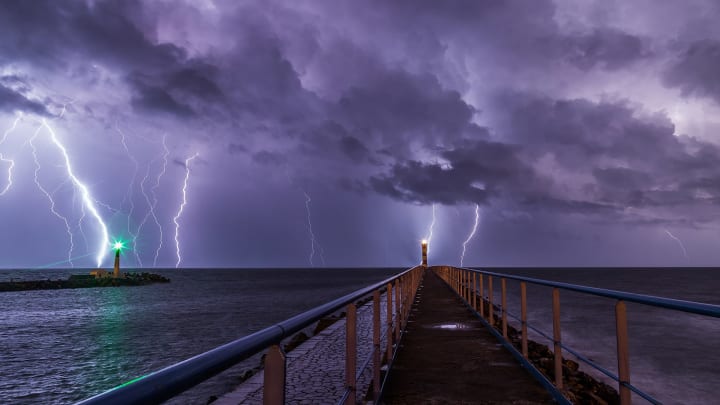
Where I am right now on my boat in Indonesia, near the Equator, it's a daily occurrence.
There are an estimated 1.4 billion lightning flashes globally each year. After a lightning strike the air is 'primed' and another is very likely in the same channel.
Lightning is more common in tropical and subtropical regions, where thunderstorms are more frequent. For example, the Democratic Republic of Congo has the highest density of lightning strikes in the world, with an average of 158 strikes per square kilometer per year.
The United States is also a region that experiences a high frequency of lightning strikes, with an average of 20 million lightning strikes per year. The most lightning-prone state in the US is Florida, which has the highest number of lightning strikes per year of any state in the country. Lightning strikes are also more common in the summer months, as the warm air creates favorable conditions for thunderstorms to form.
Lightning can be dangerous and cause significant damage and loss of life. It is estimated that lightning strikes kill around 2,000 people each year and injure many more. In addition to the immediate dangers of a lightning strike, lightning can also start fires, damage infrastructure, and disrupt power grids. And golf matches.
To offset the risks associated with lightning strikes, various safety measures are put in place. For example, buildings are often equipped with lightning rods that attract the lightning and channel it harmlessly into the ground.
Additionally, outdoor activities such as sports events and concerts may be delayed or canceled if there is a risk of lightning strikes in the area.
How powerful?
It is estimated that the average lightning strike carries 1 gigajoule of energy with a current of 30,000 amps, heating the air to around 25,000 deg, C. in less than a millisecond.
Energy is also dissipated in the form of electromagnetic radiation (which you can hear on a radio), light - obviously, and sound - the thunderclap.
Detection
In recent years, lightning researchers have made significant advances in understanding the physics of lightning, and new technologies have been developed to better predict and track lightning strikes. For example, lightning detection networks use a combination of ground-based sensors and satellite imagery to detect lightning strikes and track their movement in real-time.
On my boat I use my radar to track thunderstorms - and avoid them. And if you are at home, tune in to a local weather channel and find the link for weather radar.
Whenever I see a lightning flash I automatically start counting the seconds until I hear the clap. Roughly, the sound travels at 5 seconds a mile (750 mph) and I can guesstimate how far away the flash was. But if it's an intense storm with frequent flashes then that's not so easy.
Safety
People do get struck by lightning and survive. Even struck twice and survive.
But most people die when struck by lightning, so take no chances. If you get caught out in the open in a thunderstorm, this is what CDC advises.
Act quickly to find shelter.
- The most important action is to remove yourself from danger. Crouching or getting low to the ground can reduce your chances of being struck, but it does not remove you from danger.
- If you are caught outside with no safe shelter nearby, the following actions might reduce your risk of being struck by lightning:
- Immediately get off elevated areas such as hills, mountain ridges, or peaks.
- Never lie flat on the ground. Crouch down in a ball-like position with your head tucked and hands over your ears so that you are down low with minimal contact with the ground.
- Never shelter under an isolated tree. If you are in a forest, shelter near lower trees. [the lightning can jump from the tree to your body because of its lower resistance to earth]
- Never use a cliff or rocky overhang for shelter.
- Immediately get out of and away from ponds, lakes, and other bodies of water.
- Stay away from objects that conduct electricity (such as barbed wire fences, power lines, or windmills)
Separate from others.
- If you are in a group during a thunderstorm, separate from each other. This will reduce the number of injuries if lightning strikes the ground.
And do try to enjoy one of nature's most amazing displays of power.
***

About the Creator
James Marinero
I live on a boat and write as I sail slowly around the world. Follow me for a story diet of Tech, AI, Geopolitics and more as the world is rapidly changing. I also write techno thrillers, with six to my name. More of my stories on Medium
Keep reading
More stories from James Marinero and writers in Earth and other communities.
China's Coal Role in Global Warming
Hot and humid I’m in Indonesia as I write this and yesterday the first mate and I visited a school so that the pupils could get some experience of listening to native English speakers (although I have a Welsh accent and as the World Cup is about to start they all knew who Gareth Bale is).
By James Marinero3 years ago in Earth
When the Stars Whispered
The Night Sky Like Never Before I had always been fascinated by astronomy, spending countless nights in my backyard with a modest telescope, charting constellations, tracking planets, and occasionally glimpsing distant galaxies as faint smudges of light against the infinite darkness. But on one crisp night in March 2026, something extraordinary occurred that defied both expectation and explanation, a cosmic phenomenon that no scientific journal could easily classify, and yet it felt intimately personal, as if the universe itself were reaching out to communicate. The sky was unusually clear, the stars sharp and luminous like diamonds scattered across black velvet, and the Milky Way stretched overhead in a ribbon of silvery light that seemed to pulse ever so slightly, a rhythm I hadn’t noticed before.
By The Curious Writera day ago in Earth




Comments
There are no comments for this story
Be the first to respond and start the conversation.