
LIES ABOUT DINOSAURS
All lies we heard about dinosaurs
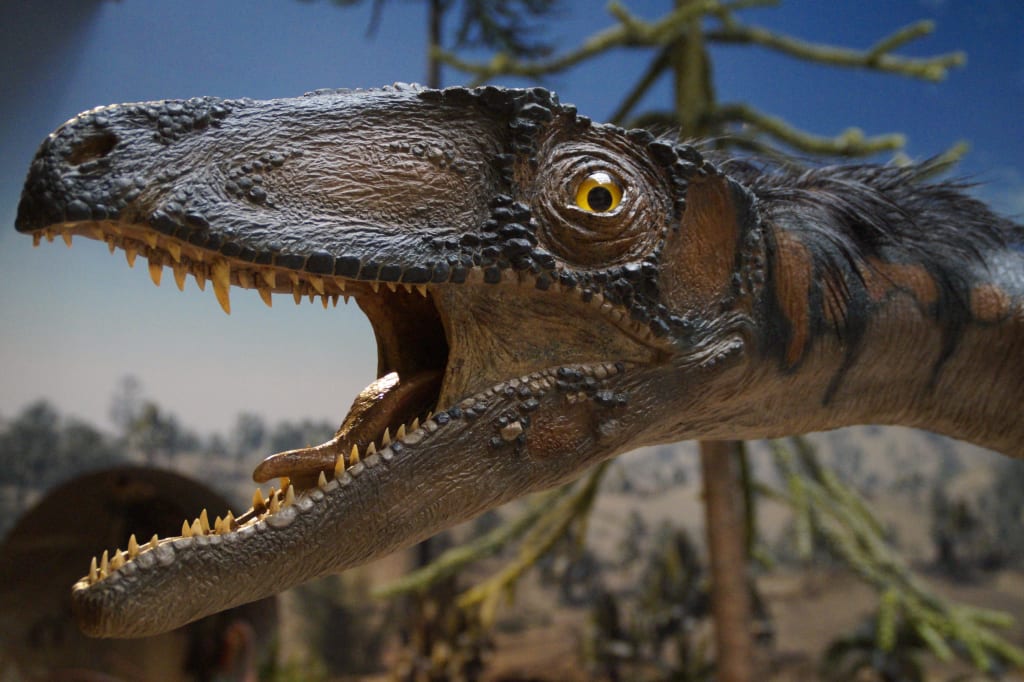
You might have heard that all dinosaurs were wiped out 65 million years ago when a 15 kilometer wide asteroid crashed into Earth and caused a mass extinction event, but that is entirely false. One species of dinosaur, theropods, managed to survive. They had feathers and hollow bones, and most of them could fly, meaning they could rise above the blast and survive the aftermath. And now, many scientists believe that these theropod dinosaurs managed to evolve into birds. So technically, dinosaurs are still alive and with us today. But that's not the only thing you were lied to about dinosaurs.
From non-existent species to T-Rex's eyesight, there are many myths and misconceptions about the Mesozoic Era. One of the craziest is that dinosaurs were all green, scaly monsters. In fact, many of them likely had feathers. Theropods would have had feathers for a variety of reasons, from giving them warmth to helping some aviation-based dinos to fly. And that's not all. Dinosaurs were a variety of colors. Yeah, some fossils have preserved pigments showing that not all dinosaurs were brown, black, or green. They may have had many vibrant colors. Some of them may even have had specific camouflage depending on their environment. And they weren't all scaly and slimy either. Different Dino species would have different textures to their skin. I want to know if any of them were fluffy. Now, when you think of dinosaurs, you probably think that they were all massive.
The T-Rex had a length of 12 meters, and the long-necked Brachiosaurus was up to 13 meters tall. But that wasn't the case for all dinosaurs. Contrary to popular belief, not all dinosaurs were giants. In fact, many of them were pretty small. Some were even the size of birds that we have today. One small dinosaur was the microraptor. This little guy was about the size of a crow. He even had wings and feathers, making him look like a bird. Dinos are typically portrayed as slow-moving, cold-blooded reptiles, but this isn't totally accurate. Scientists have recently discovered that dinosaurs weren't all cold-blooded like we thought. But that doesn't mean that they were all warm-blooded. It's a bit more complicated. Dinosaurs may have had a metabolic system known as mesothermic. This means they were somewhere between cold and warm-blooded. Mesothermic allows animals to generate some internal heat, just not as much as a warm-blooded animal would. Dinosaurs with feathers may have been warm-blooded. Feathers usually suggest warm-blooded. Now, of course, there were thousands of species of dinosaurs, so sure, many of them may have been cold-blooded, but there were also warm-blooded and mesothermic dinosaurs. The Brontosaurus is one of the most iconic dinosaurs ever, with its long neck and tail. It's probably one of the first dinosaurs you think of. But did you know that these creatures almost didn't exist? Yeah, in the 19th century, the Brontosaurus was accidentally classified as the Apatosaurus, a species with similar traits. It wasn't until 2015, after years of research, that the Brontosaurus was reclassified as its own dinosaur. Kind of like how Pluto comes and goes as a planet, the dinosaur community seems to have some sort of trouble making up their mind on the validity of the name Brontosaurus.
Movies like Jurassic Park often show the Tyrannosaurus Rex as one of the most deadly predators, destroying everything in its path. The only catch? They can only see prey if it moves. Yeah, that's also completely false. To make the T-Rex even more terrifying, they had readable vision and were easily able to see prey that stood still. Since the T-Rex's eyes were positioned forward on its head, it had binocular vision. It could easily judge distances and see objects in three dimensions, similar to how humans see. Research suggests that the T-Rex might have had better eyesight than modern-day birds because it had such large optic nerves. It's easy to forget, but dinosaurs didn't all live simultaneously. The Mesozoic Era, also known as the age of dinosaurs, spanned over 180 million years. There were three distinct periods: Triassic, Jurassic, and Cretaceous. And within these three periods, different species were unique to the specific era.
Within a span of 180 million years, certain species of dinosaurs underwent evolutionary changes while others became extinct. Notably, some of the most iconic dinosaurs, such as the stegosaurus and T-Rex, did not coexist as they lived in entirely different time periods, separated by tens of millions of years. The popular depiction of the T-Rex as a Godzilla-like creature that can stand upright is a misconception based on early artists' renderings. Paleontologists have since discovered that the T-Rex had a more horizontal posture, with its tail held up off the ground and its body balanced over the hips. The stance of the T-Rex that is typically portrayed in popular culture is entertaining but impractical for the dinosaur to move around freely.
When fossils are excavated, the shrink-wrap method is often used to portray how the dinosaurs looked. However, this technique is highly inaccurate as it does not account for any muscles, fat, or other soft tissues that the dinosaur had. Fortunately, this method is now considered outdated, and paleontologists now account for the muscles and the fact that the dinosaurs were likely packing on. They make comparisons with modern animals to find where muscle would typically be attached to the bone, resulting in a more realistic appearance for the dinosaurs.
Paleontologists have identified over 1,000 different species of dinosaurs, but there are still many more left to discover. Research suggests that we have only found about 30 percent of dinosaur species, and some may never be found due to gaps in the fossil record. Depending on where a species lived, it may have never been fossilized due to its environment. On average, paleontologists discover about 50 new dinosaur species every year.
The sounds that dinosaurs made are still a mystery as fossilization rarely preserves the soft tissues like vocal cords. However, scientists can make an educated guess that dinos sounded closer to birds and crocodiles since they are the closest living relatives of dinosaurs. Researchers have created models based on fossilized skulls, suggesting that the dinosaurs may have made low-frequency rumbles or bird-like calls.
As for the possibility of cloning dinosaur DNA and building a Jurassic Park, it is highly unlikely. DNA degrades over time, and the chance of finding intact Dino DNA is basically zero. Even if some were found, extracting the DNA without any contamination or deterioration would be incredibly difficult. The Mesozoic period was an incredible time in Earth's history, and we are learning more about it every day. However, the story of what happened immediately after this period ended, when the dinosaurs went extinct?
About the Creator
Keep reading
More stories from Akhil Raju and writers in Earth and other communities.
CUTTING EARTH INTO TWO HALF
There are many ways you could attempt to divide the planet. You could crack it open with an asteroid, blow it apart with nuclear weapons, or start digging. But no matter what, you'd have your work cut out for you. Having an asteroid do the job would be a risky move. The one that made this 160 kilometer wide, 40 kilometer deep crater in South Africa was bigger than the Jigsalube asteroid that killed the dinosaurs. A planet-splitting space rock would need to be much, much bigger, and we wouldn't fare very well.
By Akhil Raju2 years ago in Earth
Europe Amniotic Membrane Market Size & Forecast 2025–2033
Europe Amniotic Membrane Market Outlook The Europe Amniotic Membrane Market is undergoing a significant transformation as regenerative medicine gains momentum across clinical disciplines. According to Renub Research, the market is projected to grow from US$ 788.42 million in 2024 to US$ 1,892.79 million by 2033, expanding at a CAGR of 10.22% during 2025–2033.
By jaiklin Fanandish4 days ago in Earth


Comments
There are no comments for this story
Be the first to respond and start the conversation.