

The Leaky Jar
In the grove of the Academy, where the tall and shady plane trees offer philosophers a refuge from the scorching heat of the sun, there once walked a certain Socrates (not that famous one, but an elderly man with the same name, who however was not lacking in wisdom). He was accompanied by a young man named Critias, who seemed to be of good character, but was talkative and arrogant beyond measure.
Critias then, without stopping his tongue at all, spoke about all things: about the nature of the stars, about the laws of the city, and indeed about virtue itself, as if he knew everything and needed no teacher. The elderly man listened calm and silent, smiling only slightly. Like those who surely know that silence is most of the time stronger than loquacity.
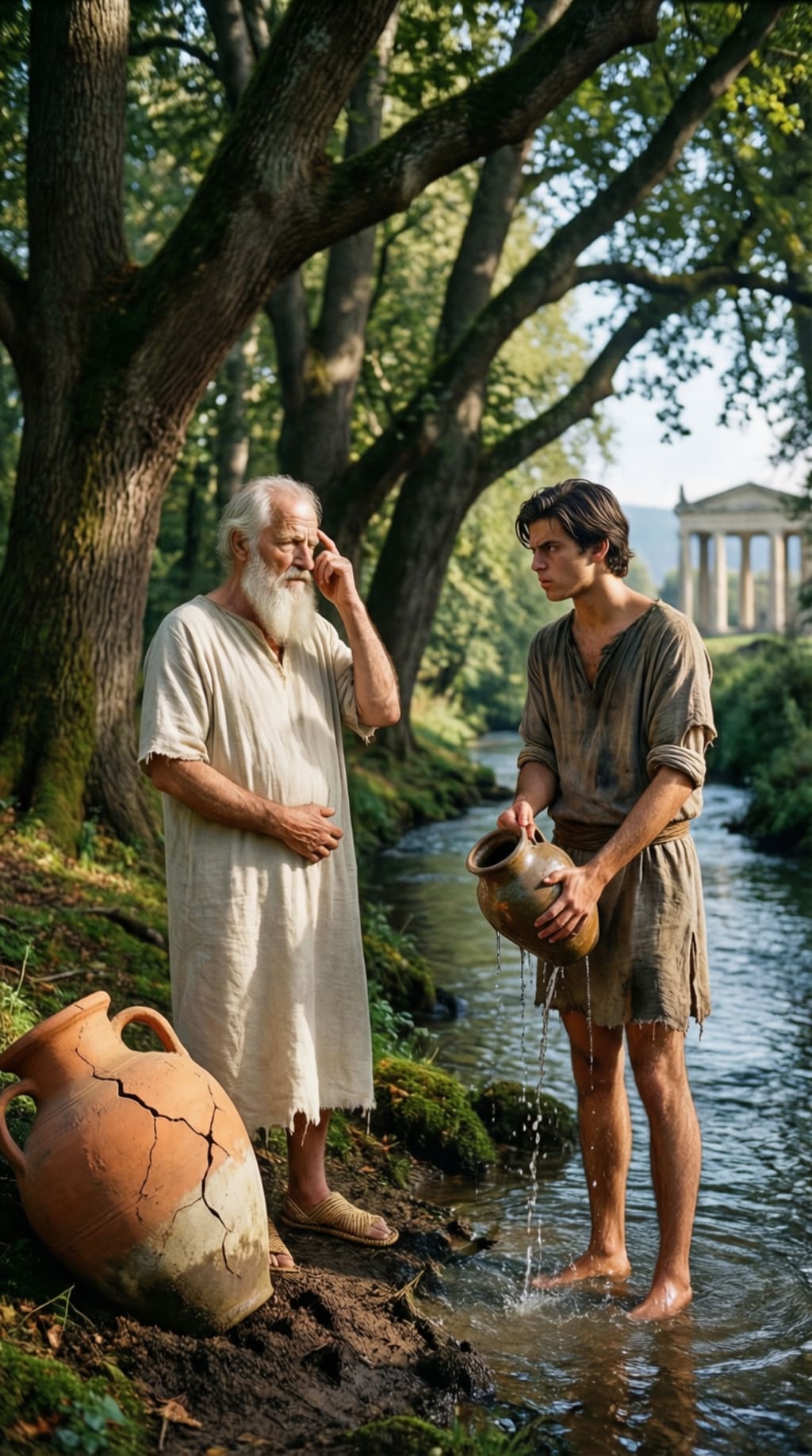
When they reached the bank of the river Cephisus, the old man stood still. There happened to be lying there an old jar, made of clay, which had a large crack in its belly, resulting in it not being able to hold anything.
"Oh Critias," said the old man, interrupting the flow of the young man's words, "do me a small favor, my friend. Do you see this jar?"
"I see it," answered the young man, wondering why the sage asked about a piece of ceramic.
"I want, then," he said, "for you to fill this jar with water from the river. Because my soul thirsts for some examples and my body for water. This will also be a lesson for you."
Critias, thinking that this was easy and a game rather than work, grabbed the jar and went down to the water. After he drew enough water, he began to ascend. But alas, as much water as he poured in from above, that much flowed out from below through the crack. Before he could reach the old man, the jar was empty again.
Two and three times the young man tried, sweating by now and being in a state of perplexity. Finally, throwing the jar on the ground, he shouted: "Oh vain old man, do you not see that it is impossible? This jar holds nothing, since it is leaky!"
Then, the very wise Socrates looked at him with eyes piercing like an eagle's but kind. Softly he said to him: "So, my good friend. You get angry at the dry clay because it does not keep the cool water inside it? But what do you have to say about your own soul which resembles it?"
"What do you mean, old man?" asked Critias, agitated.
"Learn then," said the sage, "that similar is the condition of your own mind too. Whoever speaks continuously and never listens to his elders, he has a leaky soul. Just as the water runs out of this jar, so does wisdom run out of the mind of the talkative, thoughtless man. Because he learns nothing, retains nothing, but all words pass through him like the wind through an empty house."
And adding to this he said: "Learn first to be silent and to retain, so that you may be able someday to fill up. Because without the bottom of silence, every education is vain."
Critias, as soon as he heard these shattering words, blushed and looked down. He understood the riddle very well. And from that day, he spoke less, but thought more, healing the crack of his soul that he had been carrying for years.

About the Creator
BHUMI
Turn every second into a moment of happiness.
So You Decided To Become a Nurse Practitioner:
So you decided to become an "Advanced Practice" nurse. Congratulations!... is what I would say if this was a good idea. Grad school? In this economy? What were you thinking? Likely it was something along the lines of either 1) “I've seen these other chucklefucks do it— Why can't I?” or even 2) “I've got a nice career, I should shake it up. I miss feeling like I have no clue what I'm doing.”
By Sandor Szabo6 days ago in Fiction
Split Lip
At the hospital, the nurses have got those looks on their faces where you can just forget about patient confidentiality. Behind those raised eyebrows, behind the crinkled-up foreheads, already they’re cooking up the nicknames–what they’re gonna call you after you shed that paper gown and slide your legs back into those pants.
By Maegan Heil7 days ago in Fiction


Comments (1)
Less is always more. Hemingway proved that and changed the rhetoric of writers forevermore. Hugs to you. Thank you. My friend. Thank you