
Killers of the Animal Kingdom
Episode I – Earth’s Real Monsters

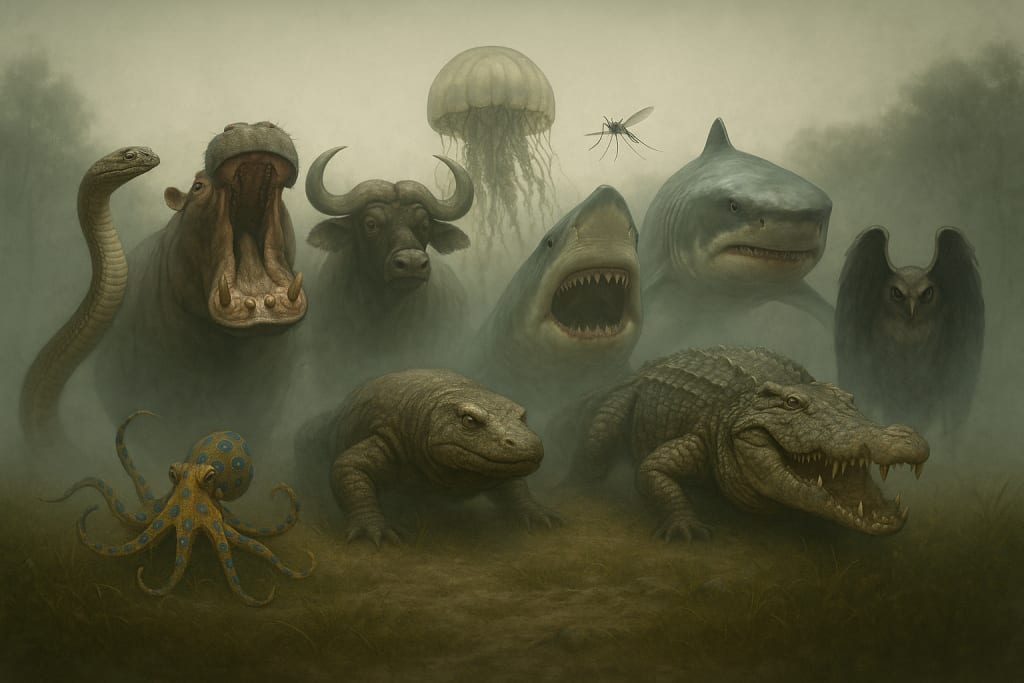
Forget the alien... Forget the cryptid... The truth is far simpler, and far more terrifying. The most efficient killers on this planet don’t come from space or superstition. They crawl, swim, and slither through the same world we call home.
Their names aren’t whispered in folklore. They’re printed in medical textbooks, research papers, and obituaries. And tonight, we begin our descent into nature’s most perfect designs for death.
1) Box Jellyfish - The Transparent Executioner
Northern Australia’s waters look like glass. That’s the problem. The box jellyfish (Chironex fleckeri) is nearly invisible until your skin lights up with fire.
Anatomy of Death
Hair-trigger cells: Each tentacle carries millions of cnidocytes - microscopic booby traps.
Spring-loaded harpoons: Inside each is a nematocyst (a pressurized capsule) with a coiled, barbed tubule and venom payload.
Instantaneous fire: Touch triggers the capsule to discharge in milliseconds, accelerating at forces so extreme they’re among the fastest motions in biology.
Injection & overload: The tubules punch into skin and dump cardiotoxins, neurotoxins, and pore-forming proteins, ripping open cells, shocking the nervous system, and stopping the heart.
Time window: Collapse can occur in 2 - 3 minutes in severe stings. Vinegar can deactivate unfired nematocysts; but do not rub.
Cold fact: One large specimen carries enough venom to kill dozens of adults. Most victims don’t scream, they simply go under and are never heard from again.
2) Inland Taipan - Reaper of the Outback
Quiet, unassuming, almost gentle in demeanor - and biologically apocalyptic. The inland taipan (Oxyuranus microlepidotus) delivers the most toxic snake venom known.
Anatomy of Death
Toxin cocktail: Taipoxin (a potent presynaptic neurotoxin) blocks nerve signaling; procoagulants explode clotting pathways, causing internal bleeding; myotoxins liquefy muscle; hyaluronidase spreads it fast.
Crisp delivery: Short fangs, precise strikes, multiple rapid hits if pressed.
Shutdown sequence: Tingling → nausea → vision blur → paralysis and respiratory failure.
Lifesaver: Antivenom exists and saves lives when given quickly; the snake’s remote range is what makes it feared.
Cold fact: A single full dose contains enough venom to kill ~100 adults without treatment.
3) Saltwater Crocodile — Ancient God of Ambush
The 'Saltie' (Crocodylus porosus) is not an animal; it’s a blueprint for ambush, perfected since the Triassic. You are literally looking at a walking, talking, dinosaur!
Anatomy of Death
Stealth platform: Eyes, ears, and nostrils ride above the surface; the rest is submerged armor.
Impact moment: From a standstill, it erupts, clamping with ~3,700 PSI of bite force. Enough to shatter bone, like chalk with a hammer.
Death roll: A high-torque spin that dislocates joints, tears flesh, and drowns prey. Once clamped into this maneuver, 99.9% of all animals including man, do no survive.
Wet larder: Victims are cached underwater to soften before feeding. Digestion begins before the first chew.
Cold fact: Mature males regularly grow to 20 ft. Though there are unconfirmed reports of one specimen, reaching 30 ft in the Congo. These monsters can drag a full grown horse off a bank, like it weighed nothing.
4) Mosquito — The Smallest Serial Killer
Imagine the smallest of animals killing the most humans in history? No roar... No glare... Just a whine in the dark. The mosquito is the deadliest animal on Earth because it delivers pathogens, not claws.
Anatomy of Death
Surgical mouthparts: Six needles probe, slice, and find a capillary; saliva adds anti-clotting and anesthetic so you don’t feel the feed.
Biological hitchhikers: Malaria, Scarlet fever, Dengue, Yellow fever, Chikungunya, West Nile, Zika - each a different route to fever, hemorrhage, neurological damage and death.
Scale of harm: Transmission explodes wherever standing water and human density meet. Nets, repellents, and public health campaigns are the only real shields. Yet nothing is 100% effective...
Cold fact: Mosquito-borne diseases kill >700,000 people each year. Malaria alone has likely killed billions across history.
5) Cape Buffalo — Black Death
These creatures might look innocuous like a Bison of the Great Plains, but don't be fooled. The Savanna’s bad temper is personified in this one mammal. The Cape buffalo (Syncerus caffer) doesn’t bluff, and it doesn’t forget.
Anatomy of Death
Mass + momentum: 1,300–1,800 lbs launched at ~35 mph.
Weapons forward: Bossed horns form a bone shield; the hooks gore, lift, tear and rip.
Ambush intelligence: Wounded buffalo circle back and wait in cover; hunters learn this lesson once.
Herd calculus: When a herd commits, it’s a multi-ton battering ram.
Cold fact: More deadly to people in Africa than lions, leopards, or elephants, these bruisers cause hundreds of human fatalities annually.
6) Cone Snail — The Beautiful Assassin
It looks like jewelry. It shoots like a dart. The geography cone (Conus geographus) hunts fish with chemistry that drops hearts and minds. Our advice is don't put any shells in your pockets. This is how people have died.
Anatomy of Death
Harpoon in a mouth: A replaceable radular tooth (hollow barb) loads a venom syringe.
Lightning strike: The proboscis flicks; the harpoon fires and anchors; venom floods in.
Conotoxin symphony: Dozens of peptide toxins jam neural ion channels, causing immediate paralysis without struggle.
Human effect: Rapid numbness → weakness → respiratory collapse. No antivenom; only ventilation buys time.
Cold fact: Nicknamed the “cigarette snail” - legend has it, you’ve got time for one last smoke before keeling over and taking an eternal nap.
7) Hippopotamus — River Tyrant
Cartoon smile with a coffin bite. The hippo rules by mood and mass.
Anatomy of Death
Territorial detonations: Boats “too close,” paths “in the way,” nights “too loud” - any pretext is sufficient.
Jaw architecture: A gape of ~150° powered by jaw muscles that turn foot-long incisors into ivory axes.
Two-terrain terror: 20+ mph on land for short bursts; underwater, it overturns boats then bites what surfaces. It has also been known to bite crocodiles in half for getting to close.
No appeasement: Displays turn lethal with no warning.
Cold fact: Estimates suggest ~500 human deaths/year in Africa, and the reporting isn’t great.
8) Blue-Ringed Octopus — Dazzling Doom
A marble of living warning lights. The blue-ringed octopus (Hapalochlaena spp.) you won’t feel until breathing stops. Absolute beauty, combined with death.
Anatomy of Death
Silent nip: Tiny beak, often painless bite. People think it’s nothing, until they drop in a heap.
Tetrodotoxin (TTX): Blocks sodium channels in nerves - signals stop, muscles follow, lungs last. Consciousness often persists. Imagine being awake while your breath leaves you?
Clock starts: Paralysis ascends in minutes. No antivenom. Rescue breaths can save a life until toxin clears.
Cold fact: One animal carries enough TTX to kill ~26 adults. This beauty is not your friend.
9) Komodo Dragon — Rotting God of the Islands
A reptile that hunts with time. The komodo (Varanus komodoensis) doesn’t race you, it ruins you.
Anatomy of Death
Dirty myth vs. deadly truth: Yes... their mouths host a gnarly soup of bacteria, but research shows venom also has a role to play. With anticoagulants and hypotensive agents that increase bleeding and drop blood pressure.
Slash, wait, follow: A quick bite opens flesh; venom and microbes get to work. Blood thins, tissues die, shock creeps in.
Sense and stalk: Komodos can track a blood scent miles downwind. When the prey goes down days later, the dragon arrives like a calendar.
Cold fact: They’ve killed deer, pigs, water buffalo and humans. The island gives no second chances.
10) Great White Shark — Engine of Fear
The ocean’s oldest design brief: approach unseen, erase resistance. The Great White (Carcharodon carcharias) is not just a monster of your nightmares, it’s method to your madness. A true eating machine designed with one intent. KILL!
Anatomy of Death
Detection suite: Sharks possess a unique sensory system called the ampullae of Lorenzini. These specialized, jelly-filled pores on their snouts can detect minute electrical fields, enabling them to locate hidden prey, sense temperature shifts, and even navigate using the Earth's magnetic field. They can even detect blood in concentrations of 1 part per million.
Ambush physics: From below, a burst to ~25–35 mph, jaws open, head shakes like a band saw.
Serrated guillotines: Rows of triangular teeth saw and replace; bite forces measured in tons, not pounds.
Hit-and-bleed: On pinnipeds, first strike maims; shark circles as blood loss finishes the job for most.
Cold fact: This blueprint has worked for ~400 million years of shark evolution. When a design is perfect, time stops editing.
Epilogue — The Monsters That Breathe Our Air
You don’t need folklore to feel fear. You need biology. Harpoons smaller than a grain of sand. Venoms that switch off breath. Jaws that turn bone into mist. The universe didn’t wait for us to invent horror. It patented it first.
Join us next Friday, when we examine another set of horrifyingly real creatures in Episode II... Until then readers, stay safe, stay vigilant and remember... Horror isn’t imagined, it’s alive and well.
About the Creator
Veil of Shadows
Ghost towns, lost agents, unsolved vanishings, and whispers from the dark. New anomalies every Monday and Friday. The veil is thinner than you think....
Keep reading
More stories from Veil of Shadows and writers in Earth and other communities.
EPISODE V - Biologists’ Worst Nightmares: The Assassins Who Walk on Six Legs
Humanity loves to imagine its predators as massive things. Lions with crushing jaws, sharks with serrated rows of teeth, bears standing ten feet tall. Evolution, however, has no loyalty to size. Nature’s most efficient killers are often the ones you need a magnifying glass to see clearly.
By Veil of Shadowsabout a month ago in Earth
Antibiotic resistance is released into rivers and other essential water supplies by melting glaciers.
Sea level rise and the disappearance of landscapes are not the only effects of glaciers melting quickly. Melt water may also contain buried genetic material that aids in bacterial resistance to drugs, scientists are now cautioning.
By Francis Damiabout 4 hours ago in Earth
Stanislav Kondrashov on the Backbone of the Energy Transition: Why Strategic Infrastructures Matter Now More Than Ever
As the world steadily moves away from traditional fuels and toward renewable energy sources, one truth is becoming increasingly clear: the energy transition is not just about new technologies—it's about the infrastructures that support them. For energy systems to evolve in a meaningful, lasting way, the scaffolding beneath them must be reimagined, reinforced, and in some cases, rebuilt entirely.
By Stanislav Kondrashov5 days ago in Earth



Comments
There are no comments for this story
Be the first to respond and start the conversation.