

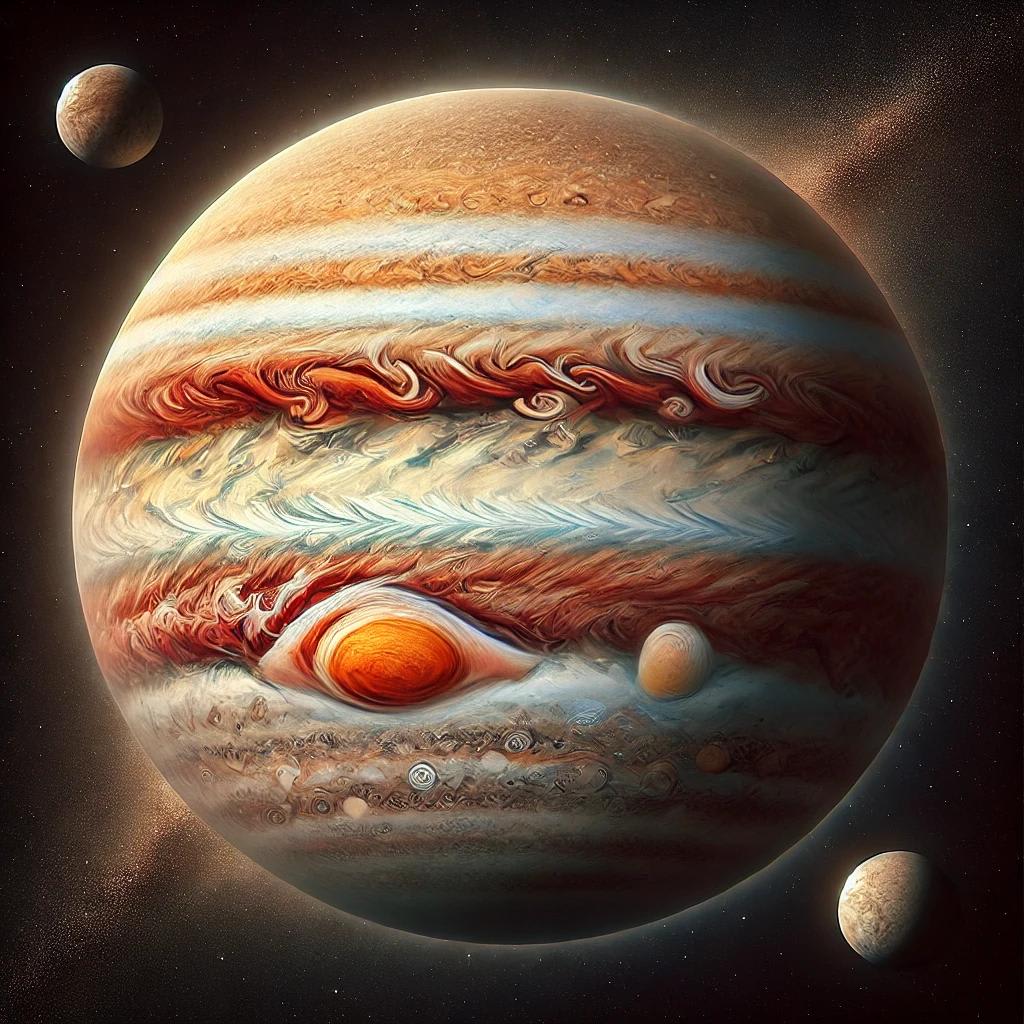
**Jupiter: The King of Planets**
Jupiter, the largest planet in our solar system, is often referred to as the "King of Planets." With its immense size, powerful magnetic field, and vibrant cloud formations, it stands as one of the most fascinating celestial bodies.
### Size and Structure
Jupiter is a gas giant, meaning it doesn't have a solid surface like Earth. It's composed mainly of hydrogen and helium, much like the Sun. In fact, Jupiter is so massive that it contains more than twice the mass of all other planets combined. Its diameter is about 11 times that of Earth, and you could fit over 1,300 Earths inside it.
Beneath its thick atmosphere, Jupiter likely has a dense core, although this is still debated among scientists. Above this core, the planet has a layer of liquid metallic hydrogen, which creates its powerful magnetic field.
### Atmosphere and the Great Red Spot
Jupiter's atmosphere is a constantly shifting sea of colorful bands and swirling clouds, driven by powerful winds reaching speeds of up to 400 miles per hour. Its most iconic feature is the Great Red Spot, a massive storm larger than Earth, which has raged for at least 400 years. This storm is a key marker of the planet's dynamic and extreme weather systems.
The planet’s colorful bands are a result of its fast rotation, which causes jet streams to form in its atmosphere. These bands are composed of ammonia clouds that reflect sunlight, creating the bright zones and darker belts we see.
### Moons and Rings
Jupiter is orbited by at least 79 known moons, making it almost a mini solar system of its own. The four largest, known as the Galilean moons—Io, Europa, Ganymede, and Callisto—were discovered by Galileo Galilei in 1610. Each of these moons is unique, with Ganymede being the largest moon in the solar system, and Europa believed to harbor a subsurface ocean beneath its icy crust, raising the possibility of life.
Jupiter also has faint rings, though they are much less prominent than those of Saturn. These rings are made of tiny dust particles ejected from its moons during collisions with meteoroids.
### Magnetic Field and Radiation
Jupiter’s magnetic field is the strongest of any planet in the solar system, 20,000 times more powerful than Earth's. This magnetic field traps charged particles and creates intense radiation belts around the planet, making its environment incredibly hostile to spacecraft and potential human exploration.
The planet's magnetosphere extends millions of kilometers into space, even reaching beyond Saturn’s orbit. This field also produces stunning auroras at Jupiter’s poles, which are even more spectacular than those seen on Earth.
### Exploration
Human understanding of Jupiter has greatly advanced through robotic space missions. NASA’s Galileo spacecraft, which orbited the planet from 1995 to 2003, provided a wealth of data about its atmosphere and moons. More recently, the Juno spacecraft, which arrived at Jupiter in 2016, has been sending back detailed images and information about the planet’s structure and magnetic field, giving scientists unprecedented insights into its inner workings.
### Conclusion
Jupiter remains a captivating subject of study for astronomers and space enthusiasts alike. Its size, complexity, and mysteries—from the raging storms of its atmosphere to the potential hidden oceans of its moons—make it a planet that both inspires awe and invites further exploration. As technology advances, Jupiter may reveal even more about the formation of the solar system and the potential for life in its most surprising corners.
The sound of Jupiter
About the Creator
Darkos
Alien
writing in the moment
channels: https://www.youtube.com/@Healingestures
For HSP mainly : patreon.com/healingawakening
The Trans Youth Athletes in the US Fighting for Their Rights: ‘Playing Is an Act of Resistance’
Across the United States, sports have become an unexpected front line in the fight over transgender rights. For many trans youth athletes, simply stepping onto a field, track, or court is no longer just about competition—it is an act of resistance. As state legislatures debate and pass laws restricting transgender participation in school sports, young athletes are finding themselves at the center of a national culture war that reaches far beyond the locker room.
By Aarif Lashari6 days ago in Earth
Cosseting the City or Keeping It in Check?
For decades, the City of London has been treated as the crown jewel of the British economy. Governments of all political colours have cosseted banks and financial institutions, convinced that a thriving financial sector is the key to faster economic growth, higher tax revenues, and global influence. The current chancellor is no exception, signalling a desire to keep City lenders comfortable in the hope they will fuel growth across UK plc.
By Aarif Lashariabout 18 hours ago in Earth
The Devil's Cut
“Comrade, finally you’re awake.” The voice was smooth, sensual. A flickering incandescent bar was all that lit the white, sterile room. All Vladimir remembered was everything going black. He tried to move his arms and found them strapped to the gurney.
By Matthew J. Fromm6 days ago in Fiction



Comments
There are no comments for this story
Be the first to respond and start the conversation.