
Journey through the Frozen Moments of Pompeii
And Feel the Thrill of a Lifetime

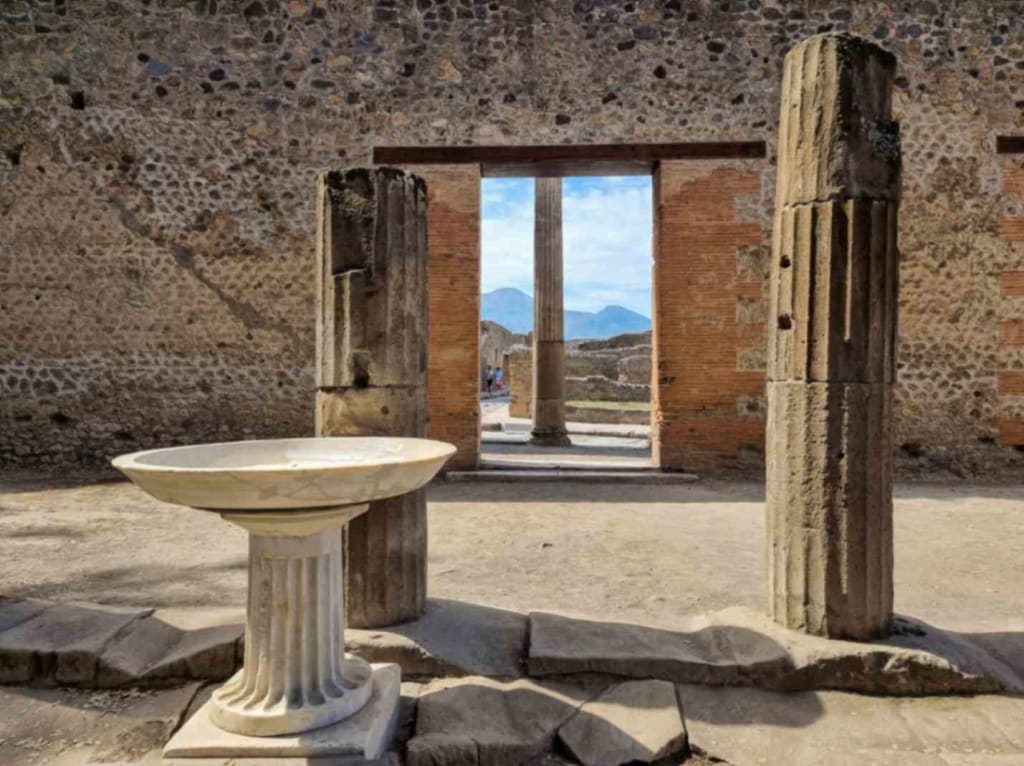
Archaeological sites are thrilling. They transport one to a different dimension and time. This is especially true of Pompeii.
But what’s more, Pompeii is not just an archaeological site. Most uninhabited ancient sites that we see today were abandoned for various reasons, and the elements just took over.
But not the ancient Roman city of Pompeii.
The people of Pompeii did not abandon the city. They were going about their daily activities when Mount Vesuvius erupted and volcanic ash froze them in time, literally.
This makes touring Pompeii not only stirring and spine-tingling but also haunting.
Pompeii was a thriving Roman city with some 12,000 residents. Many other people lived in the surrounding villages. It was, and still is, located on the southeastern base of Mount Vesuvius in Italy.
The city housed grand homes, shops, factories, taverns, bathhouses, an amphitheater, a grand theatre, and brothels.
Although there had been minor tremors in previous years, and a bigger earthquake in 62 AD, the inhabitants of Pompeii didn’t move away. It was as though they expected their menacing, explosive neighbor to spare them.
But the neighbor did not spare them.
On 24th August 79 AD, Mount Vesuvius erupted and everything came to an abrupt stop. The massive force blew off the top of the volcano, burying Pompeii and the neighboring town of Herculaneum.
Many people managed to escape, but an estimated 2,000 inhabitants of Pompeii could not get away. Deadly gases choked them to death and volcanic ash buried them.
The buildings and the dead stayed underground – preserved and protected by volcanic ash – until 1748 when some builders stumbled upon the ruins, and excavation started.
Pompeii is now a UNESCO World Heritage site.
What to see in Pompeii
The city covered a large area so there is much to see at the Pompeii archaeological site. Depending on your interest, you may need to visit Pompeii over two to three days as it’s impossible to see everything in one visit.
It’s best to hire a guide, mainly because they will put everything into context.
Following are some items of interest:
• The Amphitheatre
The Pompeii Amphitheatre is the oldest surviving Roman amphitheater. In ancient times, the 2,000-capacity arena used to host chariot racing, animal hunts, and gladiator fights – all violent events.
The amphitheater attracted audiences from Pompeii and the surrounding countryside. It was thus located on the outskirts of the city, to help with crowd control.
• Grand Theatre
This was the first large building to be excavated completely. It’s located on the natural slope of a hill.
In its days, the theatre hosted performances of Greek and Roman-style comedies and tragedies. Nearby is a small theatre where music concerts and mimes were held.
• Ruins of the Temple of Apollo
The Temple of Apollo is Pompeii’s oldest building. Parts of the temple date back to the 6th century BC, while the current form dates back to around the 3rd century BC.
The temple lies in a prominent location on the main street in the central part of the city.
• The body casts
Prepare yourself to view the haunting body casts. In 1860, archaeologist Guiseppe Fiorelli realized that the voids next to human bones were the spaces human bodies had occupied before decomposition.
Fiorelli came up with the idea of filling the voids with plaster to recreate casts of the position of the bodies at the time of death. The result is a reproduction of the gruesome and poignant figures of people in their last moments of life.
One of the places you can see the body casts is at the Garden of the Fugitives, where people tried to take refuge in an orchard.
However, many body casts and other relics from Pompeii have been moved to the Archaeological Museum in Naples.
• The Villa dei Misteri (Villa of the Mysteries)
This villa, just outside the city walls, was the holiday home of a rich merchant. The monument stands out for its well-preserved murals.
There is disagreement on what the murals depict. Some say it’s a woman preparing for marriage. Others think the murals depict an initiation into a cult. Still, others speculate that the murals show the story of the Roman god Dionysos.
It’s all a mystery, and that’s how the villa got its name.
You can visit other grand villas, including the House of Faun and the House of Vettii.
Final thoughts
These are just a few attractions of the Pompeii ruins.
To get the most out of your tour:
• Give yourself adequate time.
• Wear your most comfortable walking shoes.
• Cover your head for protection from the sun.
There are water refill points and a restaurant on site, but you might find it better to bring food to eat at any of the many picnic sites.
Opening hours of the Pompeii archaeological site
April to October - 9:00 am to 7:00 pm
November to March - 9:00 am to 5:00 pm
The site is closed on 25th December, 1st January, and 1st May.
It’s advisable to buy a ticket online to avoid the queues.
Frequently Asked Questions
1. What are the rules for visiting Pompeii?
Big dogs are not allowed into Pompeii. You may bring in a small dog but must keep it on a leash all the time and carry it in your arms inside the buildings.
Bags larger than 30 x 30 x 15 cm are barred. There is storage at the entrances but this gets full because of the number of visitors. It’s best to carry only small bags.
2. Why is Pompeii unique?
Life was going on in Pompeii when disaster struck on 24th August 79 AD. Volcanic ash covered the city and preserved objects and buildings extremely well. No other archaeological site in the world is as well conserved as Pompeii.
3. What is the best time of the year to visit Pompeii?
Pompeii lies in south Italy, where it’s warm the whole year, except in the winter months of December to March. Although the winters are mild, they are damp and so not given to outdoor activities. You may also want to avoid visiting during the summer heat, especially in August when most Italians are on holiday.
About the Creator
Wanjiru Ciira
I'm a story-teller with an interest in the human condition. I write on relationships, health, aging, parenting, travel, and fiction. I've a background in journalism - feature-writing, reporting, and investigative journalism.
Keep reading
More stories from Wanjiru Ciira and writers in Earth and other communities.
White Mushroom Market Size and Forecast 2025–2033
Introduction White mushrooms—scientifically known as Agaricus bisporus—are no longer confined to salads, pizzas, and soups. Once considered a humble kitchen staple, they are now emerging as a strategic crop in the global agrifood ecosystem. Driven by sustainability trends, plant-based eating, and rising health consciousness, white mushrooms have carved out a powerful position in both consumer markets and foodservice industries.
By jaiklin Fanandish3 days ago in Earth


Comments
There are no comments for this story
Be the first to respond and start the conversation.