
It is better to protect arable land than to worry about food security!
Explore the earth.


Related Reading: natural Resources and one of Chinese Civilization.
@ the "Copper" Age of Chinese Civilization.
Agriculture is the most important thing in the world, so the people depend on their livelihood.
-- "Han Shu Wen Di Ji"
Natural resources are the material basis of all historical activities such as human survival, reproduction, civilization development and so on, in which food is very important to the survival of any individual, ethnic group, society and country.
Most of the time in the history of human evolution is the struggle to get enough food.
The emergence of agricultural civilization makes the innovative use of cultivated land resources, especially the cultivation of high-quality land resources to obtain sufficient food crops, so as to feed more people, which is the most important event in the long history before the Industrial Revolution.
From the simple grab of natural resources to the all-round development of the production economy, this great change takes only thousands of years.
China is one of the most important birthplaces of agricultural civilization in the world. Thousands of years of Chinese history is, to a large extent, the civilization history of the Chinese people in the development and utilization of cultivated land resources by virtue of wisdom.
slash-and-burn cultivation.
Peach Blossom Flood in Hukou Waterfall of the Yellow River.
Ephedra beam on the Loess Plateau.
During the ignorant period, the people ate grass and drank water and did not know how to grow crops. The first ancestor, Emperor Yan, began to teach the people to sow grain and the land was suitable, but the means of opening up wasteland in the early stage were simple and rough.
Slash-and-burn cultivation that still exists in tropical rainforest areas.
According to legend, the "Yan Emperor" Shennong, also known as Lishan.
The meaning of the so-called "fierce mountain" is to set fire to burn wasteland, which is now called slash-and-burn cultivation.
In this way, we can not only expand the cultivated area, but also get plant ash fertilizer to further nourish the land.
However, the fertility of the corresponding land decreases rapidly, and new land must be opened up the next year.
In the late Neolithic period, people have gradually mastered the hoing operation and improved the utilization efficiency of cultivated land.
The agricultural tools used are also constantly rich, such as stone shovel, stone axe, stone knife, stone sickle and so on.
More than 20 kinds of main crops are known. Millet and millet are mainly planted in the Yellow River basin and rice is mainly planted in the Yangtze River basin.
A corner of Liangzhu ancient city ruins park.
Corresponding to the slash-and-burn farming method is the Neolithic Age.
Archaeology has found that Yangshao culture, Dawenkou culture and Longshan culture in the Yellow River valley, as well as Hemudu culture and Liangzhu culture in the Yangtze River basin, all belong to this period.
Judging from the cultural distribution of the Neolithic Age discovered at present, the main farming areas at that time were more concentrated in the Yellow River basin.
The gradual rise of civilization.
After the origin of civilization, the development and utilization of cultivated land resources in China took the North China Plain as the center, showing a diffuse growth.
The Xia, Shang and Zhou dynasties is the most brilliant stroke in the history of Chinese civilization. Due to the extensive use of bronze ware, it is also known as the Bronze Age in history.
During this period, people looked up to astronomy, surveyed geography, set 24 solar terms, smelted metals, dredged rivers, built water conservancy, and moved from slash-and-burn cultivation to intensive cultivation, which changed the relationship between people and land. The civilization nurtured by loess is flourishing.
Dayu flood control stone carving relief.
Dayu did not enter the house three times, only to dredge Kyushu and divert water to irrigate the fields.
People also gradually know how to take advantage of the situation and establish a crisscross gully farmland system, which has developed from fire ploughing to cooperative tillage, coupled tillage, ridge farming and other farming methods.
According to the calendar, the monthly farming life is arranged in every detail, which not only ensures the smooth sowing and harvest of crops, but also protects the ecological environment.
During the Spring and Autumn and warring States period, water conservancy, iron farming tools and cattle farming techniques greatly improved the utilization rate of cultivated land.
Dujiangyan has made Chengdu Plain a "land of abundance". Zheng Guoqu of the Jingwei River system has irrigated an area of 40,000 hectares, making the Guanzhong Plain a fertile field that has so far benefited thousands of people.
Schematic diagram of water conservancy project in the warring States period.
The improvement of farming technology has also led to many historical changes, known as "reform" in the annals of history.
By increasing the degree of privatization of arable land, farmers are encouraged to work hard and increase food output.
According to historical records, in the pre-Qin period, the grain yield per mu was about 1.2 stone (1 stone is about 56 jin today). To the warring States period, the yield per mu in water conservancy irrigation area was only 2 stone.
For a family of five, planting 100 "weekly mu" of land, the annual output of the family is only about 150 stone, while the daily needs of the family plus tax needs 165 stone to maintain a basic living.
Ordinary workers are still struggling on the line of subsistence.
A bumper wheat field.
During the Qin and Han dynasties, the establishment of a unified country fundamentally changed the state of separate farming areas, and put the historical agricultural areas of Jinwei, Jisi, Jianghuai and Jianghan under the central government, thus realizing the national overall planning and planning of agriculture.
Whole grains and miscellaneous grains.
According to the statistics of some scholars, the area of arable land per capita in the Qin and Han dynasties has not changed much compared with that in the Spring and Autumn and warring States period, while the grain yield has increased steadily. In general, the yield per mu is 2 stone, and the year of bumper harvest can even be as high as 3 or 4 stones.
In the Spring and Autumn and warring States period, the "five grains" developed into "nine grains" in the Qin and Han dynasties, mainly including grain, millet, rice, millet, barley, wheat, soybeans, adzuki beans, hemp and other crops, especially the promotion of wheat cultivation in the Han Dynasty. improved people's daily diet.
The center of gravity moves to the south.
During the Wei, Jin, Southern and Northern dynasties, social unrest led to great changes in agricultural structure.
After the "Yongjia Rebellion", the northern minorities moved inward on a large scale, while the whole family in the Central Plains avoided disaster.
This extremely tragic historical migration led to the economic dissipation and population emptiness of the traditional farming areas in the middle and lower reaches of the Yellow River basin, the gradual development of cultivated land resources in the south, and the key changes in the national agricultural geographical pattern with far-reaching historical impact.
Rural rice fields in Wujin District, Changzhou, Jiangsu Province.
The south was once regarded as a land of miasma, and "ploughing with fire and water" and "people without calves" were the norm in the use of arable land.
After the population of the north moved to the south, the wisdom of farming brought new vitality to the water villages in the south of the Yangtze River. the improvement of natural nutrients, farming techniques and agricultural tools of "red soil" and "green soil" and the farming methods of double-cropping rice and three-cropping rice promoted the rice yield to catch up from behind and gradually replace "millet" to become the "head of the five grains".
Jiangnan water wheel.
The stability brought by the unification of the Sui and Tang dynasties did not last long.
After the an-Shi Rebellion, the history of exile and migration in the Wei and Jin dynasties was staged again, and the farming people seeking stability began to tilt their farming focus to the south.
Asking for land from the mountains, building fields around lakes, roller carts and rollover enable people to further master paddy field irrigation.
During the Southern Song Dynasty, the national economic center of gravity officially shifted from the north to the south.
At this point, the economic era of "Yellow River axis" is gradually moving towards
About the Creator
Keep reading
More stories from Fwuebks Sushma and writers in Earth and other communities.
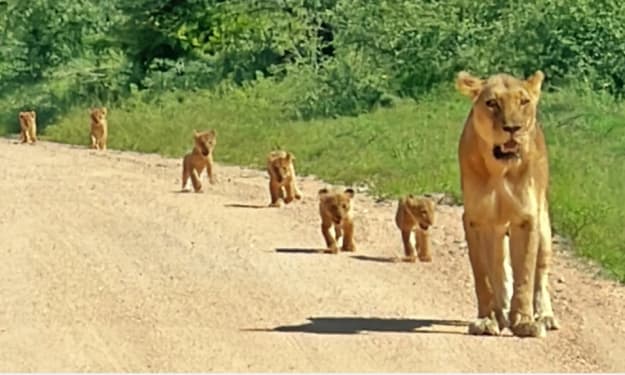
Tiny Lion Cubs Struggle To Keep Up With Mom
In the heart of the African savannah, life is a constant lesson for young animals. Few scenes are as endearing — or as heartwarming — as tiny lion cubs trying to keep pace with their mother. These little bundles of fur face a world full of challenges, from learning to hunt to avoiding dangers, all while depending on the guidance and protection of their experienced mom. Watching cubs wobble and tumble as they attempt to keep up with their mother reminds us that growing up, even in the wild, is a journey full of struggle, determination, and adorable missteps. The Early Days of Lion Cubs Lion cubs are born blind and helpless, usually in litters of two to six. For the first few weeks, they rely entirely on their mother for warmth, food, and safety. Even after opening their eyes and beginning to explore, the cubs are far from independent. The first months are crucial. Cubs learn social cues, hunting basics, and survival skills simply by watching their mother and the pride. But as anyone who has observed them knows, there’s often a huge gap between observation and action. Tiny cubs often struggle to match their mother’s pace, especially when she moves through long stretches of savannah or leads the family on patrols. A Mother’s Role in the Wild For a lioness, raising cubs is a full-time commitment. She hunts, defends her territory, and teaches her young, all while staying alert to predators such as hyenas, leopards, and even rival lions. The cubs, meanwhile, attempt to mimic her every move — often with clumsy yet charming results. A mother lion’s patience is remarkable; she frequently slows down, nudges them along, or stops to ensure no cub is left behind. These moments, while stressful for the tiny cubs, are vital learning opportunities. Struggling to Keep Up: Why It’s So Hard There are several reasons why tiny lion cubs have trouble keeping pace with their mother: Short Legs, Big Steps: Lion cubs’ legs are tiny and their coordination is limited, making it difficult to cover the same distance as an adult lioness. Curiosity: Cubs are naturally curious. A single butterfly or rustling bush can distract them, leaving mom to pause repeatedly. Energy Levels: Young lions tire quickly. Even with frequent naps, the cubs’ stamina is far lower than their mother’s. Learning Through Play: Play is not just fun; it teaches hunting, balance, and social skills. Running off to pounce on a sibling or chase an insect is all part of their education. Despite these challenges, the cubs’ determination to keep up demonstrates their resilience and growing understanding of the wild world. Lessons in Teamwork and Survival Every cub struggling to keep up is also learning crucial survival skills. The journey across the savannah is more than a test of speed — it’s a lesson in: Coordination: Cubs learn how to move efficiently across different terrains. Patience: They begin to understand the rhythms of adult life and the pace required for survival. Social Skills: Staying with the group teaches cubs how to interact with siblings and the pride, which is essential for their future roles. Observation: By following their mother, cubs study hunting techniques, territorial behavior, and predator awareness. Even the moments when cubs stumble or lag behind are essential for their development. These experiences prepare them for independence, which comes sooner than many might expect. The Cutest Moments in the Wild Anyone who has watched tiny lion cubs knows that their struggles are often irresistibly cute. Video clips from wildlife reserves frequently show cubs toddling along, tumbling over each other, or getting distracted mid-step. Observers often comment that these little stumbles reveal personality, determination, and playfulness, making them one of nature’s most heartwarming spectacles. While their mother is serious and focused, the cubs inject a sense of humor and lightness into life on the savannah. Why This Matters The struggles of lion cubs aren’t just adorable — they’re vital for understanding wildlife behavior. Conservationists and animal behaviorists use these moments to study growth patterns, social structures, and survival strategies in lion populations. These observations also highlight the importance of preserving natural habitats. Cubs must learn in a safe environment to survive; habitat loss, poaching, and climate change make these early struggles even more dangerous. Protecting the African savannah ensures that future generations of lions can experience the same lessons and playful tumbles. The Road to Independence Within a year, these tiny cubs will be more agile, faster, and more confident. By the time they reach two to three years old, males may begin to leave the pride, while females often stay and become caretakers themselves. Every misstep, tumble, and lagging moment is part of the journey toward strength, coordination, and independence. Watching them now gives us a glimpse of the challenges they will overcome, and the survival skills they will carry for life. A Celebration of Motherhood Ultimately, these scenes remind us of the incredible bond between mother and cubs. Her patience, vigilance, and teaching are the foundations of their future. The cubs’ struggles highlight the trials of growing up, while their determination showcases the resilience and beauty of wildlife. For those observing, it’s a powerful lesson in care, guidance, and perseverance, not just in lions but in the natural world as a whole. Final Thoughts Watching tiny lion cubs try to keep up with their mother is both entertaining and enlightening. It’s a story of growth, struggle, and resilience — a reminder that even the fiercest creatures start small, learning step by step. These little lions capture hearts while teaching life lessons: patience, determination, teamwork, and the importance of guidance. As they tumble and waddle across the savannah, they show us that growth is a process, one adorable misstep at a time. For wildlife enthusiasts, animal lovers, and anyone enchanted by nature, these tiny cubs are proof that even in the wild, love, care, and persistence are universal truths.
By Aarif Lashari2 days ago in Earth
Microbiota, microbiome or microflora: how to speak correctly and why it is for health.
You've probably heard the phrase, "We are what we eat." But modern science says more precisely: we are also those who live in us. Until 2016, it was believed that there are many times more bacteria in our body than our own cells. The latest calculations by mathematicians show that we divide the body with our microorganisms by about 50/50: about 30 trillion of our cells versus 38 trillion bacterial ones.
By Yaroslav Gorohov6 days ago in Earth



Comments
There are no comments for this story
Be the first to respond and start the conversation.