
“It Has Ventilation Systems, Food Storage, Nurseries, Toilets and Highways” – 11 Animals That Build Villages, Towns and Even Cities
From underground metropolises to towering tree-top apartments, these remarkable creatures prove that urban planning isn’t just a human skill
When we think of cities, we picture skyscrapers, highways, sewage systems, and carefully designed neighborhoods. Yet long before humans mastered architecture and infrastructure, animals were already building complex settlements complete with ventilation systems, food storage facilities, nurseries, waste management areas, and transportation routes.
Across deserts, forests, oceans, and grasslands, certain species construct communities so advanced that scientists often describe them as “cities.” These animal-built settlements are not random shelters — they are carefully engineered habitats designed for survival, cooperation, and efficiency.
Here are 11 extraordinary animals that build villages, towns, and even cities in the wild.
1. Ants – The Masters of Underground Cities
Ant colonies are among the most sophisticated societies in the animal kingdom. Beneath what appears to be a simple mound lies a vast underground network of tunnels and chambers. These colonies include specialized rooms for nurseries, food storage, and even designated waste disposal areas.
Some species build ventilation shafts that regulate temperature and airflow, ensuring the colony remains habitable. Leafcutter ants, for example, cultivate underground fungus farms — a remarkable example of agriculture in the insect world.
In certain regions, interconnected ant colonies form “supercolonies” stretching for miles, functioning like sprawling underground megacities.
2. Termites – Natural Architects with Climate Control
Termite mounds can rise several meters high and are among nature’s most impressive architectural achievements. Inside, termites construct intricate tunnel systems that maintain stable temperature and humidity levels, even when external conditions fluctuate dramatically.
These mounds feature ventilation systems that circulate air throughout the colony, preventing overheating. Some species even design structures aligned with the sun to optimize thermal regulation — a strategy that has inspired modern sustainable architecture.
3. Prairie Dogs – Grassland Town Planners
Prairie dogs create extensive underground towns across North American grasslands. Their burrow systems include sleeping chambers, nurseries, and lookout posts. Separate entrances allow for quick escape from predators.
Large prairie dog colonies, sometimes called “towns,” can cover hundreds of acres and house thousands of individuals. The tunnels are carefully engineered to prevent flooding, demonstrating impressive environmental awareness.
4. Beavers – Engineers of Water Cities
Beavers are famous for building dams, but their engineering skills extend far beyond that. By constructing dams across rivers and streams, beavers create ponds that serve as protective barriers against predators.
Within these ponds, they build lodges made of sticks and mud. These lodges have underwater entrances for safety and dry interior chambers for resting and raising young. The ponds also function as food storage areas, where branches are submerged for winter consumption.
Beaver communities transform entire ecosystems, creating wetland “towns” that benefit numerous other species.
5. Naked Mole Rats – Subterranean Societies
Naked mole rats live in highly organized underground colonies in East Africa. Their tunnel networks can stretch for miles and contain specialized chambers for sleeping, food storage, and raising young.
Like ants and bees, naked mole rats operate under a social hierarchy, with a single breeding queen and worker groups responsible for different tasks. Their elaborate tunnel systems function much like underground cities.
6. Weaver Ants – Leaf Architects
Weaver ants build intricate nests in trees by stitching leaves together using silk produced by their larvae. Entire colonies may inhabit interconnected leaf structures forming a canopy-level community.
These nests protect the ants from predators and harsh weather while allowing efficient movement across branches — effectively forming a treetop village.
7. Honeybees – Organized Vertical Cities
A beehive is a marvel of structural efficiency. Built from hexagonal wax cells, honeybee colonies include designated areas for storing honey, pollen, and raising larvae.
The hive maintains strict temperature control, with worker bees fanning their wings to regulate airflow. The highly organized structure and division of labor make bee colonies function much like vertical cities with specialized zones.
8. Wasps – Paper Apartment Complexes
Certain wasp species construct multi-layered nests from chewed wood fibers, forming paper-like structures. These nests often hang from trees or rooftops and contain hexagonal cells for raising young.
Each nest operates as a tightly organized housing complex, with different levels serving distinct purposes within the colony.
9. Meerkats – Cooperative Burrow Communities
Meerkats dig complex burrow systems in arid regions of Africa. These underground homes contain multiple entrances, sleeping chambers, and lookout points.
Living in social groups, meerkats assign sentinels to guard the colony while others forage. Their cooperative lifestyle turns simple burrows into organized desert settlements.
10. Coral Polyps – Builders of Underwater Cities
Coral reefs are among the most spectacular animal-built structures on Earth. Tiny coral polyps secrete calcium carbonate to form hard exoskeletons, which accumulate over generations to create massive reef systems.
These underwater “cities” provide shelter and resources for thousands of marine species. Some reefs are so large they can be seen from space, making them among the planet’s greatest natural constructions.
11. Sociable Weavers – Apartment Blocks in Trees
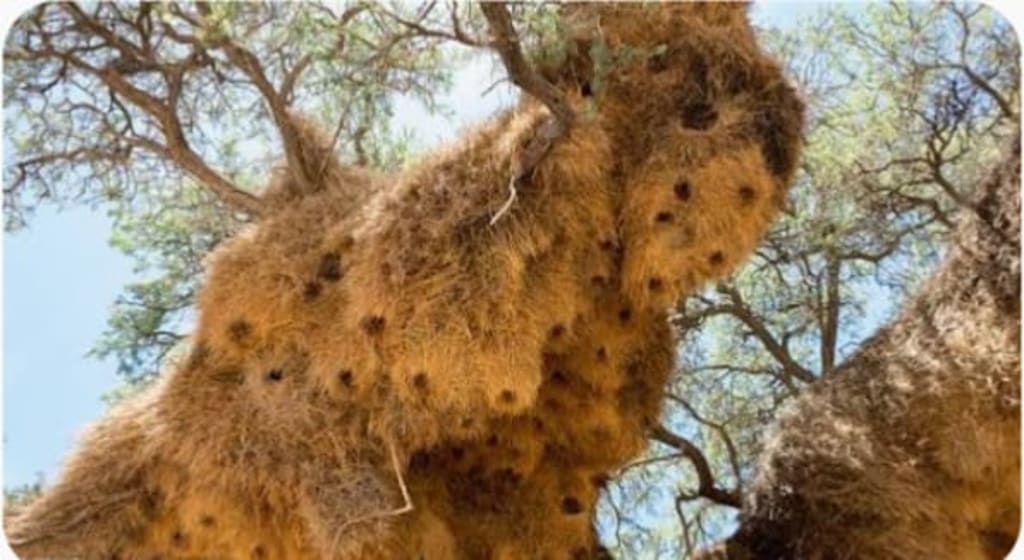
Native to southern Africa, sociable weavers construct enormous communal nests in trees or on utility poles. These structures can house hundreds of birds and persist for decades.
The nests contain multiple chambers, with interior rooms providing warmth during cold nights and outer chambers offering ventilation in hot weather. From a distance, these massive constructions resemble haystack-shaped apartment complexes.
Nature’s Urban Planners
These remarkable animals demonstrate that the principles of urban planning — ventilation, food storage, nurseries, waste management, and transportation routes — are not uniquely human inventions. Instead, they are solutions evolved over millions of years to meet the challenges of survival.
Animal-built cities highlight the power of cooperation and specialization. Whether through instinct or social hierarchy, these creatures construct environments that maximize efficiency, safety, and sustainability.
In many cases, their designs even inspire human innovation. Architects have studied termite mounds for climate control strategies, while beaver-engineered wetlands inform environmental conservation practices.
Nature’s builders remind us that civilization, in its many forms, extends far beyond humanity. Beneath our feet, high in the trees, and deep under the sea, thriving animal cities continue to grow — complete with highways, nurseries, storage systems, and carefully designed homes.
The next time you pass an ant hill or notice a beehive, consider this: you may be looking at a bustling metropolis, crafted by some of the smallest yet most remarkable engineers on Earth.
About the Creator
Keep reading
More stories from Ayesha Lashari and writers in Earth and other communities.
FCC Greenlights Massive Expansion of Amazon Leo Satellite Network
In a game-changing move for satellite broadband, the U.S. Federal Communications Commission (FCC) has approved Amazon’s plan to significantly expand its Amazon Leo low Earth orbit (LEO) satellite constellation. This approval allows Amazon to launch roughly 4,500 additional satellites, bringing the total network to nearly 7,736 spacecraft. It’s a bold step toward challenging SpaceX’s Starlink and pushing forward Amazon’s vision of global internet connectivity.
By Ayesha Lasharia day ago in Earth
The Terrarium Toolkit: AI Helps You Build and Maintain a Miniature World
You assemble layers of earth, carefully position tiny plants, and add decorative stones, culminating in the moment you place the glass lid or front panel. You've created more than a decoration; you've built a miniature, self-contained world. Yet, weeks later, that world can become clouded—literally. Condensation obscures the view, mold appears on the soil, or a once-vibrant plant turns to mush. The delicate balance you sought has tipped.
By Emma Wallace7 days ago in Earth




Comments
There are no comments for this story
Be the first to respond and start the conversation.