
Is there still a lot of water hidden in the Martian crust? Another discovery by NASA may overturn previous inferences
There is still a lot of water hidden in the Martian crust

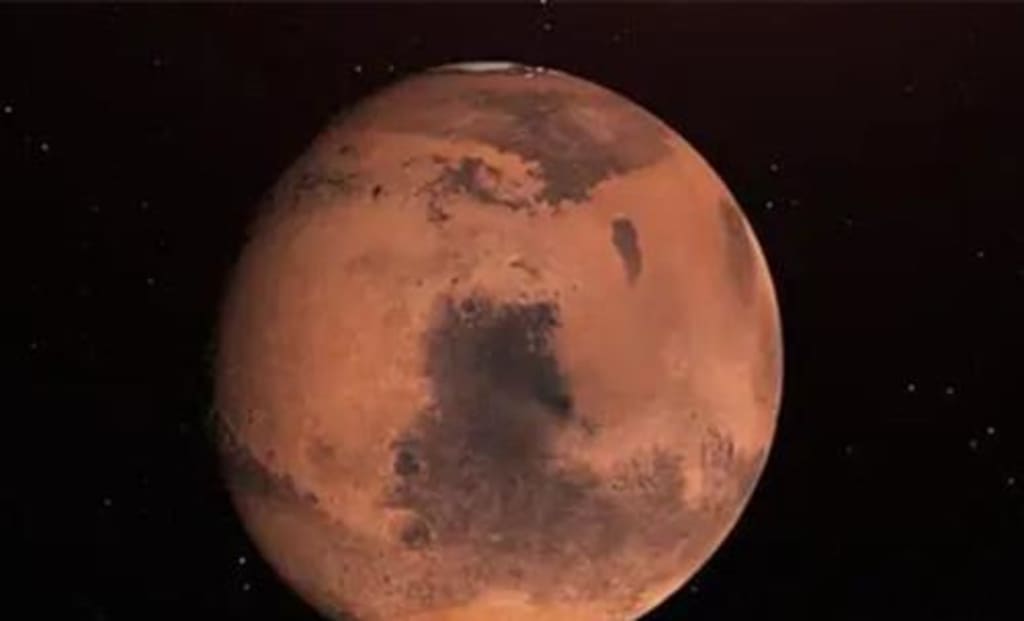
It has been 64 years since the first man-made satellite was launched in 1957. During these 64 years, the pace of human exploration of the universe has been accelerating, not only giving us a better understanding of the solar system, but also He also set his sights on more distant galaxies.
So in these 64 years, which planet has mankind explored the most? Seeing this question, I believe that many friends will think of Mars for the first time. Yes, although Mars is not the first planet that humans have explored since they left the earth, it is the planet that humans have explored the most, and the planet we know the most about.
In fact, after humans walked out of the earth, the first planet to explore was the moon, the satellite of the earth. The Apollo program of the United States successfully sent astronauts to the moon in 1969, realizing the first step in human exploration of alien planets. This can be said to be a big step for mankind. After exploring the moon, the first planet to be explored by mankind is Earth's neighbor Venus.
However, when the probe reached Venus, it was discovered that the environment of Venus is far worse than expected. This is a purgatory planet with a surface temperature of up to 460 degrees Celsius, and there is a very thick atmosphere and acid rain layer, complex and harsh. The environment makes it difficult for our probes to land, and it's impossible to get a clear view of the surface of Venus from orbit.
The harsh environment of Venus hindered human exploration. In the end, scientists had to abandon Venus and focus on Mars. Compared with Venus, the environment of Mars is much better. The thin atmosphere allows us to observe some conditions on the surface through orbiting probes. More importantly, the Mars rover can land on the surface of Mars for long-term mobile detection. This way we can get a close-up clear picture of the Martian surface.
In more than half a century, humans have launched a lot of probes to Mars. Through the continuous exploration and discovery of these probes, we have learned more and more about Mars. Humans' first impression of Mars is desolation. The surface of this red planet is very similar to the desert environment on Earth. It is dry and desolate and there are often large sandstorms.
With the increasing understanding of Mars, many scientists regard Mars as the second home of mankind, hoping to transform it into a habitable planet through transformation. So is it possible for Mars to be successfully transformed? If you want to turn the Martian desert into an oasis, then sufficient water sources are essential, but through the exploration of the probe, except for some ice caps found at the poles of Mars, no water sources have been found elsewhere.
The surface of Mars is indeed very desolate now, and there is no liquid water, so is it the same with Mars in ancient times? Through the probe, scientists have discovered a large number of ancient rivers on the surface of Mars. The width of these rivers is twice or more than that of the earth. This shows that the surface of Mars in ancient times also had a lot of water, which may even be more than the water resources of the earth. To be rich.
According to various observational data, scientists believe that Mars was a planet with sufficient water sources in the past, but 3.7-4.1 billion years ago, a large amount of water evaporated on the surface of Mars, and the evaporation rate was as high as 40-95%. As for why this happens? Scientists are currently unable to give a reasonable answer, and more are just some conjectures.
It turned out that scientists believed that all the water resources on the surface of Mars evaporated into space, leaving only a small amount of water ice at the poles. However, according to a research report released by the latest NASA space agency, all our previous inferences may be wrong. There may still be a large amount of water on Mars, which is not evaporated, but is hidden in the crust.
This situation is similar to the Sahara Desert on Earth. You must know that the surface of the Sahara Desert is dry and has no water source. However, scientists have found that there are a lot of water resources hidden in the deep crust of the Sahara Desert.
Such a discovery is undoubtedly great news for mankind. Mars has many similarities with Earth. Although the environment is harsh, it still has the potential to transform and become the second home of mankind. However, the transformation requires a lot of water resources. If there is no water on Mars, the possibility of successful transformation will be very small, and even if it can be transformed, the cost will be very large.
If Mars has no water, then we need to transport water from the earth or other water-rich planets. This project will be very large and difficult. However, through further research and exploration, scientists now speculate that there is still a large amount of water stored in the crust of Mars, so the difficulty of transforming Mars will be greatly reduced.
You must know that water is the source of life. With water, there will be no shortage of water for us to establish a preliminary survival base on Mars in the future, and the decomposition of water can generate oxygen to meet human needs for oxygen. More importantly, with water, we can grow various plants on Mars, and a large number of plants can release oxygen to further transform the ecological environment of the atmosphere.
With water, life may exist. For a long time, human beings have an important expectation for the exploration of Mars, that is, to discover life on Mars. But so far, we have not found anything, so can the surface environment of Mars allow some life to survive?
This year, a new research result was brought to the cooperation project between NASA and the German Space Center. The researchers sent the microbe to the stratosphere to observe its state on Mars, and the results showed that microbes on Earth can survive on the surface of Mars.
This experiment shows that the surface environment of Mars is not a complete forbidden zone for life. Since microorganisms can survive, other more complex organisms may also survive, which strengthens our expectations for the possible existence of life on Mars.
What's more, life can not only survive on the surface, it can also survive inside the earth's crust. You must know that there is also a lot of life inside the earth's crust, and their number may be much larger than that of surface organisms. There is naturally a source of water in the earth's crust, and these life forms depend on the environment inside the earth to survive.
Then there may be a large amount of water stored in the Martian crust, so it is entirely possible for some primitive life to be born in this environment. Therefore, many people believe that there is life on Mars. As long as the exploration continues, it may not be long before major discoveries will be made.
The new research report released by NASA this time found that it has undoubtedly inspired human expectations for Mars. In the near future, we will establish a base on Mars, and then introduce the water resources in the crust to the surface of Mars for preliminary transformation. Planet, a large number of human beings have migrated to Mars to survive, and also prepare a retreat for the future of human beings.
About the Creator
gaut chen
share some science stories
We Outpaced the Soil
We learned how to move faster than the ground beneath us. At first, it felt like progress. Roads unrolled like promises, machines hummed with the confidence of certainty, and cities rose as if the earth itself had agreed to carry our weight. We measured time in minutes saved, distances conquered, yields multiplied. We learned to outpace the seasons, to outsmart rain, to hurry seeds into obedience. We learned to treat the soil like a resource instead of a relationship.
By Jhon smithabout 17 hours ago in Earth


Comments
There are no comments for this story
Be the first to respond and start the conversation.