
Is the sun suspended in the universe?
What exists above and below the solar system?

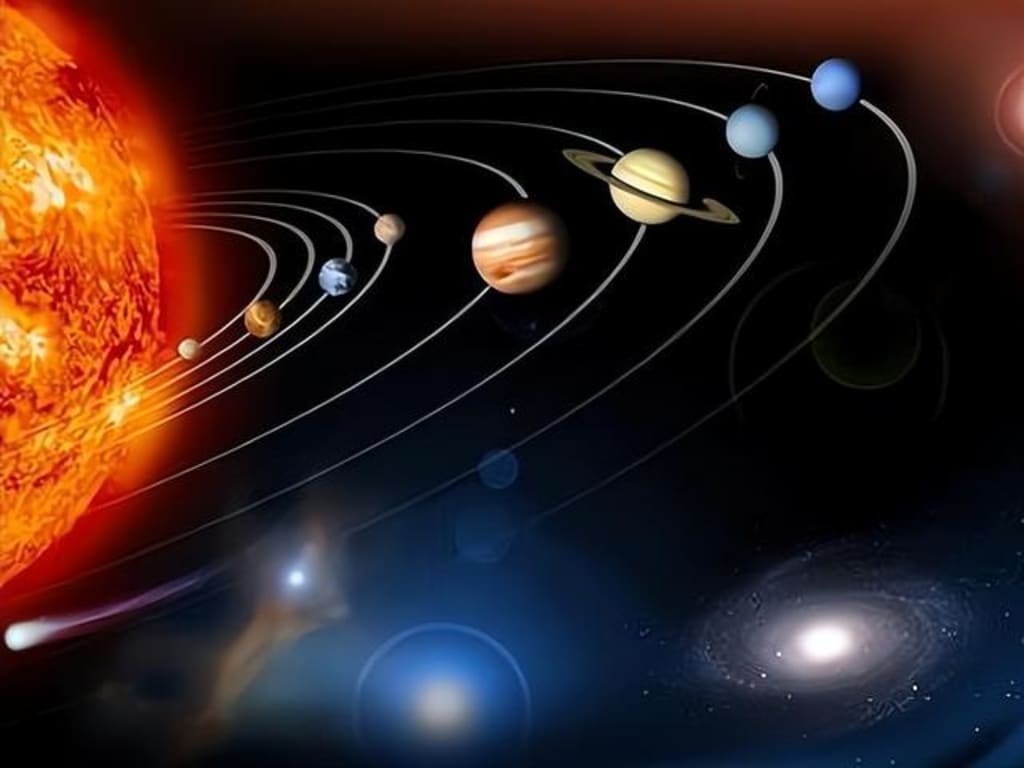
We often imagine the solar system as if the Sun were at the center of the solar system, not moving, while the eight planets and many other bodies in the solar system are orbiting the Sun in an orderly manner, with the Earth as one of them, which begs the question, is the Sun suspended in the universe?
The answer is, of course, no. The Sun is not as fixed in the universe as one might think. It has been leading many bodies in our solar system to revolve around the center of our galaxy at a speed of about 230 kilometers per second.
Interestingly, since the plane of the Sun's orbit has an angle of about 60 degrees to the ecliptic plane of the solar system (i.e., the plane of the Earth's orbit around the Sun), the actual motion of the solar system should look like this.
It can be seen that the Sun is not suspended in the universe those images we often see of the Sun fixed and immobile are simplifications to facilitate a more intuitive understanding of the solar system.
Okay, let's see what is above and below the solar system. First we need, to define which direction is "above" and "below" the solar system, after all, the so-called "above" and "below" are "and "below" are defined by humans themselves. First, let's look at a chart.
I believe that we can see at a glance, that the planet is the Earth, but with a closer look, I believe we will feel that this picture is not normal, why? Because this picture "above" is the southern hemisphere, while the "bottom" is the northern hemisphere. If you look at this picture upside down, we will feel very "normal".
This is actually our human habit, generally speaking, we default to "north and south", so we can also define that the "north" of the solar system is "above" and "south" is "above". "South" is "below". But the question is, which direction are the "north" and "south" of the solar system?
In fact, in astronomy, to avoid confusion between the definitions of "north" and "south", it is common to use a method called the "right-hand rule" to define the "north" and "south" of a celestial body. "North" and "South".
As shown above, if we use the four fingers of our right hand to indicate the direction of rotation of a celestial body, then the thumb of our right hand is pointing to the north pole of the celestial body.
In the solar system, the equatorial plane of the sun and the ecliptic plane of the solar system coincide, and the direction of the sun's rotation also coincides with the direction of rotation of the eight planets in the solar system, so we can also use the "right-hand rule" to define the "north" and "south" of the solar system. "South".
So the direction of the "North Yellow Pole" in the above diagram can be considered as the "North" of the solar system, while the direction of the "North Celestial Pole" can be considered as the "North" of the Earth. "The reason for the difference is that the rotation axis of the Earth is not perpendicular to the ecliptic plane of the solar system.
According to our habit of "north up and south down", we can define the direction of "north ecliptic" as "above" the solar system, and the opposite direction as "below" the solar system. "below".
Astronomers usually do the same when depicting the distribution of objects in the vicinity of the solar system, and the following diagram shows the known stars within 12.5 light-years of the solar system.
As you can see, there are no stars in the upper part of the solar system, which means that there is nothing in this region except for very thin interstellar matter and the occasional "passing" wandering object.
Below the solar system, there is a star system labeled "alpha Centauri".
This star system is actually "South Gate II" (also known as Alpha Centauri), which contains three stars, including "Alpha Centauri A" and "Alpha Centauri B A" and "B" are both yellow dwarfs about the size of the Sun, and they form a stable binary system orbiting each other (closest distance is about 11.2 astronomical units and farthest distance is about 35.6 astronomical units).
At a distance of about 13,000 astronomical units from this binary system, there is another faint red dwarf star orbiting them, the nearest star, Proxima Centauri.
It is worth noting that Proxima has three planets, one of which is a rocky planet named Proxima b. Observations show that this planet has a radius of 1.07 (±0.35) times that of Earth, a mass of about 1.17 times that of Earth, and, more importantly, that More importantly, "Proxima b" is located in the habitable zone of its host star, which means that there is a possibility of life on this planet.
About the Creator
Robert Jack
One of the secrets of emotional stability for adults is to keep the expectations of others to a minimum.
Keep reading
More stories from Robert Jack and writers in Earth and other communities.
Humans have reached the second level of civilization in the universe
If someone asks, are humans alone in the universe? I believe that most people will give a negative answer. The scientific community also generally believes that in the vast universe, there should be a large number of intelligent civilizations, some of which may even be far ahead of our human civilization, to better describe the level of technology of intelligent civilizations in the universe, scientists also put forward the concept of "cosmic civilization level".
By Robert Jack4 years ago in Earth
Stephen Hawking’s Final Advice to Humanity
Few scientists have captured the imagination of the world quite like Stephen Hawking. Known for his groundbreaking work on black holes and cosmology, Hawking spent his life exploring the deepest mysteries of the universe. Even after being diagnosed with Amyotrophic Lateral Sclerosis (ALS) at the age of 21—a condition that gradually paralyzed him—he continued to produce revolutionary ideas that changed modern science.
By Irshad Abbasi 6 days ago in Earth
Worth the Wait: Puerto Viejo, Costa Rica
Beach bumming in a small Caribbean beach town sounded like a perfect way to end our 6-month trip through Mexico and Central America. Or so we thought. The foul, fishy stench of rotten seaweed hit our nostrils as we stepped from the cramped bus and looked out at a rather depressing, empty, and underwhelming black sand beach. It was pouring with rain, and we had to quickly fish out our ponchos. We thought, this couldn’t be it, could it?
By Sh*t Happens - Lost Girl Travel6 days ago in Wander


Comments
There are no comments for this story
Be the first to respond and start the conversation.