
Invasion of the Spice Finches
I for one welcome our scaly-breasted overlords

They blew in with a fall flock of Red-Winged Blackbirds. The Red-Wings, who often segregate themselves by sex, were an all-male crew. Rowdy, flashing their red epaulets, singing as tunefully as any rusty hinge you’ve ever heard.
But these little birds were scruffy brown finches devoid of field marks. Juveniles, I thought. Society finches. Somebody’s aviary blew down somewhere.
Only…
Society finches, long domesticated, are various. Fawn, and blond, and white, and chocolate. Pied with markings unique to the individual. Some are crested birds who boast full Beatles mops.
These birds were remarkable mainly in how unremarkable they were.
I live in southeast Louisiana. A few days later, a birder who lived to my east — closer to the Louisiana/Mississippi border and the Pearl River Wildlife Management Area — mentioned she’d seen a flock of Scaly-Breasted Munias fly in with her migrating Red-Wings. Others chimed in to say the same.
Mystery solved. I’d seen a post-breeding flock of juvenile Scaly-Breasts.
Except…
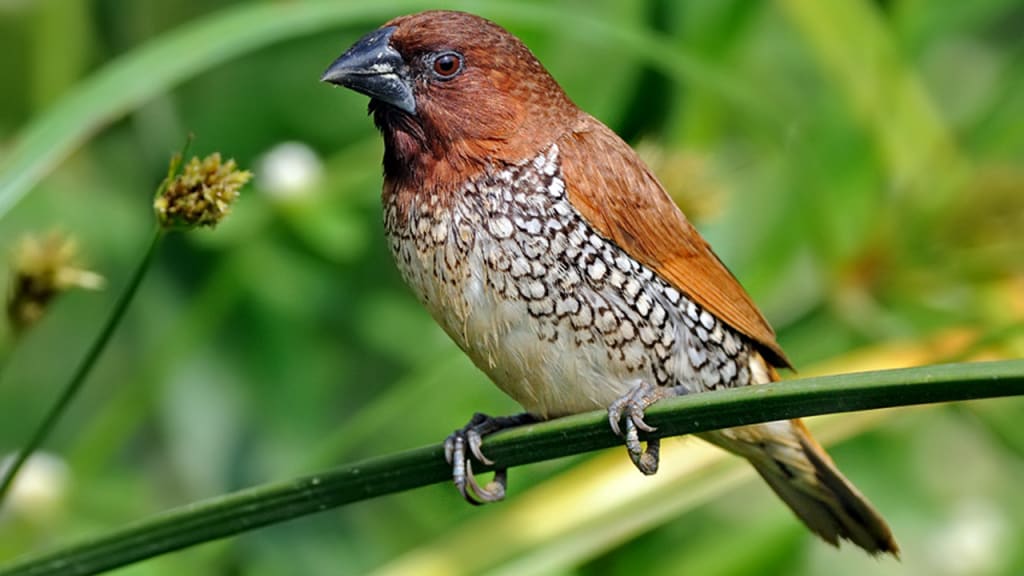
The Scaly-Breasted Munia (also known as the Nutmeg Mannikin or Spice Finch) is a wide-ranging little finch native to tropical Asia. It landed on my life list in January 2007 when I observed a long introduced population grazing on the lawn in a park in Honolulu. In late 2015, I also observed it in rural Nepal, where I presume it’s a legitimate native.
What was it doing in my backyard?
Finches on the move
Whatever did we do before Twitter? I dropped into a discussion of the mysterious little finches, which a lot of people had been seeing, and someone linked me to an article in Mississippi Kite called, Establishment and Spread of the Scaly-Breasted Munia (Lonchura punctulata) in Mississippi by Susan Epps and Jason D. Hoeksema.
Beginning in 2010, the Scaly-Breasts were first seen in Diamondhead, Hancock County — Mississippi’s most western coastal county. Then they began to be reported from the other two coastal counties, Harrison and Jackson.
Susan Epps was able to identity the population down to the subspecies level, L. p. punctulata — “native to Pakistan, India, and Sri Lanka.” Beyond that, she found a nearby pet store selling that very subspecies for less than twenty bucks a bird.
The authors also collected reports of other Southern populations. To the east, they’ve been breeding in Florida for over a decade. Another cluster of reports centered on Houston, Texas, hundreds of miles to the west.
An origin story
The Texas birds came with a story.
You see, it has become unfashionable to throw rice at weddings. If you’re a birder, you already know birds don’t explode from eating rice. But, alas, the urban legend claiming they did became wildly popular. To this day, many people continue to believe throwing rice is Wrong and Bad.
Some people swapped to releasing balloons. Uh-oh. That actually is Wrong and Bad. You’re basically releasing wildlife-killing trash into the environment. So people are stepping away from balloons too.
White doves can be hired for release. If they’re the right kind of doves (white Homing Pigeons), they’ll return to their trainer later. All is well.
Alas, not all white doves are Homing Pigeons. Many are inexpensive domesticated Ringneck Doves, fine for pulling from your magician’s hat but about as likely to survive being “released” into the wild as you or I.
So this practice too became controversial.
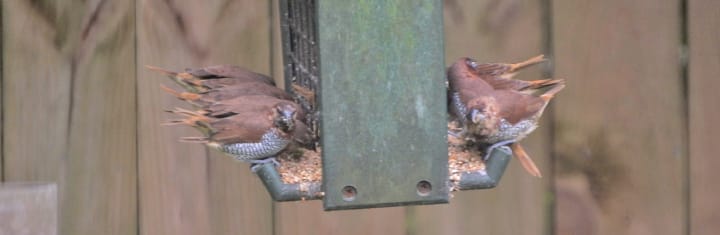
Thus, in Houston, over the last couple decades or so, some people have chosen to quietly release Scaly-Breasted Munias instead. Finches don’t “home,” and the happy couple or the trainer will not be getting the birds back. But they do seem to be adapting to the wild — at least if you include suburban bird feeders in your definition of the wild. These little cereal eaters do like to get beak deep in some millet.
In their native lands, the birds are known as a rice pest. A new controversy may come if and when the birds march into southwestern Louisiana where rice is grown. But, as long as they’re content to hang out at backyard feeders chowing down on millet, I don’t expect many people to complain. Most people won’t even notice one more tiny brown bird.
At the time the Mississippi Kite article was written, the authors preferred to say the source of the Mississippi birds was unknown.
But a reader can’t help but have her suspicions. That pet shop? That inexpensive price? Somebody’s buying and releasing for wedding luck.
The future of an introduced species
Are Scaly-Breasted Munias now breeding in Louisiana? Specifically, are they breeding in or around my yard? Much earlier in the spring, I was getting visits from a pair, rather than from a flock. Then they went quiet.
Epps reported her Diamondhead birds bred in late April and May — about the time my birds seemed to disappear.
If they have a nest, they’re very careful not to let me find it. Or, perhaps, they’ve gone back to build it in Mississippi.
I watch. I wait. And I wonder. Maybe you should be watching your feeders too. The image below compares wild juvenile Scaly-breasted Munias (one of those Little Brown Jobs without much in the way of field marks) to some of my domestic-bred Society Finches. In bad light, or if you only catch a glimpse, you could confuse your new Spice Finch overlords with lost Societies, but you'll figure it out eventually.
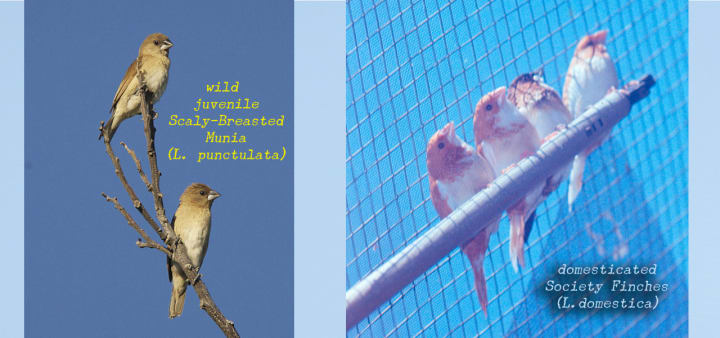
Need the live links to those Creative Commons Photos? Feature Image: “Scaly breasted Munia” by T_Monk / Bottom Left Image SB Munia Juveniles by Lip Kee / Both items CC BY 2.0
If you enjoyed this story, gently tap the <3 to let me know. A small tip is always appreciated too.
About the Creator
Amethyst Qu
Seeker, traveler, birder, crystal collector, photographer. I sometimes visit the mysterious side of life. Author of "The Moldavite Message" and "Crystal Magick, Meditation, and Manifestation."
https://linktr.ee/amethystqu
Keep reading
More stories from Amethyst Qu and writers in Earth and other communities.
Ghana Wheat Market Size & Forecast 2025–2033
Introduction Ghana’s wheat market is steadily emerging as an essential segment of the country’s food economy. Driven by rapid urbanization, changing dietary habits, and the expansion of bakeries, fast-food outlets, and packaged food manufacturing, wheat has become a key ingredient in everyday Ghanaian diets. According to Renub Research, the Ghana wheat market was valued at US$ 46.20 million in 2024 and is projected to reach US$ 79.89 million by 2033, growing at a compound annual growth rate (CAGR) of 6.27% during 2025–2033.
By Marthan Sir3 days ago in Earth
Met Office Issues Yellow Fog Warnings After Parts of UK Battered by Rain
After days of relentless rainfall sweeping across large parts of the United Kingdom, the Met Office has issued yellow fog warnings, cautioning residents and travelers to prepare for reduced visibility and hazardous conditions. The sudden shift from heavy rain to dense fog highlights the volatile nature of the UK’s winter weather and underscores the challenges it poses to transport, public safety, and daily life. From Heavy Rain to Thick Fog The recent spell of intense rain saturated the ground across England, Wales, and parts of Scotland, leaving rivers swollen and fields waterlogged. As calmer weather followed the downpours, a combination of high moisture levels, falling temperatures, and light winds created ideal conditions for fog formation. According to meteorologists, this type of fog—often called radiation fog—develops when moisture near the ground condenses overnight, forming thick, low-lying clouds that can linger well into the morning. The Met Office’s yellow warning signals that fog could significantly reduce visibility, in some areas dropping below 100 meters. While not the most severe level of weather alert, yellow warnings are designed to prompt awareness and caution, particularly for motorists, cyclists, and pedestrians who may be caught off guard during early morning commutes. Travel Disruptions and Safety Concerns Fog is one of the most dangerous weather conditions for road travel, as it can dramatically shorten reaction times and obscure hazards. Authorities have urged drivers to slow down, use fog lights appropriately, and maintain greater distances between vehicles. Motorways and rural roads alike are vulnerable, with sudden patches of thick fog appearing without much warning. Rail services may also experience delays, as drivers are required to reduce speeds when visibility drops. At airports, fog can disrupt flight schedules, causing delays or cancellations, particularly during peak morning hours. Aviation authorities closely monitor visibility thresholds, and even a short-lived fog bank can ripple through tightly scheduled operations. Emergency services have emphasized that pedestrians and cyclists should wear reflective clothing where possible, especially during early mornings and evenings. With darker winter days already limiting visibility, fog compounds the risks for vulnerable road users. Why Fog Follows Heavy Rain Meteorologists explain that fog warnings often follow periods of heavy rainfall. When rain saturates the ground, it leaves behind large amounts of surface moisture. If skies then clear and winds ease, the ground cools rapidly overnight, allowing moisture to condense into fog. This pattern is becoming increasingly familiar in the UK, where weather systems are growing more erratic. Climate scientists note that a warming atmosphere holds more moisture, increasing the likelihood of intense rainfall events followed by fog, frost, or sudden temperature drops. Regional Impact Across the UK The yellow fog warnings are not uniform across the country. Low-lying areas, river valleys, and rural regions are particularly susceptible. Parts of southern England, the Midlands, and eastern regions are among those most at risk, though localized fog could appear almost anywhere conditions align. In Scotland and northern England, lingering wet ground combined with colder overnight temperatures raises the possibility of fog forming alongside icy patches. This mix of hazards further complicates travel and increases the risk of accidents. What a Yellow Warning Really Means A yellow weather warning does not mean severe disruption is guaranteed, but it does indicate a heightened likelihood of impacts. The Met Office uses yellow alerts to encourage the public to stay informed and take sensible precautions. For fog, that means checking travel updates, allowing extra journey time, and staying alert to rapidly changing conditions. Weather experts stress that fog can be highly variable. One area may experience clear skies while another, just a few miles away, is blanketed in thick mist. This unpredictability is what makes fog particularly dangerous. Looking Ahead: More Changeable Weather Forecasts suggest that unsettled weather will continue in the coming days, with further spells of rain interspersed with calmer, colder nights—conditions that could lead to additional fog warnings. While no prolonged severe weather is currently expected, the pattern reflects the broader trend of increasingly changeable winters in the UK. For many residents, this serves as another reminder that winter weather is no longer defined by just cold or snow. Instead, a mix of heavy rain, flooding risks, fog, and sudden temperature shifts is becoming the new normal. Staying Prepared The Met Office advises the public to regularly check forecasts, especially before traveling, and to remain flexible with plans during periods of weather warnings. Simple measures—such as cleaning car windows, ensuring lights are functioning, and staying updated via official channels—can significantly reduce risk. As the UK continues to navigate this wet and fog-prone winter, awareness and preparation remain the best defenses. While the fog may lift by midday in many areas, its early impact serves as a timely reminder that even seemingly mild weather hazards can have serious consequences.
By Fiaz Ahmed a day ago in Earth


Comments