
Inside Russia’s Historic 8.8 Quake
🧭 A powerful earthquake rattled Russia’s Far East, triggering tsunami alerts and testing the nation’s resilience. But the real story is what didn’t happen.

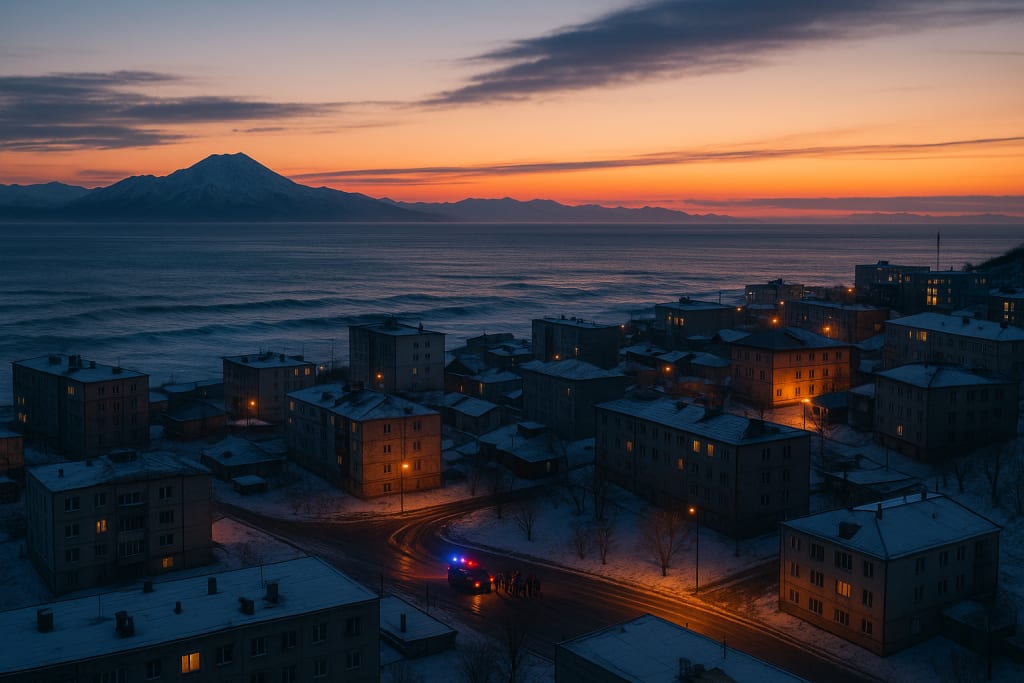
When the Ground Moved, the World Watched
On July 29, 2025, the people of Russia’s remote Kamchatka Peninsula felt the kind of tremor that usually leads to tragedy.
A massive 8.8 magnitude earthquake, centered 120 kilometers southeast of Petropavlovsk-Kamchatsky, struck the seabed beneath the Pacific Ocean. The quake lasted just under three minutes, but its ripples were felt across continents — and not just physically.
Phones buzzed. Sirens wailed. Families gathered in doorways, stairwells, and open fields. And for a terrifying moment, it felt like history was about to repeat itself.
But then… it didn’t.
The Silence That Followed
In an age of instant catastrophe coverage, global news networks were bracing for scenes of chaos. But instead of crumbled hospitals, collapsed schools, and body bags, they got something unexpected: resilience.
Yes, buildings swayed. Streets cracked. Power lines blinked. But no fatalities were reported.
The tsunami that followed was real — waves of up to 5 meters struck the Kuril Islands and flooded portions of Severo-Kurilsk. More than 3 million people were evacuated from coastlines in Japan, Chile, Hawaii, and Alaska. But no widespread destruction was seen. No cities flattened. No refugee camps.
What Made the Difference?
This wasn’t luck.
Kremlin officials credited years of earthquake preparedness, investments in reinforced infrastructure, and public education efforts.
“We’ve studied every disaster — from Turkey to Fukushima,” said Kremlin spokesperson Dmitry Peskov. “This is what learning looks like.”
Indeed, Russia had turned its tragic past into preparation. After the devastating 1952 Severo-Kurilsk quake, which killed over 2,300 people, the region began enforcing stricter building codes and early warning systems.
In 2020, Kamchatka implemented a smart alert system powered by seismographic AI. It was this system that sent out tsunami warnings just 70 seconds after the quake’s detection.
That alert saved lives.
The Heroes in the Operating Room
One of the most remarkable stories came not from a collapsed building, but from a surgical table.
At the Kamchatka Oncology Center, a team of doctors were in the middle of a complex tumor removal when the quake struck. As walls trembled and lights flickered, the team didn’t flinch. They stabilized the patient, braced their equipment, and completed the procedure.
“It wasn’t just about medicine. It was about humanity,” said Dr. Alina Mirova. “In that moment, we weren’t doctors. We were hope.”
A History of Tremors, A Future of Resilience
The Kamchatka Peninsula is one of the most seismically active regions on Earth, part of the infamous “Pacific Ring of Fire.” For centuries, residents have lived with the knowledge that the ground beneath them is alive.
In 1737, a 9.3 magnitude quake struck the same region, triggering a tsunami that erased entire settlements. Again in 1841, thousands perished.
But this time, Russia was ready.
Old homes had been retrofitted. Schools practiced monthly drills. Bridges were rebuilt with flexible foundations. Emergency shelters were stocked and tested.
This was not luck. This was engineering, foresight, and hard-earned wisdom.
Why This Story Matters — Even Without Casualties
You might wonder why we’re telling this story so loudly when no one died.
But maybe that’s exactly why we should.
Disasters aren’t only about loss — they’re about what was prevented, what we learned, and how people stood firm. In a world constantly bracing for the worst, Russia showed what happens when you plan for the inevitable and still dare to hope.
There’s something deeply human in watching a building stand where it once would’ve fallen. In seeing a family walk home after sirens fade. In witnessing an entire coastline brace for impact… and then breathe again.
The Takeaway
Key Fact Detail
Date July 29, 2025
Magnitude 8.8
Location Offshore, Kamchatka Peninsula
Depth 19–20 km
Tsunami 3–5 meters, across the Pacific Rim
Casualties None confirmed
Response Time Tsunami alert in 70 seconds
Rescue Impact 3M+ people evacuated across 6 countries
Infrastructure Minimal damage due to reinforced buildings
Final Thoughts
This was more than a natural disaster. It was a quiet victory for science, humanity, and preparation.
In the aftermath of the Kamchatka Quake, we saw not just what Earth can do — but what people can endure, prevent, and protect.
It’s a rare thing, to report on a disaster and feel hope instead of sorrow.
But this is one of those stories.
About the Creator
Ahmet Kıvanç Demirkıran
As a technology and innovation enthusiast, I aim to bring fresh perspectives to my readers, drawing from my experience.
Keep reading
More stories from Ahmet Kıvanç Demirkıran and writers in Earth and other communities.
Tornado Outbreak in the U.S.: Nature’s Wrath Unleashed
On May 15 and 16, 2025, the American Midwest and Southeast witnessed one of the most violent and widespread tornado outbreaks in recent history. A staggering 55 tornadoes ripped through multiple states, leaving behind a trail of destruction, death, and despair. With 27 confirmed fatalities and damages exceeding $1.2 billion, this two-day catastrophe underscores the growing unpredictability of extreme weather events in the era of climate change.
By Ahmet Kıvanç Demirkıran8 months ago in Earth
Stanislav Kondrashov on the Backbone of the Energy Transition: Why Strategic Infrastructures Matter Now More Than Ever
As the world steadily moves away from traditional fuels and toward renewable energy sources, one truth is becoming increasingly clear: the energy transition is not just about new technologies—it's about the infrastructures that support them. For energy systems to evolve in a meaningful, lasting way, the scaffolding beneath them must be reimagined, reinforced, and in some cases, rebuilt entirely.
By Stanislav Kondrashov4 days ago in Earth
Gunmen Raid Village in Northern Nigeria, Killing at Least 30 People and Abducting Others
Northern Nigeria has once again been plunged into mourning after gunmen raided a rural village, killing at least 30 people and abducting several others, according to local authorities and residents. The deadly assault is the latest in a long series of violent attacks that have turned large parts of the region into zones of fear, displacement, and chronic instability. The incident underscores Nigeria’s deepening security crisis, where armed groups operate with alarming ease, targeting vulnerable communities and overwhelming local defenses. The Night of the Attack The attack occurred in the late hours when armed men stormed the village on motorcycles, firing indiscriminately and setting homes ablaze. Survivors described scenes of chaos as residents fled into nearby bushes in a desperate attempt to escape the violence. Witnesses say the attackers moved from house to house, killing civilians and forcibly abducting several villagers, including women and children. By the time security forces arrived, the gunmen had already retreated, leaving behind burned homes, lifeless bodies, and traumatized survivors. Local officials confirmed that at least 30 people were killed, though the death toll may rise as search efforts continue. A Region Trapped in Violence Northern Nigeria has become a hotspot for armed violence over the past decade. What began as localized criminal activity has evolved into a complex web of banditry, terrorism, and communal conflict. Armed groups — often referred to as bandits — carry out raids for ransom, cattle theft, and territorial control. Entire villages have been emptied as residents flee repeated attacks, contributing to a growing internal displacement crisis. In many areas, residents say they feel abandoned, with limited security presence and slow emergency response times. Abductions as a Weapon of Terror One of the most disturbing aspects of the attack was the abduction of villagers. Kidnappings have become a defining feature of insecurity in northern Nigeria, used both as a source of income and a tactic to instill fear. Victims are often held in remote forest camps, with families forced to negotiate ransoms they can barely afford. In some cases, abducted individuals are never seen again. Human rights organizations warn that mass abductions are becoming normalized, eroding trust in authorities and leaving communities feeling helpless. Security Forces Under Pressure Nigeria’s military and police face immense challenges in combating armed groups operating across vast and difficult terrain. While security forces have launched operations against bandits, limited resources, intelligence gaps, and difficult geography hinder sustained success. Residents often complain that security personnel arrive only after attacks have occurred. In remote villages, warning systems are weak, and communication infrastructure is limited. The latest attack has reignited criticism of the government’s security strategy, with calls for better intelligence, faster response times, and increased protection for rural communities. Humanitarian Impact and Displacement Beyond the immediate loss of life, attacks like this leave lasting humanitarian consequences. Survivors are often forced to abandon their homes, seeking refuge in overcrowded camps or neighboring towns. Food insecurity worsens as farmlands are abandoned, contributing to rising hunger across the region. Children miss school, healthcare access declines, and communities that once relied on farming and trade are pushed deeper into poverty. Aid organizations warn that without improved security, humanitarian needs in northern Nigeria will continue to grow. Government Response and Public Outrage Nigerian authorities have condemned the attack and vowed to pursue those responsible. Statements from officials emphasized the government’s commitment to restoring peace and bringing perpetrators to justice. However, public frustration is mounting. Many citizens question why attacks continue despite repeated promises of improved security. Social media platforms have been flooded with calls for accountability, reform, and stronger protection for vulnerable communities. For many Nigerians, words are no longer enough — they are demanding tangible results. The Broader Security Crisis The village raid is part of a broader national security challenge that includes insurgency in the northeast, separatist violence in the southeast, and widespread banditry in the northwest and north-central regions. Experts argue that addressing the crisis requires more than military action. Poverty, unemployment, weak governance, and the proliferation of illegal weapons all fuel instability. Without tackling these root causes, analysts warn that violence will continue to resurface in new forms and locations. Lives Lost, Questions Unanswered For the families who lost loved ones, the tragedy is deeply personal. Funerals are being held amid fear that attackers could return. Survivors grapple with trauma, loss, and uncertainty about the future. Many villagers are asking painful questions: Why was there no protection? Why do these attacks keep happening? And how many more lives must be lost before meaningful change occurs? These questions echo far beyond one village, resonating across a nation struggling to protect its citizens. Conclusion The deadly raid on a village in northern Nigeria, which left at least 30 people dead and others abducted, is a stark reminder of the country’s ongoing security crisis. It highlights the vulnerability of rural communities and the urgent need for effective, sustained solutions. Until security improves, villages will remain targets, civilians will continue to suffer, and the cycle of violence will persist. For Nigeria, the challenge is not only to respond to each attack but to create conditions where such atrocities no longer occur. The lives lost in this latest raid demand more than sympathy — they demand action, accountability, and a renewed commitment to protecting the most vulnerable.
By Muhammad Hassan5 days ago in Earth



Comments (2)
Nice to know they were prepared for it.
The worlds upside down the gods are angry 🙏