
If the Earth flies out of the solar system, can the solar system still exist peacefully?
Earth flies out of the solar system

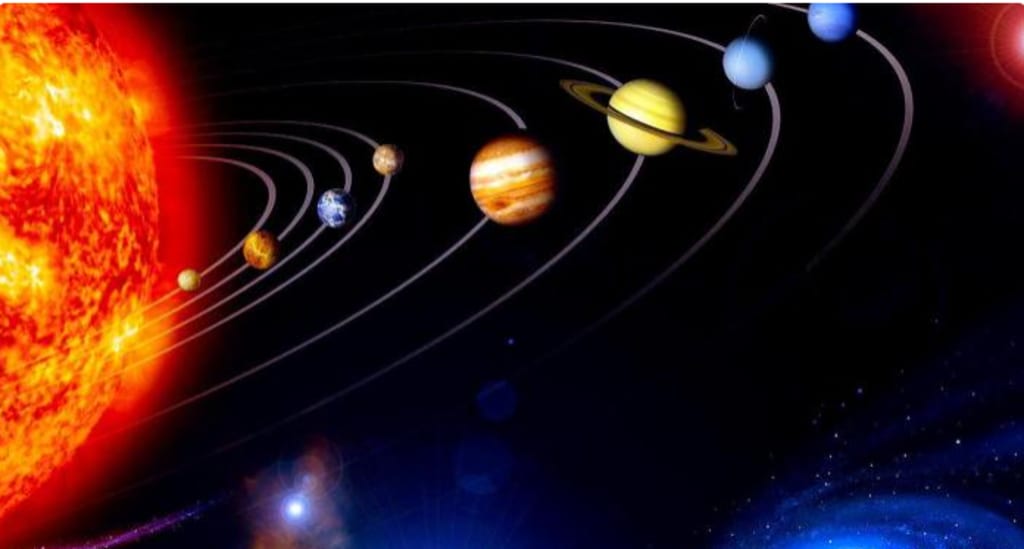
Remember a prophet once said, "When all mankind loves science and astronomical exploration, it will not be far before mankind flies out of the solar system."
This great prophecy is approaching us, isn't it?
In this new 21st century, the ideology of mankind is awakening to the fact that the "exploration of science and the universe" is not only the work of scientific researchers but of all of us. The "scientific exploration of the universe" is not only from the interest of exploration but also as a new era of human responsibility.
Exploring science, exploring the universe, Mizuki Chalong and you continue our journey of exploration together. I believe that many astronomy enthusiasts have seen the "Wandering Earth" by Liu, Mizuki certainly can not miss it. To avoid the solar helium flash in the next 400 years, the Earth is expected to fly out of the solar system through a "five-step plan". We are not going to discuss Dalyu's science fiction works or movies here, but mainly think about: even if the sun does not flash helium, once the Earth flies out of the solar system, what will happen to the solar system?
If human technology is so advanced that the Earth can be completely transformed into an "Earthship", then it is expected to drive the "Earthship" out of the solar system and go to the Proxima. So, will the rest of the Sun and the other planets and moons of the solar system be safe when the Earth leaves the solar system from orbit? Or will the other stars in the solar system be affected by only minor perturbations, as most researchers believe, without major changes? Or could the solar system be turned upside down, or could it lead to the collapse of the entire solar system?
What are the possible outcomes? Next, we analyze the possible scenarios in detail.
According to Newton's law of gravity, it is easy to see that all the planets in the solar system (including the Sun itself and the planets' satellites) are in their places, orbiting steadily, over and over again, mainly due to "gravitational equilibrium", i.e., the gravitational forces of the bodies in the solar system are in basic balance with each other. This balance exists not only between the visible planets but also between the "dark matter and dark energy" that scientists speculate and are looking for evidence of (if dark matter and dark energy exist).
All the stars in our solar system are in regular motion, without chaos and with regularity, which is called "dynamic equilibrium". For example, although the planets in our solar system revolve around the Sun at different speeds and rotate at different speeds, their systematic momentum (including angular momentum and corresponding transformations) remains in constant balance so that even if all the planets move to the side of the Sun and form a line, this systematic momentum remains in balance, just as in the case of accurate computer simulations (once scientific researchers used mathematical formulas The position and rotation speed of all the planets in the solar system were calculated precisely).
Therefore, once the Earth flies out of the solar system, the "dynamic equilibrium" system of the solar system will not continue to be as stable as it would have been if the Earth had not left. So, what happens to the solar system after the Earth leaves it?
It has to do with the way the Earth leaves the solar system. For example, the Earth flies out of the solar system on a certain path, which is very different from the effect of the sudden disappearance of the Earth from the solar system by a "transient".
In the first case, if the "Earth ship" (a ship directly transformed from the Earth) flies out of the solar system according to a set route, and the route is within the ecliptic plane, then the solar system will not be affected too much. Because when the Earth gradually moves away from the solar system in the ecliptic plane, although it will disturb the original "dynamic balance system" of the solar system and make it lose its original dynamic balance, as the Earth moves away from the Sun, the "gravitational balance" of the solar system will automatically and gradually adjust itself, however, as the Earth moves away from the Sun, the "gravitational balance" of the solar system will automatically and gradually adjust itself, thus only gradually changing the relative positions of other stars in the solar system. When the Earth flies completely out of the solar system, the "dynamic equilibrium" of the solar system will also be adjusted automatically. The position of the other planets in the solar system may change concerning the Sun, asteroids, moons, and other bodies, but the solar system will not change significantly.
In the second case, if the "Earth spacecraft" fly out of the solar system at a large angle to the ecliptic plane, then the Earth will leave the ecliptic plane when the solar system will be more perturbed. Because of the large angle between the Earth's path and the ecliptic, when it leaves the solar system at high speed, it is equivalent to a sudden departure from the solar system without sufficient inertial cushion. When the "dynamic equilibrium" of the solar system is suddenly broken, there is not enough time to adjust to the sudden loss of momentum, and it will cause a huge momentum disturbance to the surrounding planets centered on the original departure position of the Earth. In severe cases, Mercury may move rapidly toward the Sun, or even directly towards it. As the Earth leaves the ecliptic, Venus can jump out of its original orbit and spiral into the Sun. Mars may approach Jupiter under Jupiter's gravity, the Moon will fly toward Mars or Jupiter, and most asteroids will converge toward Jupiter. Eventually, Jupiter may swallow Mars, the Moon, and the asteroids and approach the Sun. Saturn, Uranus, Neptune, etc. will all change their orbits, either close to the Sun or away from it. Eventually, only Jupiter, Saturn, Uranus,s, and Neptune may remain in the solar system.
In the third scenario, if mankind has thoroughly studied quantum theory and mastered the method of "instantaneous transfer" with the help of quantum technology, then the Earth may suddenly disappear from the solar system and immediately appear in Proxima. The solar system's dynamic equilibrium system would be most affected at this point. The instantaneous disruption of the "dynamic equilibrium" is like the sudden removal of a key screw from a running machine. How can the machine keep running? At this time not only Mercury will rush toward the Sun, but also Venus will quickly jump into the orbit of Mercury, and the Moon will be thrown out (the direction depends on the position of the Moon concerning the Earth when the Earth suddenly disappears). Mars will rush towards Jupiter and the asteroid belt will be scattered by Mars and will be attracted as Mars approaches Jupiter. Eventually, Jupiter could be extremely distorted and squeezed by the instantaneous disturbance of "dynamic equilibrium", and the 60 or so moons of Jupiter would rush towards Jupiter like a hailstorm. With constant pressure and friction, eventually, our solar system may become a binary system.
About the Creator
Zeev Lo Va
Who to idle away one's time, youth will fade, life will abandon them。
Keep reading
More stories from Zeev Lo Va and writers in Earth and other communities.
The world's nine oldest surviving "antique" astronomical observatories
Since the birth of man on earth, man's reverence for the heavens and his search for the mysteries of heaven and earth has rarely ceased. Astronomers and artisans have also built various observatories. Even today, one cannot help but admire the subtlety of the ancients in their grasp of the planets, constellations, and seasons. The significance of astronomical observation at that time has always been a combination of politics, religion, and science, and is far from the scientific significance of today. Let's go back to that distant time and explore nine of the world's oldest astronomical observatory sites.
By Zeev Lo Va3 years ago in Earth
Asia’s Second-Best Island in DestinAsian Ranking
Vietnam’s largest island, Phu Quoc, has achieved a remarkable milestone in global tourism by being ranked the second-best island in Asia in the prestigious DestinAsian Readers’ Choice Awards 2026, surpassing the world-famous Maldives. The recognition marks a major moment for Vietnam’s tourism industry and highlights the island’s rapid rise as one of the most desirable tropical destinations in the world. 
By Irshad Abbasi 4 days ago in Earth




Comments
There are no comments for this story
Be the first to respond and start the conversation.