
Hypatia
One of the most mysterious stones in the solar system
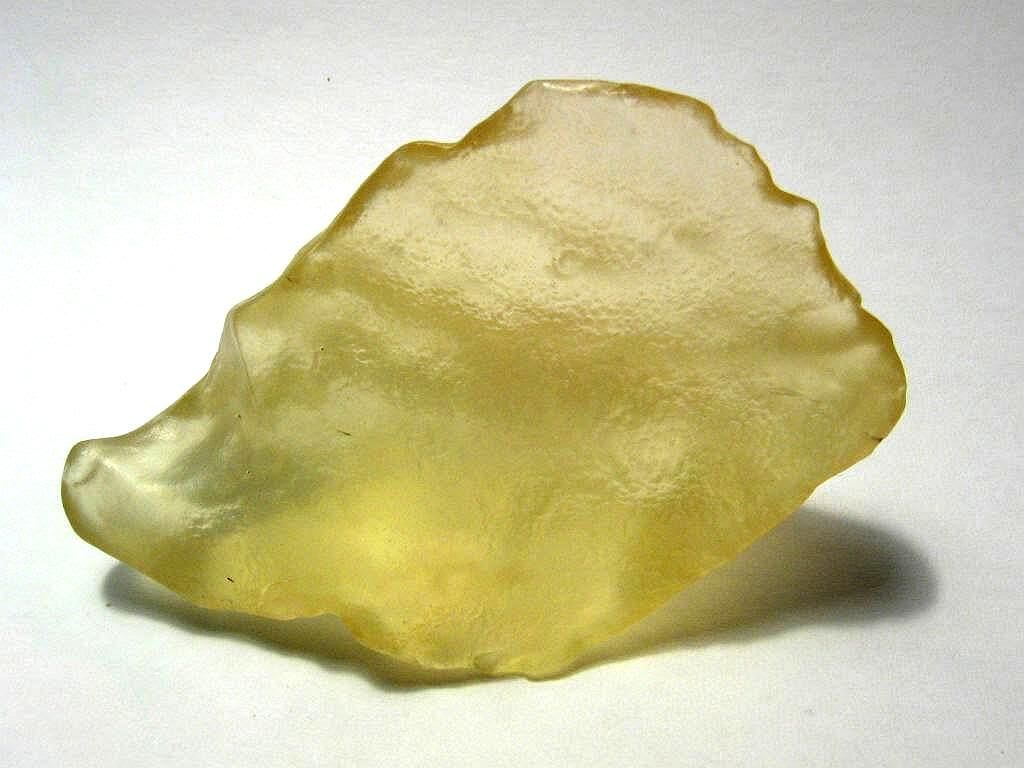
What do we know about Hypatia?
To the west of Egypt lies the Great Sand Sea, which covers an area of a whopping 28,000 square miles and extends to the east of Libya. Parts of this vast desert are dotted with yellow glass, which many scientists believe to be of otherworldly origin. Examining this field of glass uncovered tiny stones set with diamonds that defy all preconceived notions about the formation of the solar system.
In 1996 Dr. Ally A. Barakat explored an area rich in desert glass in the Great Sand Sea known as the Libyan Desert Glass Dispersal. The 2,500-square-mile area is covered in yellow glass shards, baffling researchers. It is very similar to Trinitite, the glass formed in the New Mexico desert under the blast of the first atomic bomb called Operation Trinity. This glass was of great importance to the ancient Egyptians, as evidenced by its use in jewelry adorning the mummies of pharaohs, including Tutankhamun.
During a 1996 expedition to Barakat, several seemingly unremarkable stone fragments surrounded by this mysterious yellow glass were discovered. These stones are named after Hypatia. Hypatia was a famous astronomer and mathematician who lived in Alexandria, Egypt from the 4th century AD to the 5th century. After further analysis of noble gas and nitrogen isotopes, it was announced in 2013 that these stones are of extraterrestrial origin. This was followed in 2015 by the announcement that the Hypatianitewas not the result of any known comet or meteorite impact. What sparked the scientists' attention was the discovery that the stone was composed of almost pure carbon with very little silica, a feature observed in all other meteor and comet fragments analyzed so far. It is the opposite of what is done. Moreover, unlike their terrestrial counterparts, shock diamonds have an unusual nitrogen isotope ratio, so researchers believe they formed before the mysterious impactor entered the atmosphere. You can imagine the unmixed pie crust that makes up most of Hypatia's pebbles, what we called in geological terms two mixed 'matrices'," said the chief scientist. Jan Kramers said. "The glazed cherries and nuts in the cake represent that." Mineral particle "inclusions" found in Hypatia. And the flour dusting the cracks of the fallen cake represents the "secondary matter" from Earth found in the cracks of Hypatia.
Pure metallic aluminum was discovered. Aluminum does not exist in this form on Earth and is thought to be extremely rare in the solar system. An even more surprising discovery was an alloy of phosphorus and nickel that did not contain iron. This has never been observed before. Professor Kramers continued, "What's even more unusual is that the matrix contains very specific compounds called polycyclic aromatic hydrocarbons (PAHs), which are the main constituents of interstellar dust that existed before the formation of our solar system. It contains large amounts of carbon compounds."Interstellar dust is also found in comets and meteorites that have not been heated for a considerable period in history." It is believed to indicate that it is very far from the heat of such stars. has happened. These are regions of the solar system that are currently poorly understood.
Hypatia probably formed in a cryogenic environment with temperatures below the temperature of liquid nitrogen on Earth. In our solar system, it would have been much further than the asteroid belt between Mars and Jupiter, where most meteorites land. Comets mostly come from the Kuiper belt, beyond the orbit of Neptune, about 40 times our distance from the Sun. Some came from the even more distant Oort Cloud. Little is known about the chemical composition of objects in space. "So the next question will dig deeper into Hypatia's origins," Kramer concluded. What if this yellow glass was formed by Hypatia, which exploded under the force of a nuclear bomb, leaving only tiny fragments of it for future explorers to use as clues? Where is the crater? A potential candidate for a crater formed by this event that produced all the core glass turned out to be too large to be seen only from space. It wasn't until 2007 when Egyptian space explorer Farouk El-Baz and geomorphologist Eman Goneim analyzed data collected from orbiting satellites that what appeared to be a 31-mile-wide crater fully explained the origin of the desert. discovered. Fragments of glass and Hypatia stone.
They named the formation they found Kebira Crater, but little further research has been done on it due to its remote location.
About the Creator
Keep reading
More stories from Donal Dieuvelhomme and writers in Earth and other communities.
How to creat wealth
Without a doubt, wealth carries an irresistible attraction to people especially the young fully 20 of all adults under age 30 say being wealthy is a top priority and that is easily the largest proportion of any age group and only 10 percent of surveyed adults believe that it is not important so what is wealth in actuality?
By Donal Dieuvelhomme3 years ago in Education
Met Office Names All the UK Areas Facing Snow This Weekend
The Met Office has issued fresh forecasts warning that snow is set to affect large parts of the UK this weekend, with wintry conditions expected to develop from Saturday and persist into Sunday. As colder air moves south and meets bands of moisture, forecasters say a mix of snow, sleet, and freezing rain could disrupt travel and daily life across multiple regions.
By Aarif Lashari5 days ago in Earth
Met Office Names All the UK Areas Facing Snow on Saturday and Sunday
The Met Office has confirmed that snow is likely to affect multiple parts of the UK this weekend, with cold air sweeping southwards and increasing the risk of wintry conditions on both Saturday and Sunday. Forecasters say a combination of falling temperatures and incoming weather systems could bring snow, sleet, and icy conditions, particularly across northern and central regions.
By Aarif Lashari5 days ago in Earth




Comments
There are no comments for this story
Be the first to respond and start the conversation.