
HVAC Systems Market Size & Forecast 2025–2033
Smart Climate Control Powers the Future of Global Infrastructure

Global HVAC Systems Market Outlook
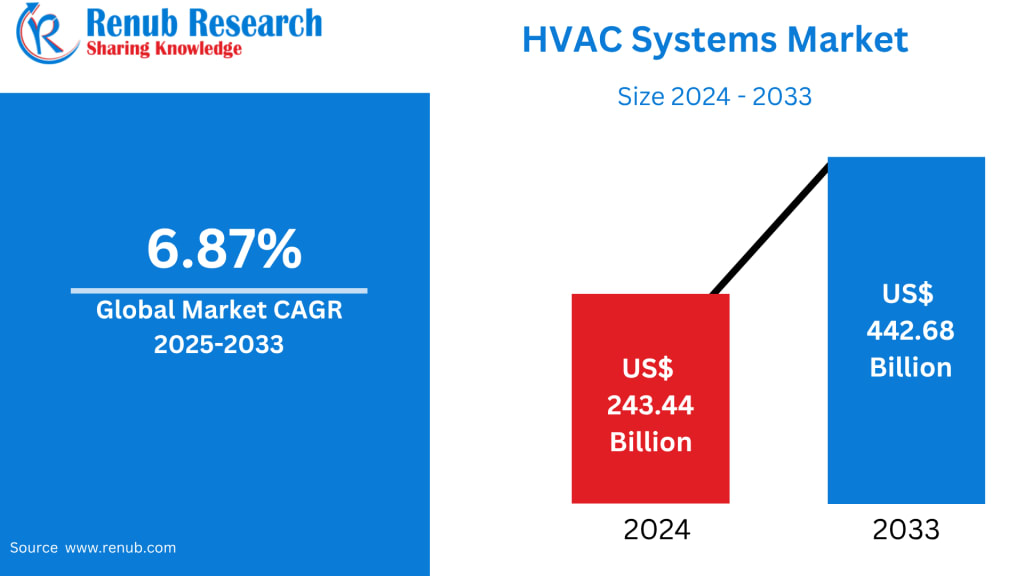
The global HVAC systems market is entering a decisive decade of expansion as climate resilience, urban infrastructure, and energy efficiency become top global priorities. According to Renub Research, the worldwide HVAC systems market is projected to reach US$ 442.68 billion by 2033, rising from US$ 243.44 billion in 2024, registering a strong CAGR of 6.87% during 2025–2033.
This sustained growth is being driven by accelerating urbanization, expanding construction activities, stricter energy-efficiency regulations, and rapid technological advancements in smart HVAC solutions. Heating, ventilation, and air conditioning systems have evolved from basic comfort tools into intelligent infrastructure assets essential for modern living, working, and industrial environments.
HVAC systems play a crucial role in regulating temperature, humidity, and indoor air quality, ensuring healthy, productive, and energy-efficient spaces across residential, commercial, and industrial settings. As climate volatility intensifies and cities grow denser, demand for advanced HVAC technologies is rising across both developed and emerging economies.
Understanding HVAC Systems and Their Applications
HVAC (Heating, Ventilation, and Air Conditioning) systems are engineered to maintain indoor comfort and safety regardless of external weather conditions. Modern HVAC setups typically include furnaces, heat pumps, air conditioners, chillers, ventilation units, air filters, ducting, and smart control systems.
Residential applications focus on thermal comfort, indoor air quality, and energy savings.
Commercial buildings such as offices, malls, hospitals, and hotels rely on HVAC systems for occupant comfort, regulatory compliance, and operational efficiency.
Industrial facilities depend on HVAC solutions to protect equipment, regulate production environments, and ensure worker safety.
North America, Europe, and Asia-Pacific remain the most prominent markets, driven by extreme weather conditions, large-scale infrastructure development, and increasing adoption of smart building technologies.
Key Growth Drivers in the Global HVAC Systems Market
Rising Demand for Energy-Efficient HVAC Solutions
Energy conservation has become a defining theme of global HVAC adoption. Governments worldwide are enforcing stricter building energy codes while offering incentives for energy-efficient upgrades. As a result, manufacturers are accelerating the development of inverter-based systems, variable refrigerant flow (VRF) technologies, and IoT-enabled HVAC solutions.
In February 2025, Mojave Energy Systems launched ArctiDry HP, a next-generation liquid desiccant HVAC system integrated with a reversible heat pump. This innovation delivers year-round heating and cooling with significantly improved energy efficiency, marking a major step forward in sustainable climate control technology.
Rapid Urbanization and Construction Growth
Urban expansion continues to be one of the most powerful drivers of HVAC demand. Over 4 billion people currently live in cities, and by 2050, nearly 70% of the global population is expected to be urban. This demographic shift fuels large-scale construction of residential towers, commercial complexes, healthcare facilities, and industrial parks.
Emerging economies across Asia-Pacific and the Middle East are witnessing massive investments in smart cities, transportation hubs, and industrial corridors—each requiring sophisticated HVAC infrastructure.
Technological Innovation and Smart HVAC System
The integration of artificial intelligence (AI), Internet of Things (IoT), cloud platforms, and predictive maintenance has transformed HVAC systems into intelligent, self-optimizing solutions. Smart HVAC systems enable remote monitoring, real-time diagnostics, automated temperature control, and predictive fault detection.
In February 2025, Midea completed its acquisition of ARBONIA Climate, merging it with its subsidiary Clivet to form MBT Climate. This move significantly strengthens Midea’s European footprint and expands its portfolio of sustainable heating and cooling solutions.
Challenges Facing the Global HVAC Systems Market
High Installation and Maintenance Costs
Advanced HVAC systems require substantial upfront capital investment. Energy-efficient and smart-enabled models often involve higher equipment, installation, and integration costs. Additionally, routine maintenance and skilled labor requirements can limit adoption in price-sensitive developing markets, particularly in residential segments.
Environmental Regulations and Refrigerant Transition
The HVAC industry faces increasing scrutiny over greenhouse gas emissions and refrigerant usage. Global agreements such as the Kigali Amendment mandate a transition away from high-global-warming-potential refrigerants. Compliance requires costly system redesigns, refrigerant replacements, and responsible disposal of legacy equipment, creating operational and financial challenges for manufacturers and end-users alike.
Market Segmentation Analysis
Heating Segment
Heating systems—including furnaces, boilers, electric heaters, and heat pumps—remain essential in cold climates. Europe and North America dominate this segment due to prolonged winter seasons and aggressive policies promoting energy-efficient heating upgrades. Heat pumps and hybrid systems are gaining rapid traction as decarbonization accelerates.
Cooling Segment
Cooling systems such as air conditioners, chillers, and cooling towers are witnessing surging demand due to rising global temperatures. Asia-Pacific, led by China and India, dominates this segment as urban housing and commercial developments expand rapidly. Inverter-based ACs, VRF systems, and eco-friendly refrigerants are reshaping cooling technology adoption.
Residential HVAC Market
The residential HVAC market is driven by rising disposable incomes, smart home adoption, and increasing awareness of indoor air quality. Energy-efficient split ACs and heat pumps are particularly popular.
In January 2025, Panasonic Corporation announced the launch of its OASYS Residential Central Air Conditioning System in the U.S. market, integrating a Mini Split AC, ERV, and DC motor-driven fans—delivering over 50% energy savings compared to traditional systems.
Commercial HVAC Market
Commercial HVAC installations in offices, hospitals, malls, and educational institutions are expanding rapidly. Regulations on indoor air quality and sustainability targets are pushing adoption of advanced rooftop units and VRF systems that reduce operating costs and carbon footprints.
Distribution Channels
Online channels are growing quickly due to convenience, product comparisons, and wider reach.
Retail stores remain vital for customers seeking hands-on demonstrations, expert consultation, and bundled installation services.
Wholesale channels continue to support large-scale commercial and industrial projects.
Regional Market Insights
United States HVAC Systems Market
The U.S. market is driven by extreme seasonal weather, high replacement demand, and strict energy-efficiency standards. Federal tax incentives and green building programs continue to accelerate adoption of smart HVAC systems.
Germany HVAC Systems Market
Germany emphasizes sustainability and carbon reduction, driving demand for heat pumps and hybrid HVAC systems. Government subsidies and large-scale building renovation projects further support market growth.
India HVAC Systems Market
India’s HVAC market is expanding rapidly due to urbanization, rising middle-class incomes, and commercial real estate growth. Cooling systems dominate, supported by government initiatives such as Smart Cities and Make in India.
Brazil HVAC Systems Market
Brazil’s tropical climate drives strong cooling demand, particularly in residential and commercial segments. While economic volatility affects large industrial projects, residential HVAC adoption remains steady.
Saudi Arabia HVAC Systems Market
Saudi Arabia’s HVAC market is dominated by cooling solutions due to extreme temperatures. Mega infrastructure projects, smart cities, and energy diversification initiatives are accelerating demand for high-capacity, energy-efficient HVAC systems.
Competitive Landscape and Key Players
The global HVAC systems market is highly competitive, with companies focusing on innovation, sustainability, and regional expansion. Key players include:
Carrier Corporation
Daikin Industries Ltd.
Fujitsu
Haier Group
Honeywell International Inc.
LG Electronics
Lennox International Inc.
Mitsubishi Electric Corporation
Bosch Group
Each company is analyzed across five viewpoints: overview, key leadership, recent developments, SWOT analysis, and revenue performance.
Final Thoughts
The global HVAC systems market is evolving into a cornerstone of sustainable urban development and smart infrastructure. As cities expand, climates grow more extreme, and energy efficiency becomes non-negotiable, HVAC technologies will continue to advance in intelligence, performance, and environmental responsibility.
Backed by Renub Research’s market forecasts, the HVAC sector is well-positioned for long-term growth through 2033—powered by innovation, regulation-driven upgrades, and the global push toward healthier, smarter, and more energy-efficient indoor environments.
About the Creator
Keep reading
More stories from Aaina Oberoi and writers in Earth and other communities.
Global Polyether Ether Ketone (PEEK) Market Size and Forecast 2025–2033
Global Polyether Ether Ketone Market Outlook The Global Polyether Ether Ketone (PEEK) Market is entering a phase of sustained expansion as industries worldwide accelerate their shift toward lightweight, durable, and high-performance materials. According to Renub Research, the market is projected to grow from US$ 833.45 million in 2024 to US$ 1,646.73 million by 2033, registering a robust CAGR of 7.86% during 2025–2033.
By Aaina Oberoi14 days ago in Earth
Australia Metal Recycling Market: A Sustainable Growth Story Amid Circular Economy Shifts
The Australia metal recycling market is rapidly emerging as a key pillar in the nation’s transition toward a circular economy and sustainable industrial framework. Valued at USD 5.27 billion in 2025, this sector is forecast to expand to USD 7.35 billion by 2034, growing at a compound annual growth rate (CAGR) of 3.78% between 2026 and 2034.
By Rashi Sharma7 days ago in Earth
‘Green Arabia’: Saudi Arabia’s Vast Deserts Were Once Rivers, Lakes, and Grasslands, Studies Show
Saudi Arabia’s iconic deserts, with their endless dunes and arid expanses, are often seen as the epitome of extreme dryness. However, recent studies reveal a surprising chapter in the region’s geological and ecological history: vast parts of what is now the Arabian Desert were once verdant landscapes, complete with rivers, lakes, and flourishing grasslands. This discovery not only challenges our understanding of the region’s past but also offers insights into climate change, human migration, and the evolution of ecosystems in one of the world’s harshest environments.
By Fiazahmedbrohi 4 days ago in Earth
Violence Begets
"Any last words, cowboy?" "None you'd understand, sodbuster." "Funny. That's Marshall Sodbuster to you. But I meant some last nugget that would help us in the adjudication of the myriad offenses counted against you and your gang. I wasn't asking for penitence."
By Adam Diehl5 days ago in Fiction


Comments
There are no comments for this story
Be the first to respond and start the conversation.