
Hubble Space Telescope.
History and Function of Hubble space telescope Astronomical observatory.
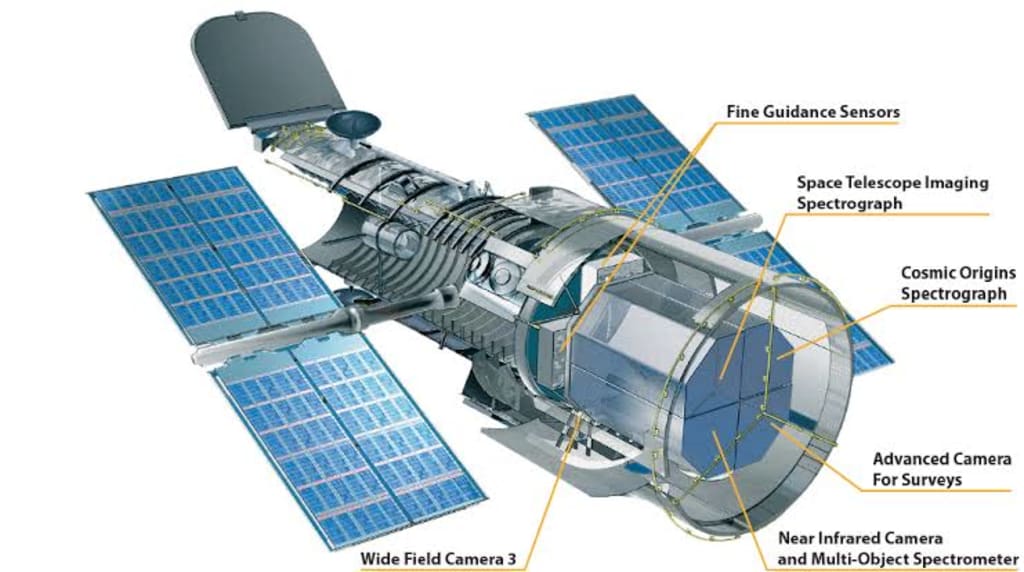
The Hubble Space Telescope (HST) is one of the most important scientific instruments of the modern era. Launched into low Earth orbit in 1990, it has revolutionized our understanding of the cosmos, providing stunning images of distant galaxies and helping us to answer some of the biggest questions in astronomy. In this article, we will take a look at the history and function of the Hubble Space Telescope.
History
The idea for the Hubble Space Telescope dates back to the 1940s, when astronomer Lyman Spitzer first proposed the concept of a large telescope in space that would be free from the distortions caused by the Earth's atmosphere. However, it was not until the 1970s that the project began to take shape, with NASA beginning to develop plans for a space telescope that would be capable of making high-resolution observations of the cosmos.
The Hubble Space Telescope was launched into orbit on April 24, 1990, aboard the space shuttle Discovery. However, shortly after deployment, it became clear that there was a problem with the telescope's primary mirror. The mirror had been ground to the wrong shape, causing images to be blurry and out of focus. This was a major setback for the project, and it took several years of engineering work to develop a solution.
In December 1993, a team of astronauts was sent to the Hubble Space Telescope to install a corrective optics package, which included a set of corrective lenses that were able to compensate for the mirror's flaws. This repair mission was a major success, and it enabled the telescope to achieve its full potential.
Function
The Hubble Space Telescope is a large, reflecting telescope that is designed to observe the cosmos from space. It has a primary mirror that measures 2.4 meters in diameter, which is able to capture light from distant galaxies and stars. The telescope is equipped with a range of instruments, including cameras, spectrographs, and coronagraphs, which enable it to make a variety of different observations.
One of the main functions of the Hubble Space Telescope is to take images of distant galaxies and stars. These images have provided astronomers with a wealth of information about the structure and composition of the universe, including the existence of dark matter and the nature of black holes.
The Hubble Space Telescope is also used to make spectroscopic observations, which allow astronomers to analyze the light emitted by distant objects. This enables them to determine the chemical composition of stars and galaxies, and to study the behavior of matter under extreme conditions.
In addition to its scientific observations, the Hubble Space Telescope has also captured some of the most iconic images of the cosmos. These images have captured the public imagination and have helped to inspire a new generation of astronomers and space enthusiasts.
Experiment
One of the
most iconic experiments with the HST was the Hubble Deep Field (HDF) observation. The HDF is an image of a tiny patch of sky that was observed for 10 consecutive days in 1995. The image revealed thousands of previously unseen galaxies, providing a glimpse into the early universe. This observation has been used to study galaxy evolution and to estimate the age of the universe.
Another important experiment conducted with the HST was the measurement of the Hubble constant. The Hubble constant is a measure of the expansion rate of the universe. Using the HST, astronomers were able to accurately measure the distances to remote galaxies and determine the Hubble constant with greater precision. This experiment has helped to refine our understanding of the age and size of the universe.
The HST has also been used to study the atmospheres of exoplanets. By analyzing the light passing through a planet's atmosphere as it transits in front of its star, astronomers can determine the composition of the atmosphere. This technique has been used to discover the first exoplanet with an atmosphere, and to study the atmospheres of numerous other exoplanets.
In addition to these experiments, the HST has made many other significant discoveries, such as the discovery of dark energy, the study of black holes, and the observation of the collision of galaxies. These experiments have revolutionized our understanding of the universe and have cemented the HST's place as one of the most important scientific instruments in history
The Hubble Space Telescope is one of the most important scientific instruments of our time. It has revolutionized our understanding of the cosmos, providing us with stunning images of distant galaxies and helping us to answer some of the biggest questions in astronomy. Despite its initial setbacks, the Hubble Space Telescope has been a major success, and it continues to be an essential tool for astronomers around the world
About the Creator
Keep reading
More stories from Yaman Khan and writers in Earth and other communities.
Horror Story of Texas State
In February of 2021, the state of Texas was hit by a winter storm that left millions without power, heat, and water for days. The storm, dubbed "Winter Storm Uri," brought record-breaking cold temperatures and snow to the state. While the storm itself was a natural disaster, the aftermath of the storm turned into a horror story for many Texans.
By Yaman Khan3 years ago in Horror
Temperatures Plummet With Wind Chills in Single Digits
Winter is showing no mercy as temperatures across many regions have plummeted, with wind chills dropping into single digits. Meteorologists are warning residents to take precautions, citing the risks of frostbite, hypothermia, and other cold-related hazards. This cold snap is shaping up to be one of the most intense of the season, affecting daily routines, travel, and public safety.
By Aarif Lashariabout 17 hours ago in Earth


Comments
There are no comments for this story
Be the first to respond and start the conversation.