
How does hot water will turn into ice faster than cold water?
useful fact

Introduction:
In the realm of physics, there exists a phenomenon that defies conventional wisdom and challenges our understanding of temperature dynamics – the Mpemba effect. Named after Tanzanian student Erasto Mpemba, who first observed it during a physics experiment in the 1960s, this enigma revolves around the counterintuitive assertion that hot water can freeze faster than cold water. As we delve into the intricacies of this paradox, we unravel the scientific complexities and explore the various factors that contribute to the confounding reality of hot water exhibiting a propensity to transform into ice at an accelerated pace.
Chapter 1: The Mpemba Effect Unveiled
Erasto Mpemba's discovery stemmed from a seemingly simple observation – hot water when placed in freezing conditions, often solidified more rapidly than its colder counterpart. This observation challenged the prevailing notion that water, like many other substances, should follow a linear cooling trajectory. Instead, the Mpemba effect suggested that there were subtleties in the transition from liquid to solid that defied conventional expectations.
Chapter 2: Heat Transfer and Energy Dissipation
To understand why hot water may freeze faster than cold water, one must delve into the complex realm of heat transfer and energy dissipation. When hot water is subjected to freezing temperatures, its higher initial temperature facilitates faster heat loss to the surrounding environment. While this might seem counterintuitive, the increased temperature differential between the hot water and the freezing medium expedites the dissipation of thermal energy, pushing the hot water toward the freezing point more rapidly than its cooler counterpart.
Chapter 3: Convection and Agitation
Convection, the process through which heat is transferred through the movement of fluids, plays a crucial role in the Mpemba effect. Hot water, being less dense than cold water, experiences more vigorous convection currents. These currents lead to increased mixing and agitation within the hot water, accelerating the homogenization of its temperature. As a result, the hot water can shed heat more efficiently, expediting the transition to freezing conditions.
Chapter 4: Supercooling and Nucleation
Supercooling, a phenomenon where a liquid remains in a liquid state below its freezing point, contributes to the Mpemba effect. Hot water, having experienced more rapid cooling, may exist in a supercooled state for a longer duration than cold water. When the supercooled hot water encounters a nucleation site – a point where ice crystals can form – the transition to a solid state becomes almost instantaneous. In contrast, cold water, having had a more gradual cooling process, may not exhibit the same propensity for supercooling and rapid nucleation.
Chapter 5: Container Effects and Evaporation
The vessel in which water is contained also plays a role in the Mpemba effect. Hot water may evaporate more rapidly, losing some of its mass and leaving behind a smaller volume to freeze. This reduction in mass can accelerate the freezing process. Additionally, the thermal conductivity of the container can influence how quickly heat is transferred from the water to the surrounding environment, affecting the overall cooling rate.
Conclusion: Unraveling the Thermal Tapestry
While the Mpemba effect may initially defy intuition, it finds its roots in the intricate dance of thermal dynamics, convection currents, and supercooling phenomena. As we unravel the thermal tapestry that governs the freezing of water, we discover that the Mpemba effect is not a magical anomaly but rather a manifestation of the complex interplay of physical processes. The counterintuitive reality of hot water freezing faster than cold water invites us to question assumptions, delve deeper into the mysteries of thermodynamics, and appreciate the subtleties that make the natural world a perpetual source of wonder and scientific inquiry.
About the Creator
Keep reading
More stories from fatima zahra ajankar and writers in Earth and other communities.
20 fascinating facts offer a glimpse into the rich tapestry of our world
Human Brain: The human brain is an astonishing organ, comprising approximately 86 billion neurons connected by trillions of synapses. Despite accounting for only 2% of the body's weight, the brain consumes about 20% of its energy.
By fatima zahra ajankar2 years ago in Earth
UAE Weather Tomorrow: Rains Likely; Temperatures to Rise
The United Arab Emirates is preparing for a change in its weather conditions as forecasters predict rain and rising temperatures across the country tomorrow. Residents and travelers are advised to stay updated with local weather alerts, as the shift could affect daily activities, traffic, and outdoor events. Meteorologists have noted that this weather pattern is part of a seasonal transition, bringing a mix of showers, mild winds, and warmer daytime temperatures. The change comes after several days of relatively dry and moderate weather across the UAE. Expected Weather Conditions According to the National Centre of Meteorology (NCM), the UAE will experience partly cloudy skies in most areas, with chances of scattered rain showers in some regions. Temperatures are expected to rise slightly, reaching maximums higher than the recent average for this time of year. Specific forecasts for major cities include: Abu Dhabi: Cloudy periods with isolated showers; temperatures between 22°C and 30°C Dubai: Sunny to partly cloudy with chances of light rain; temperatures around 24°C–31°C Sharjah: Light rain expected in some areas; highs of 30°C Northern Emirates (Ras Al Khaimah, Fujairah): Increased cloud cover with scattered showers; temperatures between 20°C and 29°C The NCM has also issued a notice for occasional gusty winds, particularly along coastal areas, which may affect marine activities and beachgoers. Causes of the Weather Change Meteorologists explain that the predicted rains and temperature rise are linked to: Shifting air masses: Cooler air from the north interacting with the warmer Gulf air is causing cloud formation and occasional rain. Seasonal transition: As the UAE moves towards its warmer months, temperatures naturally rise, even as intermittent rain falls in some areas. Regional atmospheric disturbances: Occasional low-pressure systems over the Arabian Peninsula bring moisture from surrounding seas, increasing rain potential. While the rain is expected to be light to moderate, it can temporarily affect visibility and road conditions, especially in areas prone to water accumulation. Impact on Daily Life Residents and visitors are advised to consider the following due to the changing weather: Road Safety: Rain may make roads slippery. Drivers are encouraged to maintain safe speeds and keep a safe distance from other vehicles. Travel Plans: Flight schedules may experience minor delays due to weather-related air traffic adjustments. Outdoor Activities: Those planning outdoor events, picnics, or beach visits should check local forecasts and be prepared for sudden showers. Marine Conditions: Boating and fishing enthusiasts should note choppy seas due to gusty winds, particularly along the UAE coastline. Temperature Trends While rain is expected, temperatures are forecasted to rise slightly across the country. Daytime highs will generally reach 30°C to 31°C in major cities, with cooler early mornings between 20°C and 24°C. Meteorologists emphasize that even with rain, the overall trend points toward warmer daytime conditions, marking a transition into the pre-summer period. Nights may remain slightly cooler, offering relief from the daytime heat. Preparation and Precautionary Measures Weather experts advise the public to take simple precautionary measures: Carry umbrellas or raincoats when moving outdoors. Check local weather apps and official NCM updates regularly. Drive cautiously on wet roads and follow traffic advisories. Secure outdoor items such as furniture, tents, or decorations that could be affected by gusty winds. Stay informed about marine weather updates if engaging in boating or fishing activities. By taking these precautions, residents can safely navigate the changes in weather without significant disruption to daily life. Regional Weather Patterns The UAE’s weather is influenced by its desert climate, but seasonal shifts and occasional regional disturbances often bring short-term rainfall and temperature variations. Northern Emirates: More likely to receive rain due to proximity to the Hajar Mountains, which can trap moist air and cause showers. Central and Southern Emirates: Rain is usually less frequent, but isolated showers can occur, particularly near coastal regions. Coastal Areas: Experience higher humidity and occasional gusty winds, especially when rain systems pass through. Expert Advice Experts from the NCM stress that such weather changes are normal and seasonal. While heavy rains are unlikely, even light showers can temporarily affect commuting, outdoor plans, and local businesses. Meteorologists also advise keeping an eye on short-term forecasts, as local weather can shift rapidly due to regional atmospheric changes. Conclusion Tomorrow, the UAE can expect a mix of rain showers and rising temperatures, signaling a shift in the seasonal weather pattern. Residents are encouraged to stay informed, take necessary precautions, and plan outdoor activities carefully. While the rain may be light and scattered, its presence reminds everyone that even in a predominantly arid country, weather conditions can change quickly, affecting roads, travel, and daily life. With proper awareness and preparation, the UAE’s residents and visitors can navigate these weather changes safely while enjoying the mild rainfall and warmer daytime temperatures.
By Fiaz Ahmed 3 days ago in Earth
Global Leaf Blowers Market Size and Forecast 2025–2033: Growth Powered by Eco-Friendly Landscaping Trends
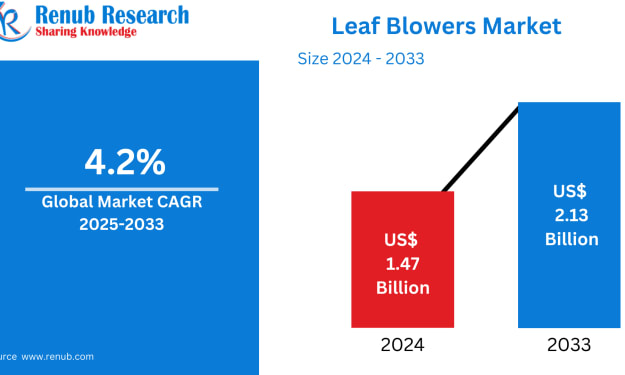
Introduction: A Growing Market Fueled by Cleaner, Smarter Landscaping The global leaf blowers market is entering a transformative phase, driven by rising demand for efficient landscaping solutions and the global shift toward environmentally responsible tools. According to Renub Research, the leaf blowers market was valued at US$ 1.47 billion in 2024 and is projected to reach US$ 2.13 billion by 2033, expanding at a CAGR of 4.2% during 2025–2033.
By Aaina Oberoi3 days ago in Earth



Comments
There are no comments for this story
Be the first to respond and start the conversation.