
How Do Ants Recognize One Another?
How Do Ants Recognize One Another?

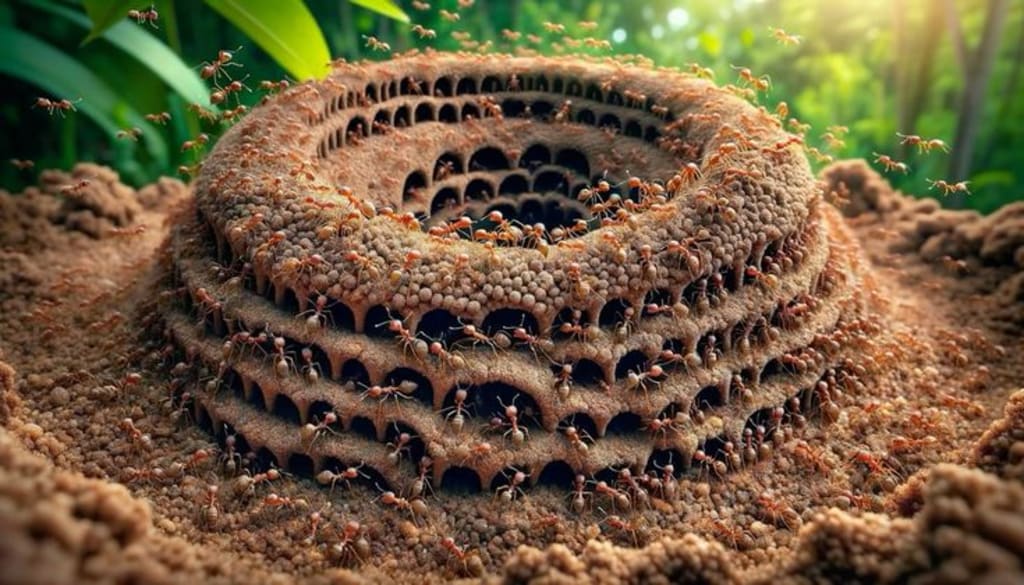
Ants are among the most organized and disciplined creatures on Earth. Despite their tiny size, they live in highly structured communities where recognition, cooperation, and division of labor play a vital role. One of the most fascinating aspects of their life is how ants recognize members of their own colony and immediately identify strangers or enemies.
Ants recognize one another primarily through smell. Each ant colony has a unique scent that comes from chemicals released by the ants’ bodies. This scent acts like an identity card. All ants living in the same nest carry the same smell, which allows them to recognize each other instantly. When an ant encounters another ant, it smells it using its antennae. If the scent matches the colony’s odor, the ant is accepted as a member. However, if the smell is different, the ant is identified as a stranger or an enemy.
The smell of foreign insects or enemies is always different from the colony’s scent. Guard ants stationed near the nest entrance are specially trained for defense. As soon as they detect an unfamiliar odor, they react immediately. These guard ants attack the intruder, chasing it away from the colony or, in some cases, killing it to protect their nest. This strict system ensures the safety of the colony and prevents enemies from entering.
Ants do not have ears like humans. Instead, they rely heavily on their antennae, which are extremely sensitive. Through their antennae, ants can smell, sense vibrations, and even “hear” in their own way. These antennae also help ants detect taste and texture. This is why ants are constantly moving their antennae—it helps them gather information about their surroundings at all times.
Using their antennae, ants can communicate with each other, recognize colony members, locate food, and find their way back to the nest. Ants leave behind scent trails on the ground, which guide other ants toward food sources or safe paths. By following these invisible trails, ants move efficiently even without maps or signs.
Human eyes have a single lens, but an ant’s eyes contain multiple lenses. These compound eyes allow ants to see movement very clearly, even if their vision is not as sharp as that of humans. Thanks to these multiple lenses, ants can quickly notice moving objects, which helps them detect danger or pre
There are many different species of ants, each with unique habits. One remarkable type of ant cuts leaves and carries them back to its nest. These ants do not eat the leaves directly. Instead, they use the leaves to grow a special type of fungus inside their colonies. This fungus becomes their primary food source. This shows how ants practice a form of farming, long before humans learned agriculture.
Ant colonies can contain thousands or even millions of ants, and they are almost always in motion. Ants rarely build permanent homes in one place. Some colonies move when conditions become unfavorable, such as lack of food or danger. Despite frequent movement, ants remain highly organized.
Ants live together cooperatively. In a single colony, there can be hundreds, thousands, or even millions of ants, and each ant has a specific role. Some ants collect food, others protect the nest, some care for the young, and others maintain the structure of the colony. Every ant stays busy, working tirelessly for the survival of the group.
Most ants feed on fruits, flowers, seeds, and plant material. Some ants prefer to drink sweet liquids, such as nectar or the sugary substances produced by insects or trees. Certain ants hunt and eat other insects, while others consume almost anything they find, even tiny living creatures. This variety in diet allows ants to survive in many different environments.
Overall, ants are extraordinary creatures. Their ability to recognize each other, communicate without sound, organize massive colonies, and work collectively demonstrates intelligence and discipline far beyond their size. Studying ants helps humans better understand teamwork, cooperation, and survival in nature.
About the Creator
Sudais Zakwan
Sudais Zakwan – Storyteller of Emotions
Sudais Zakwan is a passionate story writer known for crafting emotionally rich and thought-provoking stories that resonate with readers of all ages. With a unique voice and creative flair.
Keep reading
More stories from Sudais Zakwan and writers in Earth and other communities.
The Jinn Fled
This short story was narrated by my grandson Taimoor, who is thirteen years old. He heard it from the family of his friend Zain Ali. Zain Ali’s mother, Nusrat Bibi, loves Taimoor like her own son. She is a pious, well-mannered, kind-hearted, and refined woman.
By Sudais Zakwan6 days ago in Earth
Protesters Bid to Save the ‘Heart’ of Margate
Residents and activists in Margate have launched a passionate campaign to save what they describe as the town’s “heart” — a historic public space facing redevelopment. The dispute has ignited local debate over preserving heritage, supporting small businesses, and maintaining the cultural identity of one of England’s most iconic seaside towns.
By Aarif Lashariabout 6 hours ago in Earth



Comments
There are no comments for this story
Be the first to respond and start the conversation.