
How Big is The Universe?
Earth our home planet a tiny blue dot floating in the immense Cosmic ocean here resides everyone you ever knew every human who ever lived every story that was ever told it's where our journey begins but as we zoom out beyond our atmosphere past the moon Beyond The Familiar planet and the sun we embark on an Epic Quest a quest to grasp the true scale of our universe as we leave Earth's embrace the first marker on our Cosmic journey is the moon about 384,000 km away a distance so vast that if you were to drive a car at a constant speed of 100 km per hour it would take you over 160 days to reach it and from this lunar Vantage Point Earth appears as a a fragile sphere of Blues and greens cradled in the black void of space a sight that puts our existence into a humbling perspective this is Earth as seen from the Moon as we continue our outward Journey the next Milestone is the sun lying approximately one astronomical unit away from Earth this unit equivalent to about 150 million kilm is the stan

Earth our home planet a tiny blue dot floating in the immense Cosmic ocean here resides everyone you
ever knew every human who ever lived every story that was ever told it's where our journey begins
but as we zoom out beyond our atmosphere past the moon Beyond The Familiar planet and the sun we
embark on an Epic Quest a quest to grasp the true scale of our universe as we leave Earth's embrace
the first marker on our Cosmic journey is the moon about 384,000 km away a distance so vast that if
you were to drive a car at a constant speed of 100 km per hour it would take you over 160 days to
reach it and from this lunar Vantage Point Earth appears as a a fragile sphere of Blues and greens
cradled in the black void of space a sight that puts our existence into a humbling perspective
this is Earth as seen from the Moon as we continue our outward Journey the next Milestone is the
sun lying approximately one astronomical unit away from Earth this unit equivalent to about 150
million kilm is the standard measuring stick for distances in our solar system imagine this light
traveling at an astounding speed of 300,000 km/s takes about 8 minutes and 20 seconds to Journey
from the Sun to Earth if you were to travel this distance in a commercial jet flying at 900 km
hour it would take you about 19 years this immense distance is a stark reminder of the vastness of
space even within our own solar system the Sun a fiery Behemoth provides life- sustaining energy to
our planet from this incredible distance venturing beyond our home planet and its solar companion
the sun we set our sites on Mars our enigmatic red neighbor Mars at its closest approach to Earth
is about 54.6 million kilm away however this distance can stretch up to 401 million km when
the two planets are on opposite sides of the sun to put that in perspective traveling to Mars at
the speed of a commercial jet would take upwards of 50 years this vast expanse of space between
Earth and Mars has been a significant challenge for space exploration The Rovers and probes we've
sent to the red planet embark on a journey that is not just far but fraught with complexities due
to the constantly changing distances and orbital Dynamics as we journey to the outermost reaches
of our solar system we encounter Neptune the distant ice giant lying roughly 4.5 billion kilm
from Earth Neptune marks the edge of our solar neighborhood sunlight racing across the vacuum
of space takes about 4 hours and 15 minutes to reach Neptune from the Sun this staggering
distance showcases the enormity of our solar system launched in 1977 the Voyager One space
probe represents Humanity's insatiable curiosity and our desire to explore Beyond known bound
boundaries as of now Voyager 1 has traveled for over four decades covering a staggering distance
of more than 22 billion kilometers from Earth it's the farthest human-made object from our planet
a silent Wanderer in the cosmic sea in 1990 at the suggestion of the renowned astronomer Carl San
Voyager 1 turned its camera back towards Earth for one final photograph this resulted in the iconic
pale blue dot image and at a distance of about 6 billion kilm from Earth our planet appeared as
a tiny faint dot in the vastness of space Sean poetically reflected on this image emphasizing
our responsibility to cherish and preserve our only home a small Speck in the immense Universe At
the very fringes of our solar system lies the ort Cloud a vast theoretical sphere of icy objects
this distant cloud is thought to extend up to a staggering 100,000 astronomical units from the
Sun that's about 1.9 light years a distance so immense that it's on the cusp of interstellar
space scientists determine the boundary of interstellar space known as the heliopause
where the sun's solar wind is stopped by the interstellar medium this is where the influence of
our sun ceases and the vast realm of interstellar space Begins the or Cloud represents the final
frontier of our solar system a boundary Zone where the sun's influence wanes and the cosmic
journey into the Galaxy truly begins as we venture beyond the confines of our solar system our next
point of interest is Alpha centor the closest star system to our sun located about 41.3 trillion km
away this distance is equivalent to over 276,000 astronomical units at such colossal distances the
AU a measure so convenient within our solar system begins to lose its practicality hence astronomers
use the Lightyear the distance light travels in one year for Interstellar measurements Alpa
centu is about 4.4 light years away from us considering our current space travel technology
a journey to Alpha centor is almost unfathomable for instance the Voyager spacecraft traveling at
about 17 km/ second would take over 70,000 years to reach this neighboring star system this
immense distance underscores the vastness of space that separates the stars and highlights the
challenges of interstellar travel our journey now takes us to the Grand scale of our home galaxy
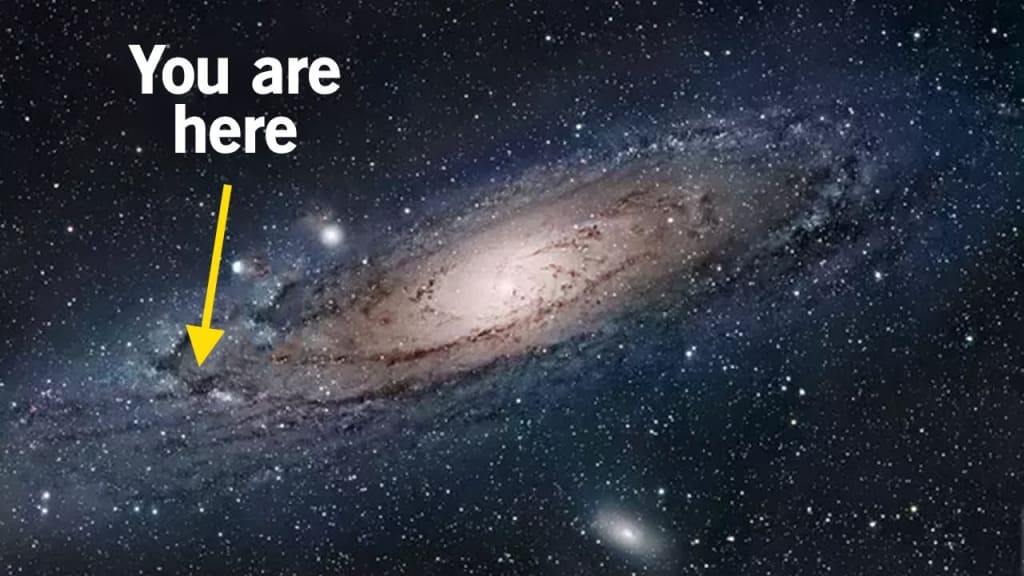
The Milky Way spanning about 100,000 light years in diameter this vast spiral galaxy is home to
hundreds of billions of stars each potentially hosting their own planetary systems within this
immense structure there's a a tiny sphere known as the human radio bubble extending about a 100
light years from Earth this bubble represents the farthest extent of human influence in the cosmos
the reach of our radio and television broadcasts into space beyond this bubble it's as if Humanity
never existed any civilizations residing in the vast majority of our galaxy would be oblivious
to our presence given that our signals haven't reached them yet the scale of the Milky Way is
so vast that our entire recorded history is but a whisper in the Cosmic Wind undetectable Beyond
this small bubble as we leave the Milky Way we enter the vast almost incomprehensible realm of
Intergalactic space here galaxies float in the cosmic ocean separated by mindboggling distances
our galaxy is part of a small Cosmic neighborhood known as the local group a cluster of more than
50 galaxies spread across approximately 10 million light years the local group is a diverse assembly
including not just spiral galaxies like the Milky Way and Andromeda but also a multitude of smaller
dwarf galaxies the distances here are so vast that light from one end of the local group to the other
would take 10 million years to Traverse this scale dwarfs anything within our own Galaxy underscoring
the enormity of the universe Intergalactic space is a silent expanse a vast Wilderness between the
islands of Galactic light in this immense void our galaxy home to our entire history is just
a tiny Speck among many a single story in the grand Cosmic Library as we extend our Cosmic gaze
beyond the local group we encounter the Colossal Virgo supercluster an immense collection of Galaxy
groups and clusters including our own local group encompassing a region of space about 110 million
light years in diameter or 33 megap parex the Virgo super cluster is a Titanic structure in the
universe containing thousands of galaxies from at least 100 Galaxy groups and clusters each with
their own Myriad stars and planets as we journey outward from the Virgo supercluster we arrive
at an even more staggering Cosmic structure the lanaka supercluster this immense Congregation
of galaxies which includes the Vergo supercluster and extends over 500 million light years is our
Galactic home on a grand scale lakia meaning immense Heaven in Hawaiian truly lives up to
its name containing the mass of 100 million billion Suns lakia is a gravitational Masterpiece
with Galaxy clusters superclusters and countless celestial bodies Bound in a cosmic web of
Attraction and motion at the heart of lanaka Lies the great attractor a mysterious region
of space that exerts a massive gravitational pull on the galaxies within this super cluster
in this vast expanse our Milky Way the entire local group and even the Virgo supercluster are
just tiny components of this gigantic structure lanak Kia provides a profound context for our
existence in this immense supercluster we are part of something far greater and more Majestic
than we can fully comprehend as we reach the boundaries of our Cosmic exploration we encounter
the limits of the observable universe an Aston astronomical Marvel stretching about 93 billion
light years in diameter this begs a fascinating question if the universe is only 13.8 billion
years old how can it be so vast the answer lies in the nature of cosmic expansion the universe has
been expanding since the Big Bang stretching space and increasing distances between celestial bodies
but what lies beyond the observable universe this remains one of the greatest mysteries of cosm
ology some regions of space are expanding away from us faster than the speed of light placing
them forever out of our view consequently the true size of the entire universe remains unknown
and potentially infinite the observable universe vast as it is might just be a tiny fragment
of the entire Cosmic expanse we are left with the humbling realization that there might
always be regions of space entire galaxies and wonders that we will never witness as they Retreat
endlessly into the depths of the ever expanding universe
About the Creator
Michael Jackstha
show your support and read my stories
trying to make money online
I'm poor and I'm someone's hope for survival
Keep reading
More stories from Michael Jackstha and writers in Earth and other communities.
Are We Alone In The Galaxy?
are we alone in the universe this question has been in the minds of scientists for centuries capturing the imagination of people everywhere and driving countless other questions of the unknown many scientists believe that Earth isn't the only place in the UN Universe to host life but considering just how big the universe is with an estimated 2 trillion galaxies perhaps then a better question is are we alone in the Milky Way according to a new study published in the astrophysical journal researchers from the University of Nottingham suggest that the Milky Way galaxy is home to 36 communicating intelligent alien civilizations but how did they arrive at this very specific number they say the estimate is actually conservative and it's based on the assumption that intelligent alien life forms on other planets in a similar way to how it does on Earth the scientists assume that Earth is not special if we imagine a planet much like ours orbiting a star like our sun hosting a civilization that develops technologically in a similar way to humans and under the assumption that it takes 5 billion years for intelligence life to form then there would be at least 36 earthlike civilizations in our galaxy previous calculations of alien life have been based on the Drake equation which includes seven factors needed to find the number of intelligent civilizations but the estimates have been extremely broad ranging from zero to a few billion civilizations with this new method the researchers refined the equation using new data and assumptions they found that there are ly between 4 and 21 civilizations with 36 the most likely number however finding these civilizations is another issue entirely scientists said they would be thousands of light years away but let's begin by exploring Proxima centor B the nearest exoplanet that may potentially Harbor alien life this intriguing World orbits within the habitable zone of Proxima centor the habitable zone or the goldilock zone is the region around a star where the conditions are just right for liquid water to exist on a planet's surface in this Zone the temperature is ideal neither too hot which would cause water to evaporate if the planet were too close to its star nor too cold which would cause water to freeze if the planet were too far away this temperature range offers the potential for Life as we know it to thrive Proxima centor B is very similar in size to Earth with a mass of of approximately 1.17 Earth masses this suggests it's only about 10% larger in diameter than our world the planet is likely tidily locked meaning one side of the planet always faces the star receiving constant daylight while the other side is In Perpetual Darkness there could be three distinct climate zones due to Tidal locking a hot sun-facing side a cold dark side and a potentially habitable Twilight Zone in between if alien life exists on Proxima centor B the unique conditions of being tidily locked could lead to extraordinary adaptations on the perpetually lit side life forms might have evolved to withstand continuous exposure to the Stars radiation possibly developing protective mechanisms or using the constant light to their advantage perhaps through photosynthesis like processes On the Dark Side organisms could have adapted to the extreme cold and constant Darkness possibly relying on geothermal energy or other forms of heat different from Starlight to survive now if intelligent alien life exists on Proxima centor B the implications would be astonishing first it would suggest that intelligent life is likely common throughout the Galaxy considering the Milky Way hosts an estimated 400 billion stars the odds that the only two planets with intelligent life happen to be neighbors would be astronomically low second the discovery could provide clues into the nature of space travel among extraterrestrial civilizations if these neighboring beings have not yet made contact it could indicate that even for a more advanced alien Society Interstellar travel is an even bigger challenge than we thought or it might also suggest that they are technologically less advanced than we are positioning Humanity as the potential first Interstellar visitors in this scenario we would be the aliens arriving on their planet however before we get ahead of ourselves it's crucial to remember that these ideas remain purely speculative the existence of extraterrestrial life let alone intelligent life beyond Earth has yet to be confirmed another intriguing candidate for hosting alien life is Kepler 62e a superar located about 1200 light years away and here's why this exoplanet stands out it's approximately 1.6 times the size of Earth which suggests it might have similar mass and gravity it orbits within the habitable zone of its star which is smaller and cooler than the sun creating potentially ideal conditions for liquid water there's a strong hypothesis that Kepler 62e could be a water world covered mostly or completely by oceans this could mean a variety of of Aquatic Life forms might exist there if Kepler 62e has an atmosphere it's thought to be very cloudy warm and humid extending to the polar regions if it truly is a water world this could make the development of civilization as we know it more challenging yet it does not eliminate the possibility of advanced marine organisms the concept of Life on Kepler 62e is still speculative but it's a top candidate in the search for alien in life due to these promising characteristics however its great distance from Earth means that our current technology doesn't allow us to study it in detail to confirm these possibilities Glee 667cc is another Super Earth with the potential to host alien life the planet has a radius 1.7 times that of Earth and is about 23 light years away Glee 667 cc is part of a triple star system which could mean that if you were standing on the planet you might see three suns in the sky its host star is a red dwarf with about a third as much mass as the sun as a result stars like Glee 667 C can live up to 150 billion years or 15 times longer than the sun's lifespan even if alien life does not currently exist on Glee 667cc the system's potential lifespan of one 150 billion years offers an extended window for life to emerge and evolve this prolonged period of stability far exceeds that of our own Sun providing more than enough time for complex life forms to develop at a later stage in the planet's history G 667 cc is among five other planets that orbit the red dwarf star three of which are within the habitable zone this makes this system a prime candidate for the potential of alien life however whether life actually exists there remains a mystery as we currently lack the technology to detect life at such a distance directly the study of exoplanets like Glee 667 CC helps astronomers understand the conditions under which life might arise and how common habitable worlds might be in our galaxy Kepler 22b is another fascinating alien world categorized as a super Earth and is about 2.4 times Earth's radius the planet's composition is still a matter of debate it could be covered in a vast Ocean or it might even be gaseous but if it is an ocean world it's possible that life could exist in such an environment as suggested by some scientists involved in the Kepler project the idea of an ocean world is particularly interesting because it opens the possibility of Aquatic Life forms however with a staggering distance of about 640 light years separating us from Kepler 22b it's currently beyond our reach for direct exploration using today's technology now picture an advanced alien civilization on Kepler 22b peering through sophisticated telescopes aimed at Earth what they'd be observing is our planet as it was back in the year 1384 they would see Earth's Medieval Era this delay is due to to light the fastest thing in the universe taking 640 years to travel from our world to theirs yet even as vast as 640 light years may seem it represents less than 1% of our Milky Way staggering bread of 100,000 light years so far our exploration of exoplanets has barely touched a tiny fraction of the potentially habitable worlds that might exist out there drawing on data from the kep Space Telescope estimates suggest there could be up to 300 million potentially habitable planets within our galaxy alone considering this estimating only 36 potential alien civilizations in the Milky Way seems extraordinarily conservative now let's imagine for a moment that each Galaxy hosts just one single civilization if true with the estimated 2 trillion galaxies in the observable universe there would be a minimum of 2 trillion civiliz izations out there faced with these numbers it's humbling to realize that our civilization might just be a tiny Speck as viewed from the broad Cosmic perspective as we gaze out into the Stars we must ask ourselves what Legacy will We Leave Behind in this Cosmic sea of possibilities
By Michael Jacksthaabout a year ago in Earth
Chameleon: Nature’s Master of Disguise
Few creatures in the animal kingdom capture the imagination quite like the chameleon. Known for its ability to change color, its slow, deliberate movements, and its incredible eyes that move independently, the chameleon is one of nature’s most extraordinary reptiles. These small but remarkable creatures have inspired scientists, photographers, and animal lovers for centuries.
By Aarif Lashari6 days ago in Earth
World Spends $30 Destroying Nature for Every $1 Spent Protecting It
The world is at a crossroads when it comes to environmental protection. A shocking new analysis reveals that for every $1 spent protecting nature, humanity spends roughly $30 destroying it. This staggering imbalance underscores a harsh reality: economic development, industrial growth, and resource exploitation continue to take precedence over the planet’s ecological health.
By Muhammad Hassanabout 16 hours ago in Earth




Comments
There are no comments for this story
Be the first to respond and start the conversation.