
Hoatzin: The Living Herbivorous Dinosaur of the Amazon Rainforest
Uncovering the mysterious ‘stinkbird’ of South America’s green ocean

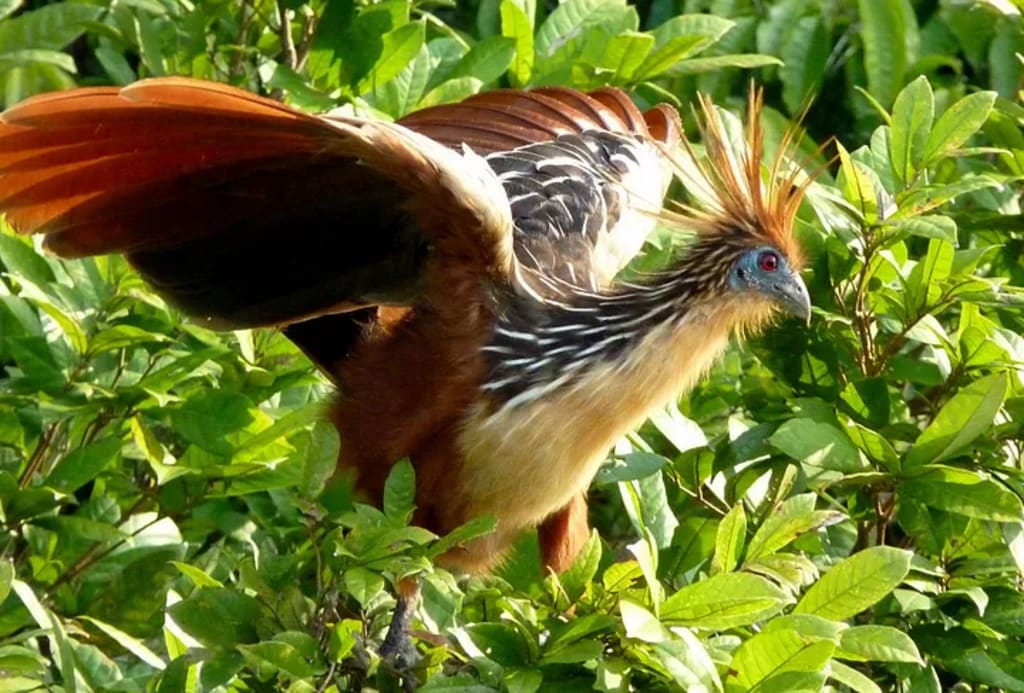
Found in the swamps, mangroves, and riparian forests of South America, this eccentric looking, chicken-sized bird can be seen clumsily moving through the foliage searching for its leafy dinner.
Hoatzin is a neotropical species that lives in social groups around slow-moving rivers and lakes in the Amazon. Being herbivorous, they are often fumbling through foliage, making them pretty easy to spot.
What makes this weird avian stand out in a crowd of over 3,200 other birds? Surprisingly, there's a few attributes Hoatzin have that aren't found in any other species.
Hoatzin Are Flying Cows?
Amazingly, Hoatzin are ruminators. Like cows, goats, and sheep, these birds digest their food with the help of bacterial fermentation. Bovines and their other farmyard counterparts have special sacs in the gut called ‘rumen’. However, Hoatzins have enlarged esophagi and crops.
It is the only bird in the world that uses these foregut parts instead of a stomach to digest food. This is due to their diet, which consists mostly of leaves from over 50 species of plants, that then passes into the bird’s crop where fermentation begins.
Bacteria in the foregut produce enzymes that assist in breaking down cellulose found in the tough leaf materials. Over 1,000 bacterial species have been observed in Hoatzin crops and although some can also be found in mammalian ruminants, others remain unique to the bird.
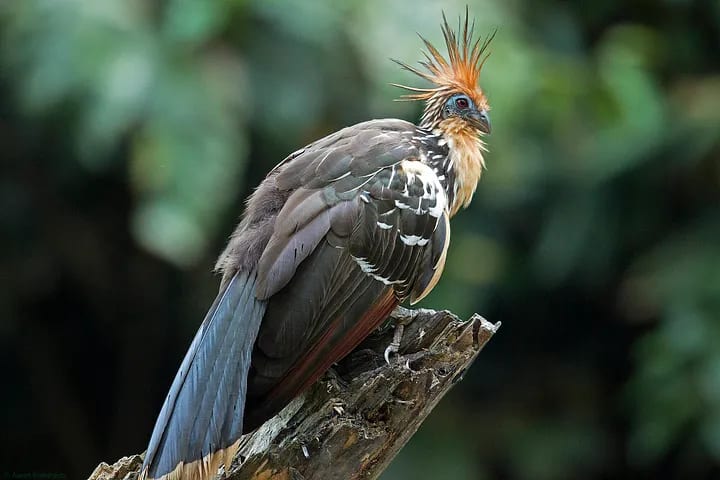
It takes up to 45 hours to completely digest the leafy brew inside their crops, leaving these birds spending a majority of the day lounging around doing nothing. Hoatzin are actually unable to fly when they've got a full load of fermenting food!
You'll find they aren't strong flyers even if their stomach is empty. Due to having less-developed flight muscles and sternum, it leaves them almost entirely arboreal.
Also, Hoatzin are known for their distinctive odour, emitting a foul-smelling vapour, therefore, they're commonly dubbed ‘stinkbirds’.
Hoatzin Chicks Have Claws
Hoatzin build nests in branches that overhang bodies of water, laying 2-3 eggs per clutch. Every chick is born with two claws on the digits of each wing; a chick may retain them only for the first 3 months of life.
If the nest is approached by predators, the chicks will jump from the nest into the water below. These shockingly capable swimmers will paddle to safety and remain hidden until the threat has moved on. Hoatzin chicks will then proceed to climb back up the tree to the nest using their claws.
The presence of wing claws has led scientists to investigate the potential connection between Hoatzins and the archaic Archaeopteryx, one the earliest known flying animals related to birds.
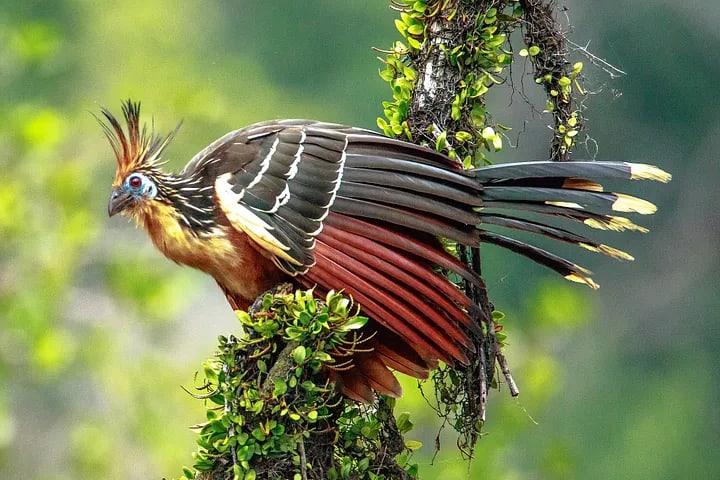
Many birds, including common species like chickens and ducks have ‘claws’ on the digits of their wings. These were present in their dinosaur ancestors and some lineages still have vestiges of that anatomy.
However, Hoatzin are different, because they aren't remnants of ancient history and instead serve as an important modern-day purpose for the survival of their offspring.
Hoatzin Are Lonely
There are no close relatives that aren't extinct. Genetic research conducted in 2015 indicated this species is the only living representative of a lineage that branched off the avian family tree around 64 million years ago.
The genetic, evolutionary relationship of the Hoatzin to other birds is still unknown. No amount of fossil data has yet cleared up where exactly belong on the evolutionary tree of birds.
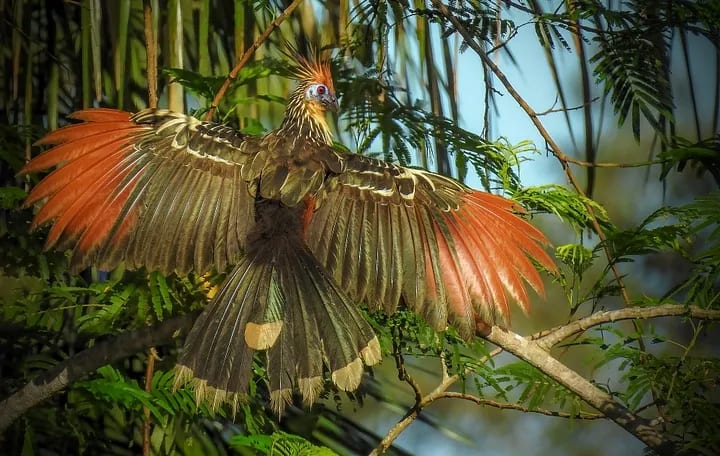
Hoatzins are the only extant species in the genus Opisthocomus, meaning it’s the only living genus in the Opisthocomidae family under the order of Opisthocomiformes.
Additionally, Hoatzins do not survive in captivity. Due to their folivorous diet, digestive system, and specialised environment, replicating these conditions in captivity is near impossible.
A Winged Mystery
Although so little is known about the origins and genetic positioning of Hoatzin, this bird has allowed us to shed the tiniest light on avian evolution.
Hoatzin, amongst other species, stand as biological outliers, breaking our conventional understanding of the complexity of life and how it adapts. If anything, it proves some questions will never quite be answered, no matter how much we ask.
Overall, it's clear this bird didn't get the memo it's not prehistory anymore, but it proves dinosaurs are still among us, even if they're chicken-sized!
About the Creator
Owen / Crazy Sheep
An eccentric, creative, and introspective travel addict who aspires to be a world-class writer across multiple mediums. My interests and passions are eclectic, spanning from gaming to ornithology, but studying Japanese is a favourite!
Keep reading
More stories from Owen / Crazy Sheep and writers in Earth and other communities.
The Star That Keeps Dimming for No Known Reason
In 2015, astronomers analyzing data from NASA's Kepler Space Telescope discovered a star designated KIC 8462852, located about 1,470 light-years from Earth in the constellation Cygnus, that was exhibiting brightness fluctuations unlike anything that had been observed in over 150,000 stars surveyed by the Kepler mission, and the pattern of dimming was so unusual and irregular that it could not be explained by any known natural phenomena including planets orbiting the star, stellar pulsations, or dust clouds, leading some scientists to seriously propose that the dimming might be caused by artificial structures built by an advanced alien civilization, specifically something like a Dyson swarm of solar collectors orbiting the star to harvest its energy, though this explanation while exciting was considered a hypothesis of last resort only to be entertained after all natural explanations had been exhaustively ruled out. The star, which became known informally as Tabby's Star after astronomer Tabetha Boyajian who led the research team studying it, showed dimming events where its brightness dropped by up to 22 percent, far more than could be explained by a planet passing in front of it, which typically causes dimming of only a fraction of a percent, and the dimming events were irregular and aperiodic, meaning they did not repeat on any predictable schedule, and different dimming events had different characteristics with some showing gradual dimming over days and others showing more sudden brightness drops.
By The Curious Writerabout 14 hours ago in Earth
Pandora’s Burden
“My brother warned me to not accept gifts from the one who commissioned you,” said Epimetheus to the woman clad in silvery raiments standing at the entrance to the temple. Her silver tiara and the silver rings on her fingers and toes glinted in the firelight cast by torches set on either side of the doorway. Lingering in the shadows, beyond the reach of the flames as she was, he could not tell what she held in her hands. At first what appeared to be a box was perhaps a funerary urn, or maybe merely an apple.
By J. Otis Haas3 days ago in Fiction


Comments (1)
What an interesting and colourful bird! It would be such a pity if it goes extinct. It’s also fascinating to learn about this rare bird. 🙂