
Hazardous Substances in Products
A Practical Guide for Makers, Brands, and Curious Shoppers
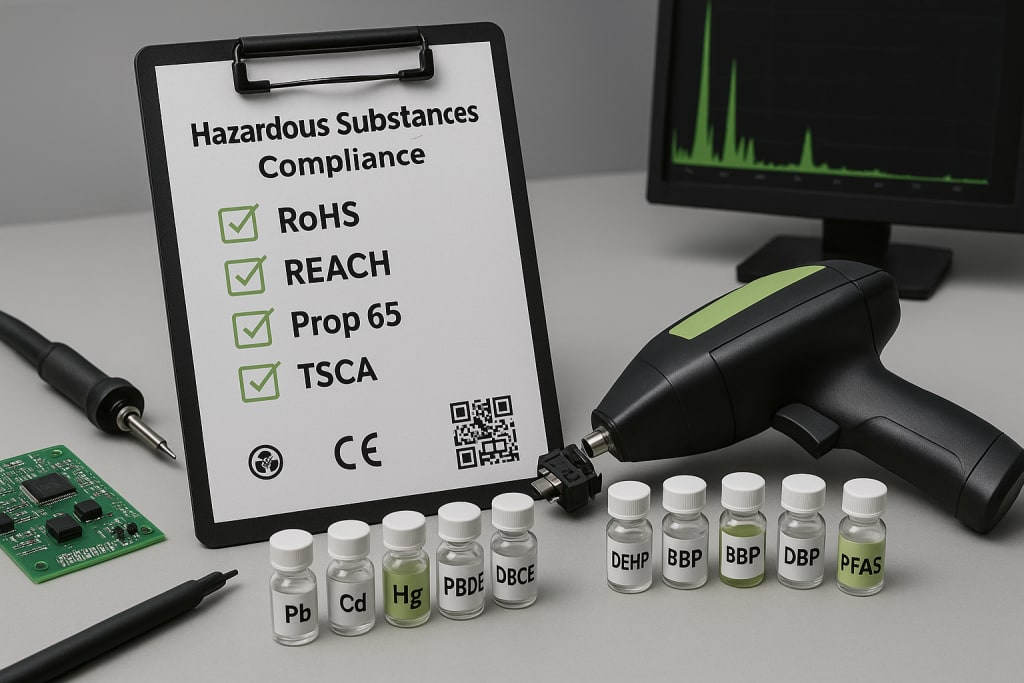
Whether you design electronics, source jewelry, package cosmetics, or simply want safer goods at home, “hazardous substances” show up everywhere in the product world. They’re part of alloys, platings, solders, coatings, plastics, adhesives, inks, and even labels. The good news: you don’t need to be a chemist to manage the risk. You need a simple plan, the right tests, and clear documentation.
Below is a plain-English guide you can share on Vocal—what “hazardous substances” really means, why regulations differ, and how to set up a program that actually works.
What “hazardous substances” really means (in products)
In consumer goods and electronics, hazard typically refers to chemicals that can cause harm to human health or the environment—think heavy metals (lead, cadmium, mercury), restricted flame retardants (PBB, PBDE), certain phthalates used as plasticizers (DEHP, DBP, BBP, DIBP), allergenic metals like nickel, PFAS (“forever chemicals”), solvents, and more. These chemicals can be in:
- Metals & solders: base alloys, platings, solder joints.
- Polymers: housings, cables, overmolds, coatings, adhesives, foams.
- Finishes: paints, inks, enamels, decorative layers.
- Consumables: oils, cleaners, cosmetics, and mixtures that need Safety Data Sheets.
Some substances are content-restricted (don’t exceed X% in a material), others are release-restricted (like nickel release from skin-contact jewelry), and some are use-restricted (can’t be used for certain applications at all).
The “big four” compliance frameworks you’ll hear about
1) EU RoHS (Restriction of Hazardous Substances)
Applies to most electronics placed on the EU market. RoHS restricts ten substances—lead (Pb), mercury (Hg), cadmium (Cd), hexavalent chromium (Cr VI), PBB, PBDE, and four phthalates (DEHP, BBP, DBP, DIBP). Limits are tight by homogeneous material (the smallest uniform material in your product), typically 0.1% for most, 0.01% for cadmium. RoHS is about what’s in the material.
2) EU REACH (Registration, Evaluation, Authorisation and Restriction of Chemicals)
Two parts matter for articles (finished goods):
SVHC “Candidate List”: if your product contains a Substance of Very High Concern above 0.1% w/w in an article, you have duties—communication to customers and, in many cases, submission to the EU SCIP database. The list grows periodically (hundreds of substances).
Annex XVII restrictions: specific rules limiting or banning certain substances in defined uses (e.g., nickel release, certain phthalates in toys, etc.).
3) California Proposition 65
Requires a warning in California if exposures to listed chemicals exceed risk thresholds. It’s exposure-based (how much can get to the user), not just content-based. That’s why two similar products might be treated differently depending on use, duration, and form.
4) TSCA and other national rules
In the U.S., certain chemicals face risk management or restriction under TSCA; Canada, the UK, and many countries maintain similar schemes. Batteries, packaging, and cosmetics often have their own specialized rules.
The testing toolbox (and when to use each tool)
XRF (X-ray fluorescence): Non-destructive screening for metals like Pb, Cd, Hg, Cr, Br (as a proxy for brominated FRs). Fast and ideal for triage across many parts.
ICP-MS / ICP-OES: Lab digestion and precise quantification of elemental content—used to confirm XRF screens or meet documentary requirements.
GC-MS / LC-MS: Organic methods for phthalates, PAHs, certain solvents, and many PFAS.
Nickel-release testing (e.g., EN 1811): For jewelry/skin-contact components—simulates sweat to measure what actually leaches.
Specialty methods: For PFAS (beyond a few legacy compounds), for specific flame retardants, for azo dyes, etc.
Pro tip: Test finished parts (as used), not just raw material coupons. Platings, paints, and solders change the picture.
Build a right-sized compliance program (that scales)
1) Design out risk early
Choose compliant alloys and lead-free finishes (ENIG, LF-HASL, etc.). Avoid cadmium pigments, brominated FRs in plastics if alternatives exist, and phthalate-plasticized PVC where possible. Specify “nickel-safe” or low-release solutions for skin-contact parts.
2) Ask suppliers the right questions
Request full material declarations (FMD) or, at minimum, targeted declarations against the rules you sell into (RoHS, REACH/SVHC & Annex XVII, Prop 65 as applicable, TSCA where relevant). Make sure declarations are current and tied to part numbers and revisions.
3) Screen smart, confirm surgically
Use XRF to screen high-risk parts (soldered joints, platings, colorful plastics). Send borderline or critical items to the lab. For jewelry/skin-contact items, include nickel-release testing; for soft plastics, confirm phthalates via GC-MS.
4) Document once; reuse often
Create a tech file for each SKU or family: drawings, BOM, supplier declarations, test reports, labels, and your Declaration of Conformity (where applicable). Update when a supplier, material, or finish changes.
5) Label and communicate
Use the right marks (CE/UKCA where needed), recycling bins (WEEE, batteries), and warnings (Prop 65, choking hazards). If an SVHC exceeds 0.1% w/w, communicate per REACH and—if you sell in the EU—submit to SCIP.
6) Monitor changes
Substance lists evolve. Instead of chasing every update manually, schedule a quarterly check, re-screen parts after ECOs, and refresh supplier declarations annually or when anything changes.
Quick glossary to keep everyone aligned
Homogeneous material: the smallest uniform material (e.g., the plating on a connector pin, the plastic housing, solder at a joint). RoHS limits apply at this level.
SVHC: “Substance of Very High Concern.” If an SVHC is >0.1% w/w in an article, you may have communication and database obligations.
DoC (Declaration of Conformity): The document where you state your product meets the applicable directives/regulations (e.g., RoHS).
Screening vs. confirmation: Screening (XRF) is fast and non-destructive; confirmation (lab) is slower but definitive and often required.
Why this matters (beyond checking a box)
Getting hazardous substances right isn’t just about avoiding fines or returns. It reduces skin reactions for customers, keeps toxic metals out of landfills and kids’ rooms, and makes your supply chain sturdier. When you design with safer materials and verify them, you cut rework, stabilize quality, and earn trust.
If you need help setting up a no-nonsense program—screening with XRF, coordinating lab tests, or building declarations—Enviropass specializes in turning complex regulations into practical steps your team can follow.
About the Creator
Keep reading
More stories from Mahgol Nikpayam and writers in Earth and other communities.
QC 080000 Made Practical
If you build or source electronics, you already live with a alphabet soup of rules—RoHS, REACH, Prop 65, TSCA-PBT, ELV, battery and packaging directives, and more. Each one asks a version of the same question: What’s in your product, and how do you know? The IECQ QC 080000 Hazardous Substance Process Management (HSPM) standard turns that question into a repeatable management system—so compliance becomes a controlled process, not a last-minute scramble.
By Mahgol Nikpayam4 months ago in Earth
Stanislav Kondrashov Explores the Hidden Power of Geothermal Energy
In a world racing to find cleaner, more reliable sources of energy, one solution has remained quite literally beneath our feet: geothermal energy. Often overlooked in favour of flashier alternatives, geothermal power quietly harnesses the Earth’s own heat to produce electricity and heating for homes, businesses, and even entire communities. It’s not new, it’s not loud, and according to energy expert and researcher Stanislav Kondrashov, it might just be one of the most stable paths forward.
By Stanislav Kondrashov 5 days ago in Earth
New Study Issues Dire Warning About Worsening Conditions in Major US River: ‘The Outlook … Does Not Look Good’
A recent study examining one of the United States’ most critical waterways has raised alarm bells for environmentalists, policymakers, and communities that rely on it for drinking water, agriculture, and commerce. The research, conducted by a consortium of scientists from leading universities and federal agencies, indicates that the river’s health is deteriorating at an unprecedented pace, and without immediate intervention, the consequences could be catastrophic.
By Fiazahmedbrohi about 14 hours ago in Earth




Comments
There are no comments for this story
Be the first to respond and start the conversation.