


Haputale, which is located in the Badulla District of the Uva Province at a height of 1431 meters above sea level, is part of that region. One of the three main tea-producing regions in Sri Lanka is called Uva, and it stretches from Haputale to Badulla. Haputale is flanked by hills covered in cloud forests and slopes covered with tea plantations. Train travel is one method to explore this region. On the route from Kandy or Nanu Oya (Nuwara Eliya) to Ella or Badulla, there is a train station called Haputale. The Colombo-Badulla route (A16 highway from Beragala to Hali Ela) passes via the Haputale pass, from which a side road leads to Nuwara Eliya. When traveling from the central highlands to the southern beaches, Haputale offers a variety of guesthouses, some of which are extremely elegant and others with breathtaking views, inviting travelers to stay a night or two. For instance, Thotalagala is a seven-suite, opulent boutique hotel. It was previously a residence for tea plantation owners. In the Best Destination Hotel category of the 2017 Condé Nast Johansens Awards for Excellent, Thotalagala took first place. With roughly 5000 people living there, Haputale town is a calm small community. Haputale's climate is chilly but often not frigid because of its altitude.
Even though Sinhalese make up the majority of the population in the surrounding areas and the city of Haputale, ethnic minorities such as Tamil and Muslim merchants from Sri Lanka as well as employees of "Indian Tamil" tea plantations play a significant role in Haputale.
Lipton tea and breathtaking panoramic views in two directions are two of Haputale's most well-known attractions. It is positioned in the southern range of Sri Lanka's mountains. We shall observe how the two attractions, Lipton and panorama, are connected. Because it is perched on a long, precarious mountain crest, Haputale offers a "double vantage point." Sinhala place names with the suffix "-tale" designate a plateau or a mountain saddle. Haputale is a village located in an extended mountain pass, with higher mountains bordering it to the east and west and the terrain falling down abruptly to the north and south. On a clear day, this ridge offers views of Pidurutalagala, Sri Lanka's tallest mountain, to the northwest and the harbor of Hambantota to the south. Haputale was one of Asia's most underrated travel spots, according to a CNN program.
In addition to being a draw in and of itself, Haputale may be used as a vacation base in the mountains' mild temperature for trips both to the highlands and the southern lowlands. Ratnapura, the gem city, Udawalawe National Park, Buduruwagala's rock-cut Buddha sculptures, Bambarakanda, The provincial capital Badulla, the mountain peaks of Ella, the tallest waterfall in Sri Lanka, Diyaluma Falls, and Dunhinda Falls are all accessible via day trip. Aside from Nuwara Eliya, Haputale is the ideal location to plan excursions to Horton Plains National Park.
Ella and Haputale both have the same climate along the East Coast. This indicates that there is a dry season from April to August and a wet season from October to January. But occasionally some of the leftover rain that falls in Nuwara Eliya might reach Haputale (which is one of the wettest places we visited during June and July).

Places to visit
Adisham monastery - Sir Thomas Villiers country home

3 km outside of Haputale town sits the Adisham Monastery, which was formerly a private residence. The British landowner Sir Thomas Lister Villiers built it as a large granite country home in the Tudor style in 1931. A 4 hectare-sized, meticulously maintained English garden surrounds it. Adisham's parish hall was the birthplace of Thomas Villiers. The community of Adisham, historically known as Adesham, is located in the southeast English county of Kent. He was the grandson of Lord John Russell, a previous British prime minister. But when he was 18 years old, the poor young Thomas Villiers left England in search of adventures in the tropical island of Ceylon. At the Elbedde Tea Plantation in Bogawantalawa, close to Adam's Peak, he trained to be a clark. He spent four years in Brazil after being married there in 1896. He started his own tea plantation, Dikoya Estate, after returning to Ceylon. He also worked for a bigger organization in Colombo, where he quickly rose through the colonial social ranks of British Ceylon. Even the governor was one of the distinguished visitors to Villier's secluded vacation home in the hills. Villiers imported furniture, rugs, and other antiques from England, including silver and china, as a result of his nostalgic tendencies. Teak from Burma is used for the wooden components of the roof, stairs, flooring, doors, window frames, and boardings (Myanmar). After retiring in 1949, Sir Thomas Villiers departed Ceylon and passed away in Kent in 1959.
Adisham Hall was acquired by the Roman Catholic Church in 1961, and it was later transformed into a monastery of the Sylvestrine Congregation, a 13th-century-founded suborder of the Benedictine brotherhood. The Catholic Brotherhood does an excellent job of maintaining the colonial structures. The former of Sir Thomas Villiers is accessible to the public on Sundays and Poya Days. The excellent personal library and living room are open to guests. A small store offering natural jams, jellies, cordials, and chutneys made in the Benedictine monastery's own gardens and orchards is also located in the garden area.
Idalgashinna

Indulgashinnam, often spelled "Idalgashinna," is located eight kilometers west of Haputale. It is a little hamlet beside the same-named railroad station. It is a mountain saddle, comparable to Haputale, located at a height of roughly 1700 meters, with breathtaking views on both sides. However, Indulgashinna has a considerably thinner ridge strip than Haputale town, which is why you can see both amazing vistas from the same location along the railway line in Indulgashinna. Xou may also ascend a nearby mountain for a 360-degree panoramic vista. Indulgashinna is reachable by foot along the railroad. Walking on rail lines is completely usual and safe in Sri Lanka since trains move slowly and honk frequently. One of the nicest sights Sri Lanka has to offer may be seen on the rail track treks from Haputale to Indulgashinna.
The remnants of the Kotugodella Fort, a seldom seen Portuguese fortification, are located inside the Needwood Tea Plantation about five kilometers south of Indulgashinna station. It is located at a height of around 1200 meters. Indulgashinna Pass was previously an attempt by the Portuguese to attack the Uva Highlands, but they were unsuccessful. Only a few stray stones and the faint traces of old bastions were left.
By including this hike with a side trip to the sparse remnants of Kotugodella Fort and then returning from Indulgashinna via Adisham, using a forest road behind Adisham instead of the railroad for the way back to Haputale, you can complete a full day's worth of hiking alongside the railroad to Indulgashinna.
Dambatenne tea factory

The Dambatenne Tea Factory is a public tea processing facility located in the Haputale neighborhood, 10 kilometers east of the city. In the latter half of the 19th century, Sir Thomas Lipton began to acquire tea estates in Ceylon. He bought Dambetenne in the year 1890. The largest tea plantation in the Uva area of Sri Lanka, this estate was home to Sir Thomas J. Lipton. Despite the estate changing ownership in the 1930s, some of the original Dambatenne Tea Factory equipment is still in operation. The Dambatenne Tea Factory does not charge a hefty admission price.To tour the upper chambers where the tea leaves are put into machines for drying before going through the refining process, which takes place below, you must wait until one of the employees is available to show you around. Except from the upper chamber, where the guide may grant permission, photos are often not allowed. By the way, the current version of Lipton Tea is not a Uva Tea from Dambatenne in Sri Lanka, but rather a fusion of 20 to 30 different tea varietals from throughout the world, particularly Kenya.
Lipton Seat

The Haputale region's top attraction is thought to be Lipton Seat. It is situated on the Dambatenne Tea Estate's Poonagala Mountain. Due of Haputale's breathtaking scenery, Sir Thomas Lipton, the creator of the firm of the same name, fell in love with it and built his tea estate nearby. Near Dambatenne, there is a particular view point that Thomas Lipton preferred the best. He used to spend a great deal of his free time here. Because of this, it is now referred to as "Lipton Point" or "Lipton's Seat." It developed into a rather well-liked endpoint for a 7 km ascent from Dambatenne. But jeeps or three-wheelers may also approach it. At 1970 meters above sea level, Lipton's Seat is located. If the weather is clear, you can see all the way to the south coast from here. Be warned that mist covers Lipton's Seat for the most of the day, especially in the afternoon. Early in the morning is the ideal time to see the viewpoint.
More view points

Excellent views of Lipton Seat may be seen from Samimale Rock Temple. Unknown Surungamuni Point also provides a bird's-eye perspective of Haputale town. This view point is at a Hindu shrine honoring Lord Shiva and the local deity Surungamuni. Another view point is Pilkington Point, which is situated halfway between Haputale and Bandarawela. The founding manager of Poonagalla Group was Sir Pilkington.
A little over two kilometers away, on the hills to the north of Haputale, is the little-known cave temple of Kande Vihara. Inside the main shrine, there are painted walls. It makes the same claim as many other highland temples: King Walagamba erected it in the first century B.C. The temple's central feature is a rock; a lake with a little waterfall greets visitors at the door.
Top of Diyaluma waterfall
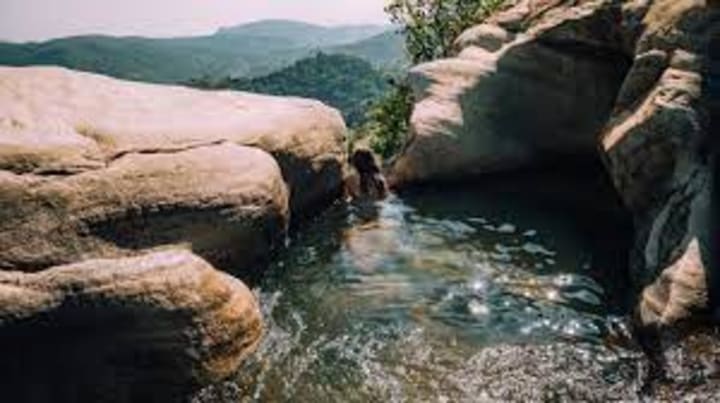
Even though it takes effort to get to the summit of Sri Lanka's second-highest waterfall, the benefits are worthwhile. There are many infinity pools at the summit that provide breathtaking views and are the ideal places to cool down in the heat. There aren't many vistas like it anyplace in the world, and if you go at the appropriate time, you won't see anybody else. The trip takes 1.5 hours each way, so give yourself at least half a day!
There are three sets of pools, so you'll need a lot of time to explore them all. The hike to the top takes around 30 to 45 minutes. It's worthwhile to view the falls from the bottom as well. It is a straightforward drive-up picture stop. We also took a 10-minute hike from the falls' base to a viewpoint and pool halfway up the falls. To the left of the falls, you'll find a clear trail; take that up through the rocky terrain until you reach the pool.
How to get in
By Train
Near the terminus of the railroad line that winds through the Hill Country, Haputale is situated midway between Nanu Oya and Badulla. From here, trains travel to Kandy and Colombo. The vistas are breathtaking, and the prices for second and third class are absurdly low. Since the trains from Badulla are normally rather full until they reach Nanu Oya, finding a seat in second or third class when traveling to Colombo or Kandy is rarely an issue. Going up to Haputale, on the other hand, is the opposite, and it may be rather congested up until the last two or three hours of the trip.
By Road
On the straight route 99 Colombo-Ratnapura-Bandarawela-Badulla, Haputale is located. Take bus 99 in the direction of Ratnapura and get out at Pelmadulla for connections to destinations in the south, including Uda Walawe, Embilipitiya, and the south coast.
Google Map:
About the Creator
Zeloan
I'm a Traveller, Blogger, and Content Creator. Visit Sri Lanka, and you can see the most beautiful places in the world and the remarkable hospitality here
After the year 2030, what will become of the International Space Station? Explanation of NASA's Deorbit Strategy
The International Space Station (ISS), the most expensive and complex structure ever assembled in space, has become both an unrivaled hub of scientific research and an increasingly difficult aging outpost to maintain in low Earth orbit. The International Space Station (ISS) has been a laboratory for experiments in everything from advanced materials science to microgravity biology for more than two decades. But as it nears its planned retirement, stakeholders are grappling with how to responsibly wind down its operations, manage its physical end, and transition to new orbital platforms.
By Raviha Imran6 days ago in Earth



Comments
There are no comments for this story
Be the first to respond and start the conversation.