
Greenhouse Gas Reduction: Building a Sustainable Future
A Call to Action for a Resilient Planet and Sustainable Prosperity.

Climate change is an urgent global challenge that calls for immediate action. Excessive accumulation of greenhouse gases in the Earth's atmosphere has resulted in increased temperatures, extreme weather events and widespread ecological disruption. Reducing greenhouse gas emissions is paramount to mitigating the effects of climate change and securing a sustainable future. In this discourse, we will consider the important topic of greenhouse gas reduction and its importance in building a sustainable future for our planet.
By understanding the role of greenhouse gases in climate change and recognizing the urgency of action, we can explore many strategies to curb emissions and promote sustainable practices in all sectors. Transitioning to clean energy sources, improving energy efficiency and promoting sustainable transportation are important components of this effort. Additionally, sustainable agriculture, waste management, and green building practices offer promising avenues for reducing greenhouse gas emissions and promoting ecological balance.
However, greenhouse gas reduction is not the responsibility of governments and industries alone. Personal actions also play an important role. Achieving significant emissions reductions requires empowering individuals to adopt sustainable lifestyles, make conscious consumption choices and contribute to the collective effort.
International cooperation, policy frameworks and monitoring mechanisms are also important for achieving greenhouse gas reductions. By collaborating at the local, national and global levels, governments, businesses and civil society can work together to implement effective strategies, share knowledge and advocate for stronger climate policies.
Furthermore, addressing greenhouse gas reduction goes beyond environmental considerations. This presents economic opportunity and job creation potential in emerging green industries. By adopting sustainable practices and fostering innovation, we can lay the foundation for a strong, low-carbon economy while ensuring social equity and a just transition for all.
In this comprehensive exploration of greenhouse gas reduction, we examine a variety of dimensions, from technological innovations and partnerships to the importance of forest conservation, climate resilience, and public engagement. By taking collective action and building a sustainable future, we can create a planet where the effects of climate change are mitigated, ecosystems thrive, and future generations live in harmony with nature.
1. Understanding Greenhouse Gases: Provide an overview of greenhouse gases (such as carbon dioxide, methane, and nitrous oxide) and their role in climate change. Explain how excessive greenhouse gas emissions contribute to global warming and need to be reduced.
2.Urgency for action: Emphasize the urgency of greenhouse gas reductions to mitigate the effects of climate change. Highlight the scientific consensus and risks associated with rising temperatures, including extreme weather events, sea level rise and ecosystem disruption.
3.Transition to Clean Energy: Discuss the importance of transitioning from fossil fuels to renewable energy sources. Highlight success stories and the potential of solar, wind, hydropower and geothermal energy in reducing greenhouse gas emissions and creating a sustainable energy future.
4.Energy Efficiency and Conservation: Explore the importance of energy efficiency measures in reducing greenhouse gas emissions. Discuss the benefits of energy-efficient technologies, building insulation, and smart grids in optimizing energy use and reducing carbon footprint.
5.Sustainable Transport: Highlight the need for sustainable transport systems to reduce emissions. Discuss the role of electric vehicles, public transport, cycling infrastructure and carpooling in reducing greenhouse gas emissions from the transport sector.
6.Green Building Practices: Discuss sustainable building practices and their contribution to greenhouse gas reduction. Highlight the importance of energy-efficient design, renewable energy integration and green materials in the construction of eco-friendly buildings.
7.Sustainable Agriculture and Land Use: Address the role of agriculture and land use in greenhouse gas emissions. Discuss sustainable agricultural practices, such as organic farming, agroforestry, and regenerative agriculture, that sequester carbon and reduce emissions from the agricultural sector.
8.Waste Management and the Circular Economy: Explain the importance of waste management practices in reducing greenhouse gas emissions. Highlight the benefits of recycling, composting and waste-to-energy technologies to reduce methane emissions and foster a circular economy.
9.Policy and Regulation: Discuss the role of policy framework and regulations in reducing greenhouse gas. Highlight examples of effective policies, such as carbon pricing, renewable energy targets and energy efficiency standards, that can encourage emissions reductions.
10.International Cooperation: Emphasize the need for global cooperation to address greenhouse gas emissions. Discuss the importance of international agreements such as the Paris Agreement and countries working together to achieve emission reduction goals.
11.Individual Actions and Education: Empower individuals to take action by adopting sustainable practices in their daily lives. Get tips on reducing energy consumption, reducing waste, supporting renewable energy, and making environmentally conscious choices. Highlight the role of education and awareness in bringing about behavior change.
12.Economic Opportunities and Job Creation: Uncover the economic opportunities and job creation potential for transitioning to a low-carbon economy. Discuss the development of green industries, the development of green technologies and the prospects for a sustainable future.
13.Forest Conservation and Deforestation: Discuss the importance of forest conservation and deforestation efforts in greenhouse gas reduction. Highlight the role of forests as carbon sinks, their ability to absorb and store carbon dioxide, and the benefits of conserving and restoring forest ecosystems.
14.Greenhouse Gas Inventory and Monitoring: Emphasize the importance of accurate greenhouse gas inventory and monitoring systems. Discuss the need for regular assessments to track emissions, identify trends, and inform decision-making processes for effective reduction strategies.
15.Technological Innovations: Explore emerging technologies and innovations that contribute to greenhouse gas reduction. Highlight advances in carbon capture and storage, renewable energy storage, and sustainable manufacturing processes that have the potential to reduce emissions.
16.Sustainable Consumption and Lifestyle Choices: Discuss the importance of sustainable consumption patterns and lifestyle choices in reducing greenhouse gas emissions. Highlight the benefits of conscious consumerism, minimalism and choosing eco-friendly products and services.
17.Partnership and Cooperation: Emphasize the importance of partnership and cooperation between governments, businesses, civil society organizations and communities. Highlight the need for cross-sectoral collaboration to implement effective greenhouse gas reduction strategies and share best practices.
18.Just transition and social equity: Address the importance of ensuring a just transition to a low-carbon economy. Discuss the need to consider social equity, protect vulnerable communities and create opportunities for those affected by the transition to green industries.
19.Climate Resilience and Adaptation: Discuss the complementary role of greenhouse gas reduction and climate resilience. Highlight the importance of adaptation measures, such as building resilient infrastructure and implementing nature-based solutions, to address current and future impacts of climate change.
20.Public engagement and political will: Emphasize the role of public engagement and political will in driving greenhouse gas reduction efforts. Highlight the power of grassroots movements, advocacy and citizen participation in influencing policy decisions and creating momentum for change.
Remember, greenhouse gas reduction is a collective effort that requires action from individuals, businesses, governments and international bodies. By implementing these strategies and working together, we can build a sustainable future and reduce the effects of climate change.
By implementing these additional points, we can further reinforce the importance of greenhouse gas reduction and building a sustainable future. Together, we can make a significant impact in mitigating climate change and building a more resilient planet.
About the Creator
Deepak Shukla
I'm Deepak Shukla, a passionate blog writer who loves to explore diverse topics and share my thoughts with the world.
Keep reading
More stories from Deepak Shukla and writers in Earth and other communities.
Collective Actions for a Sustainable Future: Combating Climate Change Together
Stopping climate change altogether is a complex task that requires global cooperation and sustained effort. While we cannot stop climate change completely, we can work towards mitigating its effects.
By Deepak Shukla3 years ago in Earth
Magnetic Magma earth
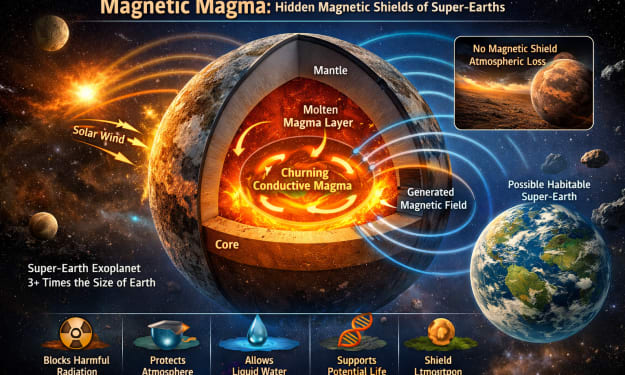
Super-Earths are rocky exoplanets more than three times the size of our planet, with far greater internal pressures and temperatures. For years, scientists assumed that if these worlds had magnetic fields, they would form the same way Earth’s does — through movement in a molten iron core. However, new laboratory experiments suggest something very different may be happening deep inside these massive planets. Under extreme pressure, certain molten rocks become electrically conductive. When these materials churn and circulate between the core and the mantle, they can generate magnetic fields on their own. This means a super-Earth might not rely solely on its core for protection. Instead, a thick, dynamic layer of magma could act as a natural magnetic shield, powered by internal heat and motion.
By USA daily update 3 days ago in Earth
Media: The Amplifier of Injustice
Media does not report reality. It selects, compresses, and amplifies fragments of it according to incentives largely unrelated to truth. What reaches the public is not an account of events; it is an engineered sequence designed to capture attention, provoke reaction, and sustain engagement.
By Meridian Voxabout 9 hours ago in Earth



Comments
There are no comments for this story
Be the first to respond and start the conversation.