

I. Introduction:
A green comet is a celestial body that appears as a bright, glowing object with a distinctive green hue in the night sky. These comets are rare and spectacular to behold, and have captured the imagination of people for centuries.
The green color of a comet is caused by the presence of a particular type of molecule, called diatomic carbon (C2), in its coma and tail. This molecule emits a green light when it is excited by the sun's radiation. The exact mechanisms behind the production of diatomic carbon in comets are still not fully understood, but scientists believe it is related to the photodissociation of carbon monoxide (CO) in the coma.
Comets are thought to be remnants from the early solar system, made up of a mixture of ice, dust, and organic compounds. They are typically small, with a nucleus that can range from a few kilometers to tens of kilometers in size. As a comet approaches the sun, the heat causes its ice to vaporize, producing a glowing coma and tail.
Recently there is a green comet which passed through earth 1st feburary 9:30 pm.This comet named Comet C/2022 E3 has been widely spoken and it again revisits earth about after 50000 years. The past visit of this comet is when neanderthals lived in earth.
Spectacular appearance:
Green comets are known for their spectacular appearance in the night sky. These celestial bodies appear as bright, glowing objects with a distinctive green hue, making them a sight to behold. The green color is due to the presence of diatomic carbon (C2) in the coma and tail of the comet, which emits a green light when excited by the sun's radiation.
As a comet approaches the sun, its ice begins to vaporize, producing a glowing coma and tail. This creates a stunning sight in the sky, as the comet moves against the backdrop of stars, leaving a bright trail in its wake. The size and brightness of the coma and tail can vary, depending on the size of the nucleus and the amount of ice and dust present in the comet.
II. Cause of green color:
The green color of a green comet is caused by the presence of diatomic carbon (C2) in its coma and tail. This molecule emits a green light when it is excited by the sun's radiation, giving the comet its distinctive green hue.
The exact mechanisms behind the production of diatomic carbon in comets are still not fully understood, but scientists believe it is related to the photodissociation of carbon monoxide (CO) in the coma. As the comet approaches the sun, the heat causes its ice to vaporize, producing a glowing coma and tail. The vaporized ice releases CO molecules into the coma, where they are excited by the sun's radiation and emit light in the green part of the spectrum.
It is important to note that not all comets exhibit a green color. The color of a comet can depend on several factors, including the composition of its nucleus, the presence of different types of molecules in its coma, and the excitation conditions in the coma. Some comets can appear yellow, white, or blue, depending on the specific types of molecules present and the conditions in the coma.
Excitation by sun's radiation:
Excitation by the sun's radiation plays a crucial role in the appearance of a green comet. As a comet approaches the sun, its ice begins to vaporize, producing a glowing coma and tail. This vapor releases molecules, including diatomic carbon (C2), into the coma.
When the sun's radiation reaches these molecules, it excites them and causes them to emit light. The green light emitted by diatomic carbon (C2) gives the comet its distinctive green hue. The sun's radiation can also cause other molecules in the coma to emit light in different parts of the spectrum, giving the comet a multi-colored appearance.
The exact excitation conditions in the coma of a comet depend on several factors, including the temperature and density of the coma, the composition of the nucleus, and the distance of the comet from the sun. These conditions can affect the brightness and color of the coma and tail, as well as the overall appearance of the comet.

III. Composition of comets:
Green comets are composed of a mixture of ice, dust, and gas. The exact composition of a green comet can vary, depending on its origin and the conditions in the solar system.
The nucleus of a green comet is composed of a mixture of ice and dust, including water ice, carbon dioxide ice, and other volatile substances. The nucleus also contains small amounts of rock, dust, and organic compounds, which are thought to be some of the building blocks of life on Earth.
The coma of a green comet is composed of gas and dust that has been released from the nucleus as it approaches the sun and its ice begins to vaporize. The gas in the coma includes water vapor, carbon dioxide, and other volatile substances, as well as smaller amounts of other gases, such as carbon monoxide (CO) and nitrogen. The dust in the coma includes small particles of rock and ice.
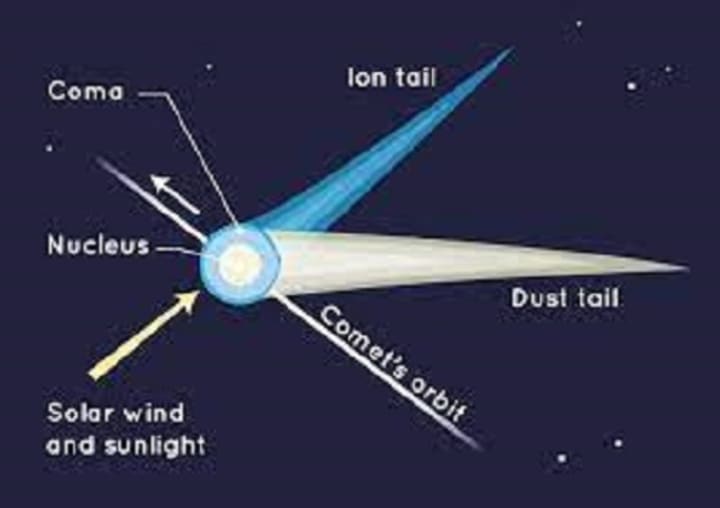
Nucleus size ranging from a few km to tens of km:
The size of a green comet's nucleus can range from a few kilometers to tens of kilometers. The exact size of a green comet's nucleus depends on several factors, including its composition, age, and the number of times it has passed close to the sun.
Smaller comets, with nuclei ranging from a few kilometers to tens of kilometers in size, are thought to be composed primarily of ice and dust. These comets are more likely to be made of volatile substances that can vaporize quickly when exposed to the sun's heat, producing a bright coma and tail.
Larger comets, with nuclei that can reach hundreds of kilometers in size, are thought to be composed of a mixture of ice, dust, and rock. These comets are less likely to vaporize completely, and their comas and tails may be less bright.
V. Famous green comet: Comet Hale-Bopp:
Comet Hale-Bopp is a famous green comet that was widely observed in the late 1990s. Discovered independently by two amateur astronomers in 1995, Comet Hale-Bopp quickly became one of the brightest comets of the 20th century.
Comet Hale-Bopp is notable for its large size, with a nucleus estimated to be tens of kilometers in diameter. This large size, combined with its bright coma and tail, made it one of the most spectacular comets in recent history. The green color of the coma was due to the presence of diatomic carbon (C2), which was excited by the sun's radiation and emitted light in the green part of the spectrum.
Comet Hale-Bopp was also notable for its long period, with a calculated orbit of about 2,500 years. This meant that it was a once-in-a-lifetime event for most observers, and it was widely studied by astronomers and space enthusiasts around the world.
Most widely observed comets:
There have been several other green comets observed in recent history, including:
- Comet McNaught (C/2006 P1): Observed in 2006, this green comet had a bright and highly visible tail and was considered one of the brightest comets of the last decade.
- Comet Neowise (C/2020 F3): Observed in 2020, this green comet was visible from Earth for several weeks and was widely observed by astronomers and the general public.
- Comet Ikeya-Seki (C/1965 S1): Observed in 1965, this green comet was one of the brightest comets of the 20th century and was visible from Earth for several months.
- Comet LINEAR (C/1999 S4): Observed in 2000, this green comet had a bright and highly visible tail and was one of the brightest comets of the late 1990s.
These comets, like Comet Hale-Bopp, are considered among the most spectacular and widely observed green comets in recent history. The green color of these comets is thought to be due to the presence of diatomic carbon (C2), which is excited by the sun's radiation and emits light in the green part of the spectrum.
VI. Conclusion:
Rare and captivating celestial objects:
Green comets are considered rare and captivating celestial objects due to their unique and visually striking appearance. They are formed by the vaporization of ice and dust in the nucleus of the comet as it approaches the sun, producing a bright coma and tail.
The green color of the coma is due to the presence of diatomic carbon (C2), which is excited by the sun's radiation and emits light in the green part of the spectrum. This gives green comets a distinctive appearance that sets them apart from other celestial objects and makes them highly sought after by astronomers and space enthusiasts.
In addition to their visually striking appearance, green comets are also of great scientific interest as they provide valuable insights into the composition and behavior of comets, which are believed to be remnants from the early solar system.
THANK YOU VIEWERS...FOR READING MY ARTICLE....
About the Creator
Industries Hit Back at Decision to Extend Over Rs15bn to Rice Exporters
The Pakistani government’s recent decision to extend more than Rs15 billion in financial support to rice exporters has sparked a wave of criticism from domestic industries. While the move is intended to boost exports and strengthen the country’s foreign exchange reserves, local manufacturers argue that it favors exporters at the expense of other industrial sectors, raising questions about fairness, economic priorities, and long-term industrial policy. Industry representatives, economists, and policymakers are now debating the potential impact of this substantial financial package, highlighting the challenges of balancing export promotion with support for domestic production and job creation. Background: The Financial Extension The government’s support package includes: Cash incentives and subsidies for rice exporters Assistance for logistics, storage, and shipment costs Measures aimed at enhancing Pakistan’s competitiveness in international rice markets According to officials, the goal is to maintain export momentum in the face of rising global demand for Pakistani rice, especially basmati and long-grain varieties. The rice industry contributes significantly to the country’s economy, providing employment to millions of farmers, millers, and transport workers. However, critics argue that while rice exporters benefit, other industrial sectors are overlooked, leaving them to bear the burden of rising costs and limited support. Industrial Sector Response Local industry associations have expressed strong opposition to the extension, citing several concerns: Unequal treatment: Manufacturers in textiles, ceramics, and other sectors feel that their contributions to the economy are being undervalued. Resource allocation: The diversion of funds to rice exporters could strain public finances and reduce available support for broader industrial development. Inflationary pressures: Critics warn that focusing heavily on exports without balancing domestic production could drive up prices for local consumers, particularly for staple goods. A spokesperson for the Pakistan Industries Association stated: "While supporting exporters is important, allocating such a large sum exclusively to rice exporters sets a dangerous precedent. All industrial sectors contribute to Pakistan’s economy and deserve equitable support." Economic Arguments Economists note that export incentives can help strengthen foreign reserves, especially in a country facing balance-of-payment pressures. Support for rice exporters may lead to: Increased foreign currency inflows Growth in agricultural output and processing industries Enhanced competitiveness in global rice markets However, experts also caution that over-reliance on subsidies for a single sector may distort the industrial landscape. Diversified support policies could help boost overall manufacturing, create jobs, and stabilize domestic prices while still promoting exports. Regional and International Implications Pakistan is a major player in the global rice market, particularly in South Asia and the Middle East. By extending financial support, the government hopes to: Maintain market share against competitors like India, Thailand, and Vietnam Encourage investment in modern milling and processing technologies Strengthen trade relations with import-dependent countries Yet, domestic industries argue that this focus on exports might undermine long-term industrial development, especially if other manufacturing sectors face financial constraints. Balancing international competitiveness with local growth remains a key challenge. Public Perception and Political Debate The decision has also sparked public debate and media scrutiny. Citizens and commentators have questioned: Why rice exporters are receiving such significant financial support while other sectors struggle Whether this approach will benefit ordinary consumers, particularly in rural and urban areas dependent on domestic production The potential for political influence or lobbying shaping economic decisions Political parties and opposition figures have criticized the government for favoring certain industries, calling for more transparent and inclusive industrial policies. Possible Solutions and Recommendations Experts suggest several measures to balance export promotion with domestic industrial growth: Equitable support: Extend incentives to other industrial sectors based on contribution to employment and GDP. Conditional subsidies: Link export incentives to investment in technology, workforce development, and sustainable practices. Transparent allocation: Ensure public funds are distributed fairly across sectors to avoid favoritism and economic imbalance. Monitoring and evaluation: Regularly assess the impact of financial support on both exports and domestic markets. By adopting a holistic approach, the government can maintain export competitiveness while ensuring that industrial growth is inclusive and sustainable. Impact on Farmers and Rural Communities While industrialists express concern, the rice industry emphasizes the benefits for farmers and rural communities: Increased income for smallholder farmers Job creation in processing, storage, and logistics Support for rural development and agricultural investment Proponents argue that supporting rice exports indirectly boosts local economies in agricultural regions, highlighting the complex trade-offs policymakers face. Looking Ahead The debate over the Rs15 billion support package is likely to continue, as industrial sectors, policymakers, and civil society weigh the benefits and drawbacks of prioritizing rice exports. Key factors to watch include: Government response to industrial backlash Adjustments to export incentives or subsidy allocations Long-term impact on domestic manufacturing and consumer prices Balancing the needs of exporters, industrial manufacturers, and domestic consumers will remain a critical challenge for Pakistan’s economic planners in the coming months. Conclusion The extension of over Rs15 billion to rice exporters has highlighted tensions between export promotion and domestic industrial interests. While the policy aims to strengthen Pakistan’s position in the global rice market and support rural economies, domestic industries argue for more equitable treatment and transparent allocation of resources. As the debate unfolds, policymakers must navigate the delicate balance between encouraging exports, supporting local manufacturing, and safeguarding consumer interests, ensuring that Pakistan’s economic growth is both inclusive and sustainable.
By Muhammad Hassan7 days ago in Earth



Comments
There are no comments for this story
Be the first to respond and start the conversation.