
Global Sugar Market Size and Forecast 2025–2033
Sweet Demand, Complex Dynamics: How the Global Sugar Market Is Evolving


Introduction
Sugar has been a cornerstone of human consumption for centuries, deeply woven into global food habits, trade routes, and agricultural economies. From everyday household use to its critical role in processed foods, beverages, pharmaceuticals, and personal care products, sugar remains one of the most essential and widely traded commodities worldwide.
According to Renub Research, the Global Sugar Market was valued at US$ 68.23 billion in 2024 and is expected to grow significantly, reaching US$ 121.08 billion by 2033, expanding at a compound annual growth rate (CAGR) of 6.58% during 2025–2033. This growth reflects the continued importance of sugar across industries, despite increasing health awareness and regulatory scrutiny.
The market’s expansion is driven by rising consumption of processed foods and beverages, growing pharmaceutical applications, expanding distribution channels, and strong demand from emerging economies. At the same time, volatility in raw material prices and health concerns related to excessive sugar intake present notable challenges.
Global Sugar Market Overview
Sugar is a carbohydrate that occurs naturally in fruits, vegetables, and dairy products, but for commercial purposes it is primarily extracted from sugarcane and sugar beet. After processing and refining, sugar is made available in several forms, including granulated sugar, powdered sugar, syrups, and liquid sugar.
Glucose derived from sugar serves as an immediate energy source for the human body, making sugar a common ingredient in food products such as bakery items, confectionery, snacks, dairy products, and beverages. Beyond food, sugar plays an increasingly important role in pharmaceutical formulations and personal care products, where it is valued for its stabilizing, moisturizing, and exfoliating properties.
Urbanization, changing lifestyles, and rising disposable incomes—especially in developing nations—have significantly increased demand for convenience foods and ready-to-drink beverages, reinforcing sugar’s relevance in the modern global economy.
Key Growth Drivers of the Global Sugar Market
Rising Consumption of Processed Foods and Convenience Products
One of the strongest drivers of the sugar market is the global rise in consumption of processed and packaged foods. Products such as soft drinks, baked goods, chocolates, candies, sauces, and ready-to-eat snacks rely heavily on sugar for taste, texture, and preservation.
Rapid urbanization and busy lifestyles have encouraged consumers to shift away from traditional meals toward convenience foods. This trend is particularly visible in emerging economies across Asia, Latin America, and the Middle East, where growing middle-class populations are adopting Western-style diets.
Growing Demand from the Beverage Industry
The global beverage sector is a major contributor to sugar demand. Sugar remains a core ingredient in carbonated soft drinks, energy drinks, flavored juices, bottled beverages, and ready-to-drink teas and coffees.
As consumption of sweetened beverages continues to rise—especially among younger demographics in developing regions—the demand for sugar remains strong. Despite growing awareness of health risks, affordability and taste preferences continue to sustain sugar usage in beverages.
Expansion of Personal Care and Cosmetic Applications
Sugar is increasingly used in personal care and cosmetic products due to its natural exfoliating and moisturizing properties. It is commonly found in facial scrubs, body scrubs, lip care products, and haircare formulations.
Consumers are showing a clear preference for natural and skin-friendly ingredients, pushing manufacturers to replace synthetic exfoliants with sugar-based alternatives. Sugar helps remove dead skin cells, improves skin texture, supports hydration, and contributes to a smoother appearance—making it a valued ingredient in clean-label cosmetic products.
This shift toward natural beauty and wellness products is positively influencing the global sugar market.
Broad Availability Through Multiple Distribution Channels
Sugar is one of the most accessible food commodities globally, available through supermarkets, local stores, wholesale markets, and increasingly through online platforms. Its affordability and long shelf life make it a staple in households and commercial kitchens alike.
Improved logistics, better storage facilities, and the rapid expansion of e-commerce have further strengthened sugar’s accessibility. Online grocery platforms, in particular, have increased bulk and retail sugar sales across both developed and emerging markets.
Challenges Facing the Global Sugar Market
Volatility in Raw Material Prices
Sugar prices are highly sensitive to fluctuations in raw material supply. Factors such as adverse weather conditions, crop diseases, changes in farming practices, and government policies in major producing countries can significantly impact sugarcane and sugar beet yields.
Droughts, floods, and climate variability often lead to supply disruptions, causing price volatility. These fluctuations affect producers, exporters, and end-users, making it difficult to maintain stable profit margins and long-term pricing strategies.
Rising Health Concerns and Shift Toward Sugar Alternatives
Growing awareness of the health risks associated with excessive sugar consumption poses a significant challenge to market growth. High sugar intake has been linked to obesity, diabetes, cardiovascular diseases, and other lifestyle-related conditions.
As a result, many consumers are actively reducing sugar intake and adopting low-carb, low-GI, and reduced-sugar diets. The increasing availability of sugar substitutes such as stevia, honey, jaggery, and artificial sweeteners is further intensifying competition.
Government initiatives such as sugar taxes, labeling regulations, and public health campaigns are also influencing consumption patterns, particularly in developed markets.
Sugar Market Size by Region and Country
Asia Pacific: The Largest Consumer Market
The Asia-Pacific region dominates global sugar consumption, led by China and India, which together account for a significant share of global demand. Large populations, rising incomes, expanding food processing industries, and strong cultural preference for sweet foods support sustained growth.
North America and Europe: Stable but Health-Conscious Markets
In North America and Europe, sugar consumption remains relatively stable but is increasingly influenced by health awareness. While demand from food and beverage industries continues, consumers are showing greater interest in reduced-sugar and alternative sweeteners.
Latin America: Global Production Powerhouse
Latin America—particularly Brazil—is a global leader in sugar production and exports. Favorable climate conditions, large-scale sugarcane cultivation, and strong infrastructure support the region’s dominance in international trade.
Middle East & Africa: Gradual Expansion
Rising populations, urbanization, and growing demand for processed foods are driving sugar consumption across the Middle East and Africa. Imports play a critical role in meeting regional demand.
Country-Level Market Insights
United States Sugar Market
The United States remains one of the world’s largest sugar markets, driven by strong demand from food and beverage manufacturers. Sugar is widely used in soft drinks, baked goods, snacks, and processed foods.
Domestic production from sugar beet and sugarcane, combined with imports, supports market supply. However, increasing health consciousness and regulatory measures are gradually encouraging reduced sugar consumption and alternative sweetener adoption.
Germany Sugar Market
Germany’s sugar market is characterized by steady industrial demand, particularly from bakery, confectionery, and beverage sectors. However, rising health awareness and clean-label trends are shifting consumer preference toward reduced-sugar and organic products.
EU policies, trade regulations, and sustainability initiatives also play an important role in shaping Germany’s sugar industry.
India Sugar Market
India is one of the largest sugar producers and consumers globally, supported by extensive sugarcane cultivation. Domestic demand remains strong due to widespread use of sugar in food, beverages, and traditional sweets.
In August 2023, NSL Sugars and UPL Sustainable Agriculture Solutions (UPL SAS) signed a Memorandum of Understanding to promote sustainable sugarcane farming, aiming to increase yield by 15% (5 metric tonnes per acre). Government policies, subsidies, and weather conditions continue to influence market dynamics.
Saudi Arabia Sugar Market
Saudi Arabia’s sugar market is driven by high consumption of processed foods, soft drinks, and confectionery. While health concerns are growing, sugar remains a dietary staple.
The market relies heavily on imports, and government initiatives such as sugar taxes and public awareness campaigns are gradually influencing consumption patterns.
Global Sugar Market Segmentation
By Product Type
White Sugar
Brown Sugar
Liquid Sugar
By Form
Granulated
Powdered
Syrup
By Source
Sugarcane
Sugar Beet
By End User
Food and Beverages
Pharma and Personal Care
Household
By Region
North America
Europe
Asia Pacific
Latin America
Middle East & Africa
Key Companies in the Global Sugar Market
Major players operating in the global sugar industry include:
Archer Daniels Midland
Tate & Lyle
General Mills, Inc.
MGP Ingredients Inc.
Kerry Group
Südzucker AG
Tereos
Cosan SA
These companies are evaluated across four key dimensions: company overview, key leadership, recent developments and strategies, and financial performance.
Final Thoughts
The global sugar market continues to balance tradition with transformation. While health concerns and sugar alternatives are reshaping consumer behavior, sugar remains deeply embedded in global food systems, industrial processes, and cultural consumption patterns.
With the market projected to grow from US$ 68.23 billion in 2024 to US$ 121.08 billion by 2033, the coming years will see sugar producers and manufacturers adapting through innovation, sustainability initiatives, and diversified applications.
As emerging economies drive demand and developed markets focus on moderation and reformulation, the global sugar industry is set to remain a vital—though increasingly complex—component of the world’s commodity landscape.
About the Creator
jaiklin Fanandish
Jaiklin Fanandish, a passionate storyteller with 10 years of experience, crafts engaging narratives that blend creativity, emotion, and imagination to inspire and connect with readers worldwide.
Keep reading
More stories from jaiklin Fanandish and writers in Earth and other communities.
Amniotic Membrane Market Size and Forecast 2025: Regenerative Medicine Accelerates Global Growth
Global Amniotic Membrane Market Overview The global amniotic membrane market is entering a decisive growth phase as regenerative medicine gains mainstream acceptance across healthcare systems worldwide. According to Renub Research, the amniotic membrane market is expected to reach US$ 7.38 billion by 2033, rising sharply from US$ 2.73 billion in 2024, at a robust CAGR of 11.68% from 2025 to 2033.
By jaiklin Fanandishabout a month ago in Earth
BRICS Wargames: Why They Matter — And Why India Chose to Sit Out
BRICS — the economic and political bloc comprising Brazil, Russia, India, China, and South Africa — has long been seen as a counterweight to Western-dominated global institutions. Over the years, it has expanded its influence in finance, trade, and diplomacy. Yet, in recent times, BRICS has begun exploring another domain that grabs headlines and sparks speculation: military cooperation, including large-scale wargames. These exercises are designed to simulate joint operations, test interoperability, and send a signal of strength. For members like Russia and China, wargames serve as both a show of force and a tool to deepen military collaboration within the bloc. However, India’s decision to opt out of recent BRICS wargames has raised questions: why does this matter, and why is India taking a different path from its BRICS partners? The Rise of BRICS Military Exercises Historically, BRICS has been portrayed as primarily economic, focused on initiatives like the New Development Bank (NDB) and trade agreements aimed at reducing Western dominance. But recent years have seen an evolution. Military drills among BRICS members are increasingly prominent, especially in the context of global tension and regional conflicts. These wargames are about more than just tactical drills. They serve multiple purposes: Strategic signaling: By conducting joint exercises, BRICS countries demonstrate unity and military capability to the rest of the world. Operational readiness: Countries test their ability to coordinate in complex scenarios, from humanitarian missions to potential combat operations. Diplomatic leverage: The exercises send subtle messages to other global powers, indicating that BRICS members can collaborate beyond economic forums. For nations like Russia, recently facing sanctions and international scrutiny, these exercises are particularly important. They showcase the ability to maintain partnerships and project power despite global isolation. For China, it is a way to cement strategic influence in Asia and beyond. Why BRICS Wargames Matter Globally The significance of these exercises extends beyond the bloc itself. Analysts note several key implications: Challenge to NATO and U.S. influence: BRICS wargames signal that alternative power centers exist outside Western-led military alliances. Regional security dynamics: Countries bordering BRICS members, particularly in South Asia, Africa, and Latin America, must monitor these developments carefully. Economic-military linkages: Military coordination among major emerging economies could shape security considerations in trade corridors, energy supply routes, and resource-rich regions. In essence, BRICS wargames are not just about soldiers and tanks, but about the broader geopolitical landscape: signaling, strategy, and shaping perceptions of influence. India’s Calculated Decision to Opt Out While Russia, China, Brazil, and South Africa have shown interest in participating actively, India has strategically chosen to abstain from the most recent wargames. This decision may appear surprising, given India’s economic and political stake in BRICS, but several factors explain it. Geopolitical balancing: India maintains complex relations with both China and Russia. While it has defense and historical ties with Russia, its relationship with China has grown tense due to border disputes and regional competition. Joining a wargame with China could be politically and militarily sensitive. Alignment with Western partnerships: India has strengthened ties with Western-led coalitions, including the Quad (U.S., Japan, Australia, India). Participating in BRICS military drills could conflict with these alliances, potentially sending mixed signals. Strategic autonomy: India has long emphasized a policy of strategic autonomy — making decisions based on national interest rather than bloc pressure. Opting out allows India to maintain flexibility in foreign policy and avoid entanglement in exercises that may not align with its regional objectives. Domestic perception: Indian public opinion and political narratives favor cautious engagement with China and Russia on military matters. Skipping the wargames minimizes domestic criticism of appearing too closely aligned with either of the more assertive BRICS powers. What India Gains by Sitting Out Choosing not to participate does not mean India is disengaged from BRICS. Economically and diplomatically, it remains a key player in the bloc. By skipping the wargames, India can: Maintain regional credibility in South Asia while avoiding the perception of aligning militarily with China. Signal strategic independence, reinforcing its image as a nation that prioritizes national security over bloc politics. Focus on bilateral and multilateral exercises elsewhere, such as those with the U.S., Japan, and Australia, which are more aligned with India’s current security priorities. In short, opting out allows India to navigate the delicate balance between its BRICS commitments and broader global strategic interests. Implications for BRICS and Global Security India’s abstention also reflects broader trends within BRICS: the bloc is not monolithic. While economic cooperation is often strong, military integration faces political and strategic limits. Differing national interests, historical rivalries, and regional tensions prevent uniform alignment. For global observers, this is crucial. It shows that while BRICS wargames are important, they are not necessarily indicative of a fully unified military bloc. The exercises are as much about optics as operations, and India’s absence underscores the challenges of aligning countries with divergent security priorities. Conclusion BRICS wargames matter because they are a window into the bloc’s evolving strategic ambitions. They signal power, test cooperation, and demonstrate emerging global influence. Yet India’s decision to opt out highlights that even within this growing coalition, national interests remain paramount. For India, the choice reflects a calculated approach: engage where it benefits national interest, avoid where risks outweigh gains, and maintain strategic flexibility. For the rest of the world, it is a reminder that BRICS, while increasingly important, is not a military monolith. Ultimately, BRICS wargames are as much about geopolitics and signaling as they are about military maneuvers — and India’s careful stance illustrates how emerging powers navigate this complex global chessboard.Start writing...
By Muhammad Hassan7 days ago in Earth
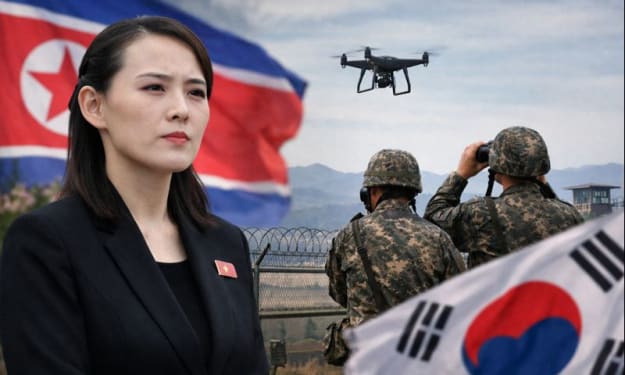
Tensions in the Sky: North Korea Calls on South Korea to Probe Drone Incidents
Tensions between North and South Korea have once again made international headlines after North Korea accused its southern neighbor of sending drones into its airspace. At the center of the issue is Kim Yo Jong, the influential sister of North Korean leader Kim Jong Un, who has urged South Korea to investigate the alleged drone incidents and provide a clear explanation. While drones may seem small, the political impact of this dispute is anything but minor.
By dua fatima7 days ago in Earth



Comments
There are no comments for this story
Be the first to respond and start the conversation.