
Global Biodegradable Plastic Market Size and Forecast 2025
Sustainable Materials Redefining the Future of Plastics

Global Biodegradable Plastic Market Outlook
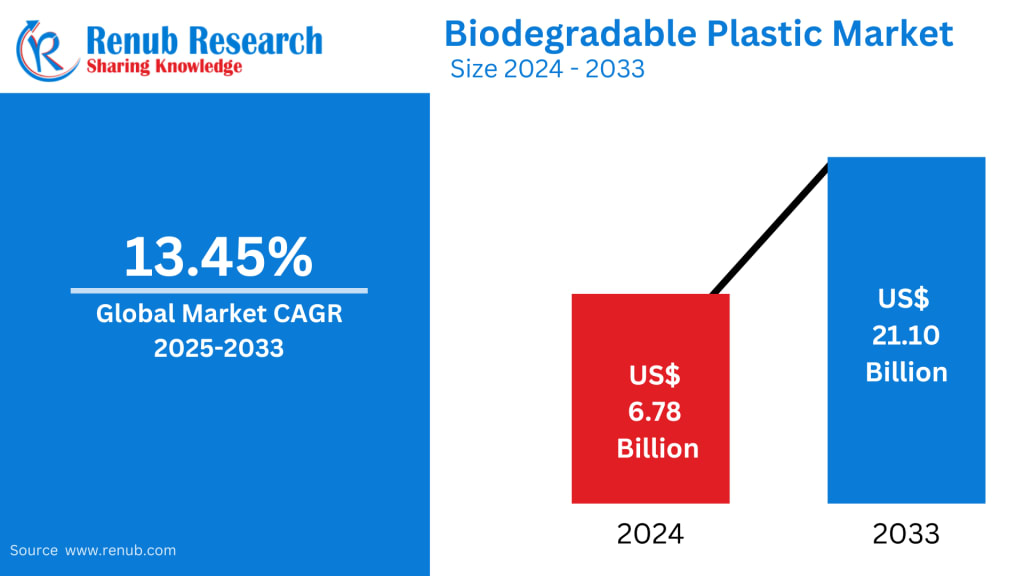
The global biodegradable plastic market is witnessing rapid expansion as governments, corporations, and consumers shift toward environmentally responsible materials. According to Renub Research, the biodegradable plastic market is projected to reach US$ 21.10 billion by 2033, up from US$ 6.78 billion in 2024, growing at a robust CAGR of 13.45% between 2025 and 2033.
This strong growth trajectory is driven by a combination of stringent government regulations, rising consumer awareness regarding plastic pollution, and surging demand for eco-friendly packaging solutions across food, agriculture, retail, and consumer goods industries.
What Are Biodegradable Plastics?
Biodegradable plastics are materials designed to break down naturally into water, carbon dioxide, and biomass through the action of microorganisms such as bacteria and fungi. Depending on the polymer type and disposal environment, decomposition may occur over months or years, significantly reducing environmental harm compared to traditional petroleum-based plastics.
These plastics may be derived from renewable plant-based sources such as corn starch, sugarcane, or cellulose, or from synthetic biodegradable polymers engineered to degrade under specific conditions like heat, oxygen, or sunlight. Their versatility has made them increasingly popular in packaging, agriculture, consumer products, and medical applications.
Market Dynamics: Key Growth Drivers
Rising Environmental Awareness
Escalating concerns about plastic waste in oceans, landfills, and ecosystems have intensified the global demand for biodegradable alternatives. Conventional plastics take centuries to decompose, causing long-term environmental damage. Biodegradable plastics offer a compelling solution by reducing landfill accumulation and lowering carbon footprints, making them a preferred choice for sustainability-focused consumers and industries.
Consumer Demand for Sustainable Products
Consumers are increasingly prioritizing sustainability when making purchasing decisions. Eco-conscious buyers favor biodegradable packaging, compostable containers, and green household products, pushing brands to innovate and diversify their product portfolios. This shift in consumer behavior is accelerating market adoption across food packaging, personal care, and daily-use consumer goods.
Corporate Sustainability Initiatives
Major corporations are committing to ambitious sustainability goals, including plastic neutrality, carbon reduction, and circular economy adoption. As a result, biodegradable plastics are becoming integral to corporate supply chains, particularly in retail, FMCG, and foodservice sectors. Beyond regulatory compliance, these initiatives enhance brand reputation and customer loyalty.
Supportive Government Regulations
Governments worldwide are implementing bans on single-use plastics, extended producer responsibility (EPR) policies, and quality certification systems that favor biodegradable materials. These regulations are acting as powerful catalysts for market expansion, encouraging manufacturers to scale production and invest in innovation.
Technological Advancements and Industry Developments
Continuous R&D has significantly improved the durability, cost efficiency, and performance of biodegradable plastics. Advances in polymer blends, barrier coatings, and nanocomposites are expanding their applicability across demanding use cases.
A notable industry development occurred in May 2024, when SKC, a South Korean chemical company, announced the construction of the world’s largest biodegradable plastic plant in Hai Phong, Vietnam. The facility will produce 70,000 tons of PBAT annually, reinforced with tree-derived nanocellulose to enhance strength and versatility for packaging and hygiene products.
Challenges Facing the Biodegradable Plastic Market
Limited Availability of Raw Materials
Many biodegradable plastics rely on agricultural feedstocks such as corn, sugarcane, and starch. Fluctuations in crop yields, climate conditions, and commodity prices can disrupt supply chains and increase production costs. Additionally, concerns regarding food security and land use may limit large-scale expansion.
Performance Limitations
Despite environmental benefits, biodegradable plastics may fall short of conventional plastics in terms of moisture resistance, mechanical strength, and durability. These limitations restrict adoption in applications requiring long-term performance, such as construction or heavy-duty packaging. Ongoing material innovation is essential to overcome these challenges.
Material Type Insights
Polybutylene Succinate (PBS)
PBS is gaining popularity due to its excellent thermal stability, mechanical strength, and compostability. Widely used in packaging films, agricultural products, and disposable items, PBS demand is increasing rapidly in Europe and Asia-Pacific as manufacturers expand capacity and invest in R&D collaborations.
Polylactic Acid (PLA)
PLA, derived from renewable resources like corn starch and sugarcane, is one of the most widely adopted biodegradable plastics. Its transparency and rigidity make it ideal for food packaging, disposable cutlery, and 3D printing. While industrial composting infrastructure remains a limitation, expanding production capacity is meeting growing global demand.
Starch Blends
Starch blends are cost-effective and widely available, making them popular for packaging films, compost bags, and agricultural mulch. Performance in humid environments remains a challenge, but formulation improvements are expanding their usability across multiple industries.
Application-Based Market Analysis
Packaging
Packaging represents the largest application segment, driven by regulatory bans on plastic packaging and growing FMCG sustainability commitments. PLA, PBS, and PHA are increasingly used for trays, films, containers, and shopping bags, supported by innovations in printability and barrier performance.
Agriculture
Biodegradable plastics are transforming agriculture through mulch films, plant pots, and seed coatings. These products eliminate post-harvest plastic waste and reduce labor costs. Government mandates in Europe and Asia are further accelerating adoption.
Consumer Goods
Daily-use items such as cutlery, straws, toothbrushes, and personal care packaging are increasingly manufactured using biodegradable plastics. Millennials and Gen Z consumers, in particular, are driving demand for sustainable consumer products worldwide.
Regional Market Insights
United States
The U.S. biodegradable plastic market is growing steadily due to environmental awareness, single-use plastic bans, and corporate sustainability commitments. While high production costs and raw material constraints remain challenges, expanding composting infrastructure and technological progress are supporting long-term growth.
United Kingdom
Strong government regulations, including plastic bag bans and EPR schemes, are driving market expansion in the UK. Packaging, foodservice, and agriculture sectors are leading adopters, with continued growth expected as composting infrastructure improves.
China
China is one of the fastest-growing markets, supported by aggressive bans on non-degradable plastics in e-commerce, food delivery, and agriculture. Large-scale investments in PLA and PBS production are strengthening domestic supply, although composting infrastructure still requires expansion.
India
India’s market is expanding due to nationwide bans on single-use plastics and rising environmental awareness. While challenges such as high costs and limited waste management infrastructure persist, government initiatives and corporate sustainability programs are expected to drive strong future growth.
Other Key Markets
Australia, Malaysia, Brazil, and the UAE are witnessing increasing adoption driven by sustainability initiatives, marine pollution concerns, and supportive regulations. Public-private partnerships and infrastructure development will be critical to unlocking full market potential in these regions.
Market Segmentation Overview
By Material Type:
PBAT | PBS | PLA | PHA | Starch Blends | Others
By Application:
Packaging | Agriculture | Consumer Goods | Others
By Country:
United States, Canada, Germany, UK, France, Italy, Netherlands, Spain, China, Japan, India, Malaysia, Brazil, UAE, Australia, South Africa, and Rest of the World
Key Companies Profiled
Total Corbion
Mitsubishi Chemical Holding Corporation
Toray Industries
BASF SE
Green Dot Bioplastics
Amcor Limited
Each company is analyzed across overview, key leadership, recent developments, and financial insights, providing a comprehensive competitive landscape.
Final Thoughts
The global biodegradable plastic market is transitioning from niche adoption to mainstream application as sustainability becomes a strategic imperative across industries. While challenges related to cost, performance, and infrastructure remain, continuous innovation, supportive regulations, and shifting consumer preferences are reshaping the plastics industry.
As governments tighten environmental policies and corporations commit to greener supply chains, biodegradable plastics are set to play a critical role in building a sustainable, circular economy over the next decade.
About the Creator
Janine Root
Janine Root is a skilled content writer with a passion for creating engaging, informative, and SEO-optimized content. She excels in crafting compelling narratives that resonate with audiences and drive results.
Keep reading
More stories from Janine Root and writers in Earth and other communities.
GCC Hydroponics Market Trends & Summary
Introduction The Gulf Cooperation Council (GCC) is undergoing a quiet yet powerful agricultural transformation. In a region long constrained by arid climates, scarce freshwater resources, and limited arable land, hydroponics has emerged as a game-changing solution. Once considered a niche farming method, hydroponics is now rapidly becoming a cornerstone of the GCC’s food security and sustainability strategies.
By Janine Root 28 days ago in Earth
Europe Draws a Red Line on Greenland After a Year of Trying to Pacify Trump
For nearly a year, European leaders walked a diplomatic tightrope. They tried calm language, quiet reassurance, and strategic patience as former U.S. President Donald Trump repeatedly revived his controversial interest in Greenland. What began as provocative rhetoric gradually evolved into something Europe could no longer ignore. Now, after months of behind-the-scenes diplomacy, Europe has drawn a clear red line on Greenland — signaling that compromise has its limits when sovereignty and regional security are at stake. This shift marks more than a response to one leader’s remarks. It reflects Europe’s growing determination to defend territorial integrity, manage Arctic competition, and assert strategic autonomy in an increasingly unpredictable geopolitical environment. How Greenland Became a Flashpoint Again Greenland, an autonomous territory within the Kingdom of Denmark, has long held strategic importance. Rich in rare earth minerals, located along key Arctic routes, and home to critical U.S. military infrastructure, the island sits at the crossroads of security, climate change, and great-power rivalry. Donald Trump’s original proposal in 2019 to “buy” Greenland was widely mocked in Europe. But as his political influence resurged, so did concerns that his renewed interest was not just symbolic. Over the past year, Trump’s rhetoric — framed around U.S. security, resource access, and countering China and Russia in the Arctic — became more persistent. European capitals initially chose restraint. Officials hoped that de-escalation, quiet diplomacy, and alliance solidarity would prevent the issue from spiraling into a transatlantic rift. A Year of European Pacification For much of the past year, Europe adopted a strategy of pacification rather than confrontation. Denmark emphasized its close defense cooperation with Washington. EU leaders reiterated NATO unity and the importance of Arctic stability. Diplomats avoided public criticism, choosing private channels instead. The goal was clear: prevent Trump’s Greenland narrative from becoming official U.S. policy while preserving transatlantic relations. However, this approach had limits. As Trump’s language grew sharper — hinting at leverage, pressure, or “strategic necessity” — European patience began to erode. What once sounded like political theater increasingly resembled a challenge to European sovereignty norms. Why Europe Finally Drew the Line Europe’s tougher stance did not emerge overnight. It was driven by several converging realities. 1. Sovereignty Is Non-Negotiable At the heart of Europe’s response is a firm principle: territorial sovereignty cannot be bargained away. Greenland is not a commodity, and its future cannot be dictated by external powers — regardless of alliance ties. European leaders made it clear that any attempt to apply pressure on Denmark or Greenland would cross a red line, undermining international law and democratic self-determination. 2. Arctic Competition Is Intensifying The Arctic is no longer a frozen backwater. Melting ice has opened new shipping routes and intensified competition over resources. Russia has militarized large parts of its Arctic territory, while China has declared itself a “near-Arctic state.” Against this backdrop, Europe fears that normalizing aggressive rhetoric over Greenland could set a dangerous precedent, encouraging other powers to challenge borders under the guise of security or economic necessity. 3. Europe’s Strategic Confidence Has Grown Compared to 2019, Europe today is less willing to absorb geopolitical shocks quietly. The war in Ukraine accelerated Europe’s defense integration and sharpened its sense of strategic responsibility. Standing firm on Greenland is part of a broader shift: Europe is signaling that being a U.S. ally does not mean surrendering political agency. Greenland’s Own Voice Matters One crucial difference between past debates and today is the prominence of Greenlandic leaders themselves. Officials in Nuuk have repeatedly emphasized that Greenland’s future will be decided by its people, not by foreign capitals. Calls for respect, partnership, and economic development — rather than transactional geopolitics — have resonated strongly in Europe. By drawing a red line, European leaders are also amplifying Greenland’s right to self-determination, reinforcing the idea that Arctic communities are stakeholders, not strategic prizes. What This Means for Transatlantic Relations Europe’s firmer stance does not signal a break with the United States. NATO cooperation in the Arctic remains strong, and U.S. military presence in Greenland continues with Danish consent. However, the message is unmistakable: allies must respect boundaries. European officials are increasingly willing to publicly disagree with Washington when core principles are threatened. This reflects a maturing alliance — one where unity does not require silence. In the long run, this clarity may actually strengthen transatlantic relations, reducing ambiguity and preventing future misunderstandings. A Signal Beyond Greenland Europe’s red line on Greenland sends a message far beyond the Arctic. It signals to Russia and China that Europe will defend its territorial order, even under pressure from powerful actors. It reassures smaller states that sovereignty remains a foundational norm. And it underscores that Europe is learning to balance diplomacy with firmness in an era of great-power competition. Conclusion: From Pacification to Principle After a year of cautious diplomacy, Europe has chosen principle over placation. The red line drawn around Greenland is not an act of hostility — it is an assertion of values. In a world where power politics are returning, Europe is making one thing clear: sovereignty is not negotiable, alliances are not blank checks, and Arctic stability requires respect — not rhetoric. Greenland may be vast and sparsely populated, but the message Europe is sending from its icy shores is unmistakably global.
By Muhammad Hassan5 days ago in Earth
Stanislav Kondrashov on the Quiet Power Driving the Energy Transition: Electrification
In the global conversation about the future of energy, it's often the loudest innovations that capture attention—new technologies, sweeping policy changes, and major infrastructure projects. Yet beneath the surface, a quieter revolution is taking place. One that Stanislav Kondrashov believes may ultimately prove to be the backbone of the entire energy transition: electrification.
By Stanislav Kondrashov5 days ago in Earth



Comments
There are no comments for this story
Be the first to respond and start the conversation.