
James Webb Telescope Discovers Possible Signs of Alien Life on Distant Exoplanet K2-18b
NASA’s James Webb Space Telescope detects potential biosignature gases in the atmosphere of exoplanet K2-18b raising hopes in the search for extraterrestrial life.

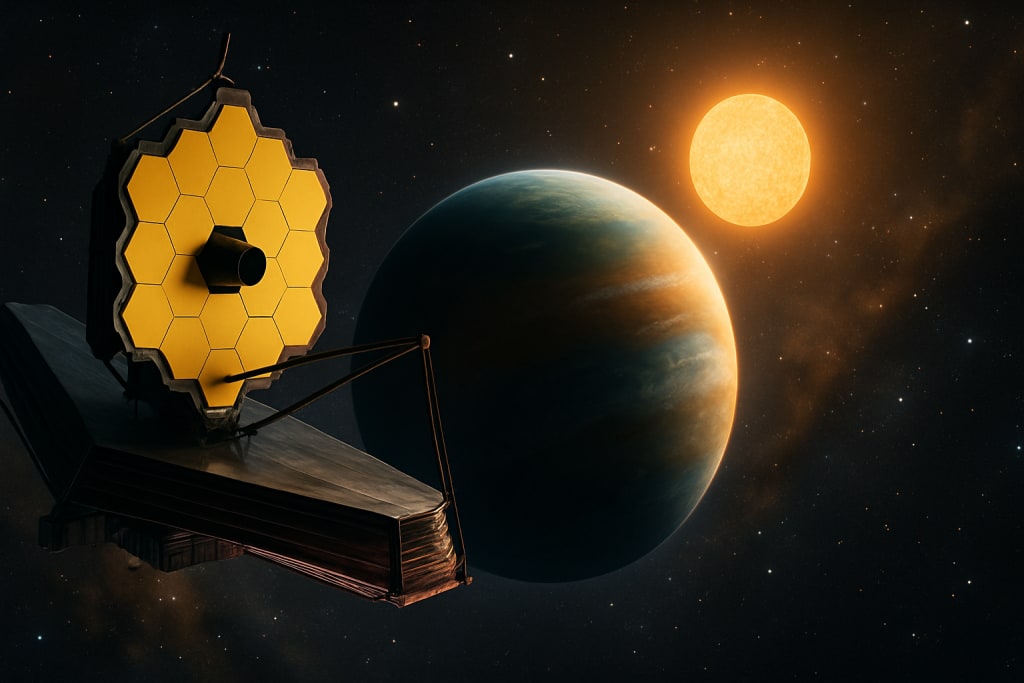
James Webb Telescope Discovers Possible Signs of Alien Life on Distant Exoplanet K2-18b
NASA’s James Webb Space Telescope detects potential biosignature gases in the atmosphere of exoplanet K2-18b raising hopes in the search for extraterrestrial life.
In a historic milestone for space exploration and the search for extraterrestrial life NASA's James Webb Space Telescope (JWST) has detected potential signs of life on a distant exoplanet. This discovery made possible by the most advanced space observatory ever built, could bring humanity one step closer to answering the profound question Are we alone in the universe? The exoplanet in question known as K2-18b is located approximately 120 light years from Earth in the constellation Leo. Classified as a “Hycean” world K2-18b is a type of exoplanet believed to be covered in vast oceans beneath a hydrogen-rich atmosphere. Its size is nearly 2.6 times that of Earth and it orbits within the habitable zone of its star meaning it receives just the right amount of heat to potentially support liquid water on its surface a key ingredient for life.
The Groundbreaking Discovery
Using its powerful infrared instruments the James Webb Space Telescope has detected a molecule called dimethyl sulfide (DMS) in the atmosphere of K2-18b. This is a particularly exciting find because on Earth DMS is almost exclusively produced by life primarily by marine phytoplankton. The presence of DMS could be a strong biosignature a chemical hint that life might be present. In addition to DMS the Webb Telescope also detected significant levels of methane (CH4) and carbon dioxide (CO2). These gases are typically associated with biological and geological processes. The specific ratio and presence of these gases in the planet’s atmosphere suggest that the environment might be suitable for microbial life especially in the presence of a large water ocean.
Why K2-18b is Special
K2-18b is considered one of the most promising candidates for life outside our solar system for several reasons:
1. Located in the Habitable Zone: The planet lies in the region around its star where conditions are neither too hot nor too cold for liquid water to exist, a fundamental requirement for life as we understand it.
2. Hycean World: This class of exoplanets is theorized to have a water-rich environment with a thick hydrogen atmosphere a combination that may support microbial life in a way similar to early Earth.
3. Complex Atmospheric Chemistry: The detection of multiple gases including a possible biosignature like DMS raises the possibility that biological processes may be occurring on the planet.
Scientific Caution and Next Steps
Despite the excitement scientists are urging caution. While the presence of DMS is intriguing it is not yet confirmed. Other non biological processes could potentially produce the same molecule especially under unfamiliar planetary conditions. More observations and data are needed to confirm the presence of DMS and understand its source. Future studies will also attempt to detect other biosignatures and understand the planet’s climate surface conditions and atmospheric stability. NASA and international space agencies plan to continue monitoring K2-18b using JWST and future missions like the Habitable Worlds Observatory. If further studies confirm that the detected chemicals are indeed of biological origin this would mark one of the most significant scientific discoveries in human history. The James Webb Space Telescope has opened a new frontier in the search for life beyond Earth. For the first time we have the tools to closely examine the atmospheres of distant exoplanets analyzing their chemical compositions with incredible precision. The possibility that a planet over 100 light years away could harbor life is both thrilling and humbling. While we still have many questions the discovery on K2-18b represents a leap forward in our understanding of the universe and our place within it. As technology advances and telescopes become even more powerful we may soon be able to confirm whether life exists beyond Earth a revelation that would reshape science, philosophy, and our vision of the cosmos forever.
SEO KEYWORD:
James Webb Space Telescope, Signs of alien life, K2-18b exoplanet, Webb telescope discovery, Biosignature gases, NASA space discoveries, Distant habitable planet, Life on other planets, Dimethyl sulfide in space, Methane and CO2 in exoplanet atmosphere, Habitable zone planets, Super Earth detection, Has the James Webb Telescope found alien life? What is K2-18b and why is it important? Evidence of life beyond Earth, Possible life on distant exoplanet K2-18b, NASA detects life signs with James Webb Telescope.
About the Creator
Adnan Rasheed
Author & Creator | Writing News , Science Fiction, and Worldwide Update| Digital Product Designer | Sharing life-changing strategies for success.
Keep reading
More stories from Adnan Rasheed and writers in Earth and other communities.
Europe Amniotic Membrane Market Size & Forecast 2025–2033
Europe Amniotic Membrane Market Outlook The Europe Amniotic Membrane Market is undergoing a significant transformation as regenerative medicine gains momentum across clinical disciplines. According to Renub Research, the market is projected to grow from US$ 788.42 million in 2024 to US$ 1,892.79 million by 2033, expanding at a CAGR of 10.22% during 2025–2033.
By jaiklin Fanandishabout 4 hours ago in Earth


Comments (1)
Very interesting and informative article, good luck