
Auther Name Hazratullah
Far away, in the quiet arms of the highest mountains, where winds sing ancient songs and peaks pierce the sky, lies a world few truly know—the world of glaciers. They are not just frozen rivers of ice; they are living archives of Earth’s history, immense and silent giants shaped by time itself.
A glacier begins with snow—endless snow that never fully melts. Layer upon layer, year after year, the snow compresses under its own weight. The crystals fuse, the air is squeezed out, and what was once soft powder becomes hard, blue ice. Over centuries, gravity pulls this mass slowly downhill. Some glaciers creep only a few centimeters a day; others slide meters in a year. They move so slowly that to the human eye they appear motionless, yet they are always alive, always flowing.
Glaciers are Earth’s natural reservoirs. Nearly seventy percent of the world’s fresh water is locked within them. When they melt, rivers swell, valleys bloom, and cities far downstream thrive. But when they vanish, drought and scarcity follow. For millions of people across Asia, South America, and beyond, glaciers are not just scenery—they are survival.
One such glacier became the heart of a young scientist’s journey. His name was Eliah, a researcher fascinated since childhood by ice and time. With his small team, he traveled into the remote folds of the Himalayas. The expedition was dangerous: narrow ridges, thin air, and nights so cold that water froze solid in the cup before one could drink it. Yet Eliah’s heart pounded with excitement. He was about to meet a glacier face to face.
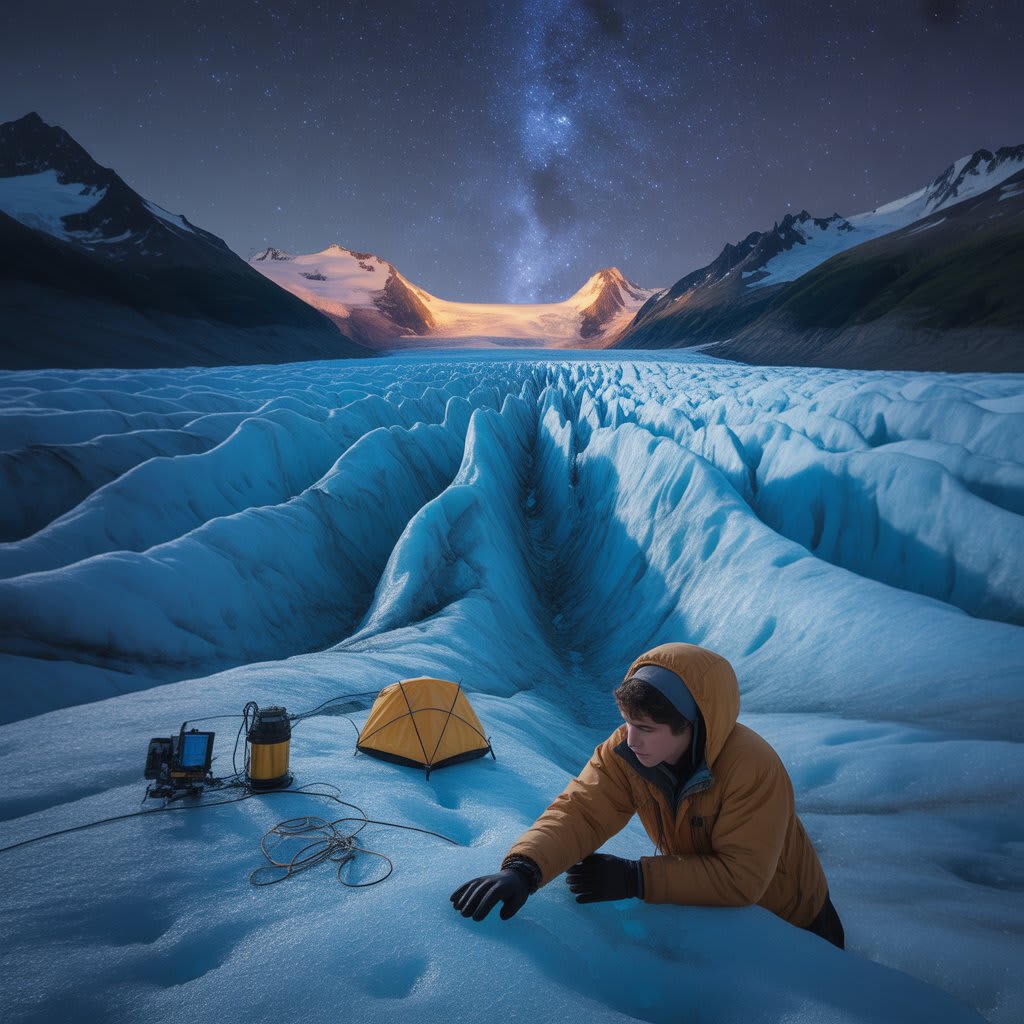
When he finally stood before it, he was struck silent. The glacier towered like a frozen sea, stretching beyond sight, its surface fractured with deep crevasses glowing with blue light. It looked less like Earth and more like another planet.
He remembered his textbooks: “A glacier is a time machine.” Every layer of ice holds a story of climate, weather, even volcanic eruptions and ancient winds. Eliah’s mission was to take samples and study them, to look back thousands of years and perhaps predict what might come next.
But the glacier was more than an object of study. It had a presence. At times, deep within its belly, Eliah and his team heard thunderous cracks and groans. The ice shifted, slowly but powerfully, like the breathing of a giant asleep. Startled, Eliah looked at his mentor, who only smiled.
“That’s the glacier speaking,” the older scientist said. “It is alive. Not in the way we are, but in the language of centuries.”
That night, beneath a dome of stars, Eliah sat by the glacier’s edge. The silence was vast. He imagined all the history sealed beneath him—the dust of ancient storms, traces of air from ages when humans had not yet lit their first fires. Each bubble trapped in the ice was a messenger from the past.
Yet a shadow of worry hung over his thoughts. He knew the truth: glaciers around the world were melting faster than ever. Rising temperatures were eating away at them. Places that had been frozen for millennia were now rivers of water. And once gone, they would not return in any human lifetime.
Days later, the team reached a yawning crevasse. Eliah descended carefully, ropes biting into the ice. Inside, it was like entering a cathedral of glass. The walls glowed with shades of turquoise and sapphire, layers stacked like the pages of an endless book. He took a core sample, drilling deep, and when he examined it later in the lab, he found bubbles of ancient air—tiny pockets from thousands of years ago. They told of climates long forgotten, of a world untouched by machines or cities.
The discovery filled him with awe. Glaciers were not merely frozen water. They were the memory of the planet. To lose them would be like burning the library of Earth itself.
But the library was already on fire. From the Alps to the Andes, from Greenland to Antarctica, glaciers were shrinking. Entire valleys that once held rivers of ice were now bare rock. Some scientists predicted that in a hundred years, many mountain glaciers would disappear completely. That meant less water for farms, less flow for rivers, and greater danger of floods when the ice broke too quickly.
Eliah wrote in his journal:
“We measure our lives in decades, in hurried years. Glaciers measure in millennia. They are patient, but they cannot withstand our impatience. If we do not change, their silence will turn into absence.”
His words carried weight. He began to speak not only as a scientist but as a messenger. He lectured about reducing carbon emissions, about rethinking how humanity used water, about protecting the balance of nature. His message was simple: the fate of glaciers was tied to the fate of humanity.
Standing once more at the glacier’s edge before leaving, Eliah placed his hand on the ice. It was solid, ancient, and cold, but beneath his palm, he felt the faint pulse of slow movement. He whispered,
“We will try to save you. Because if you vanish, so do we.”
The glacier gave no answer, only the deep rumble of shifting ice echoing from within. But Eliah knew it had heard.
-
About the Creator
Keep reading
More stories from Asmatullah and writers in Earth and other communities.
Forest
Auther Name Asmatullah The forest had always been there, silent yet alive, stretching farther than the eyes of any villager could reach. To some, it was a place of fear, full of shadows that swallowed men and never returned them. To others, it was a land of wonder, where the trees carried secrets older than human memory. For Arian, a boy of seventeen, the forest was both: danger and dream, fear and freedom.
By Asmatullah6 months ago in Earth
After the year 2030, what will become of the International Space Station? Explanation of NASA's Deorbit Strategy
The International Space Station (ISS), the most expensive and complex structure ever assembled in space, has become both an unrivaled hub of scientific research and an increasingly difficult aging outpost to maintain in low Earth orbit. The International Space Station (ISS) has been a laboratory for experiments in everything from advanced materials science to microgravity biology for more than two decades. But as it nears its planned retirement, stakeholders are grappling with how to responsibly wind down its operations, manage its physical end, and transition to new orbital platforms.
By Raviha Imran5 days ago in Earth


Comments
There are no comments for this story
Be the first to respond and start the conversation.