
From Waste to Wonder: Why Bagasse Bowls Are Redefining Sustainable Dining
Turning Sugarcane Waste into Stylish, Compostable Bowls for Takeout, Meal Prep, and Eco-Conscious Dining in 2025
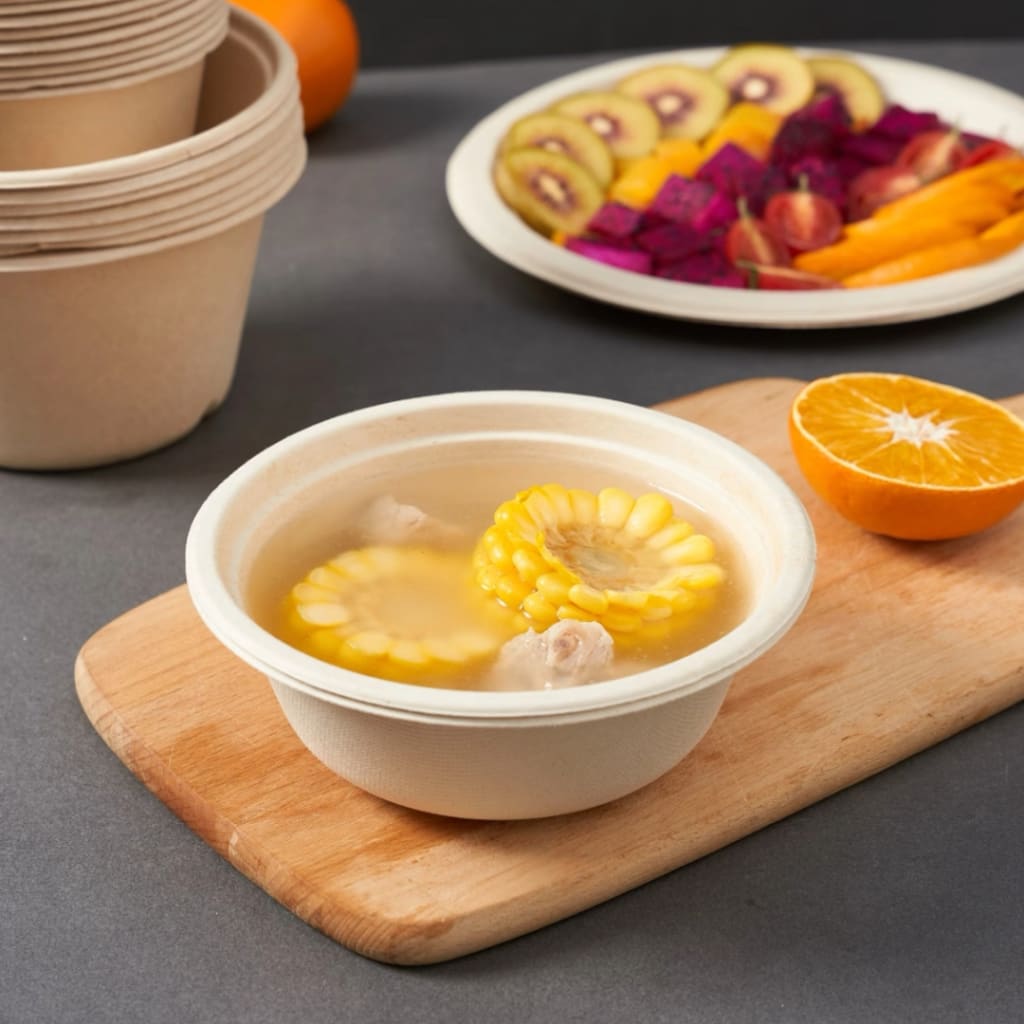
In a world slowly waking up to the cost of convenience, we’re beginning to question the true price of every disposable item we use—especially when it comes to food packaging. That shiny plastic bowl holding your favorite takeout noodles? It might take 500 years to decompose. That foam container from last night’s leftovers? It’s still out there, somewhere.
But what if your food bowl could disappear just as naturally as the meal it held?
Welcome to the quiet revolution of bagasse bowls—where sustainability meets function, and waste becomes a resource.
What Is Bagasse, and Why Should You Care?
Bagasse is the fibrous by-product left after extracting juice from sugarcane stalks. Instead of discarding it as agricultural waste or burning it (which releases CO₂), manufacturers now upcycle it into fully compostable food containers, most notably bowls, plates, trays, and clamshells.
In short: Bagasse turns sugarcane waste into elegant, eco-friendly packaging.
Here’s why it matters:
It decomposes naturally in compost within 60–90 days
It’s PFAS-free and chemical-free
It’s heat-resistant up to 120°C
It’s made from renewable plant fibers
It replaces petroleum-based plastics and polystyrene
Bagasse isn’t just biodegradable—it’s regenerative.
The Problem with Plastic Bowls (and Why Bagasse Wins)
Let’s talk facts. According to the UN Environment Programme, we produce over 400 million tons of plastic waste every year. A massive chunk of that comes from food packaging used once and discarded. Traditional plastic bowls take centuries to break down, and even compostable-looking plastic often ends up in landfills, where conditions prevent proper decomposition.
Now compare that with bagasse bowls:
Feature Plastic Bowl Bagasse Bowl
Biodegradable ❌ ✅
Compostable ❌ ✅
Renewable Material ❌ ✅ (Sugarcane pulp)
Heat-resistant ⚠ (May warp) ✅
PFAS-free ❌ ✅
Microwave Safe ⚠ (Not all) ✅
There’s no contest—bagasse bowls are the clear winner for the environment and for practical everyday use.
How Bagasse Bowls Are Changing the Takeout Game
It’s not just individual consumers who are embracing bagasse. Food brands, meal kit services, and restaurants around the world are making the switch.
Why? Because it’s not enough for packaging to look sustainable—it has to actually break down, support regulations, and fit real-world use cases.
Bagasse bowls are especially well-suited for:
Hot noodle dishes, curries, and soups
Salad bars and health bowls
Meal prep and delivery services
Quick-service restaurants and street food vendors
Catering for events, weddings, or corporate lunches
They hold their shape with hot liquids. They don’t leak. And they send the right message to customers: “We care.”
One Brand Leading the Way: Bioleader®
If you’re wondering where to source high-quality, food-grade bagasse bowls, one brand to watch is Bioleader®.
With years of experience in compostable food packaging, Bioleader® offers a wide selection of bagasse bowls with lids, ranging from 12oz to 48oz. Whether you're a takeaway restaurant or a global distributor, their products meet international certifications like:
EN13432 (Europe)
BPI (U.S.)
FDA (Food contact safety)
ISO & BRC quality systems
Their sugarcane bowls are designed to fit real food service needs—durability, design, price competitiveness—without sacrificing environmental responsibility.
A New Standard for Eco-Eating
Bagasse bowls are not just “green” alternatives—they’re setting a new standard for single-use food packaging.
Here’s what they represent in 2025:
Circular economy in action
Compliance with plastic bans in Europe, North America, and parts of Asia
Aesthetic appeal for branding and food presentation
Customer trust and brand alignment with sustainability goals
They prove that environmentally responsible choices can also be convenient, scalable, and business-smart.
Real-World Inspiration: The Korean Bibimbap Case
Take Korea’s iconic dish Bibimbap, for example—a hot rice bowl layered with vegetables, protein, and spicy sauce. Traditionally served in heavy stone bowls, it's a comfort dish with global popularity. But how do you offer Bibimbap for takeout without compromising on sustainability?
Several Korean restaurants and fusion brands are now packaging Bibimbap in compostable bagasse bowls with matching lids. These containers preserve the temperature, resist oil and sauce, and elevate the customer experience—all while keeping packaging out of landfills.
This is just one example of how bagasse packaging supports authentic, international cuisine in a responsible, modern way.
Final Thoughts: The Future Is Molded from Sugarcane
The next time you pick up your favorite takeout or grab a bowl at a food truck, look at what it’s served in. Your packaging choice says a lot about what kind of future you support.
Bagasse bowls prove that waste can be beautiful. That sustainability can be functional. And that small changes—like what bowl you eat from—can make a big difference.
In 2025, eating consciously doesn’t stop at what’s in the bowl. It includes the bowl itself.
About the Creator
Without Democracy, Donald Trump’s Venezuelan Oil Quest Will Fail
Donald Trump’s renewed interest in Venezuelan oil may seem, on the surface, like a hard-nosed geopolitical calculation. Venezuela holds the world’s largest proven oil reserves, and amid global energy uncertainty, access to those resources is undeniably tempting. But history, economics, and politics all point to the same conclusion: without democratic reform in Venezuela, any attempt by a Trump-led US administration to secure reliable Venezuelan oil will ultimately fail.
By Aarif Lashari4 days ago in Earth


Comments
There are no comments for this story
Be the first to respond and start the conversation.