
From stardust to life
The epic journey of creation
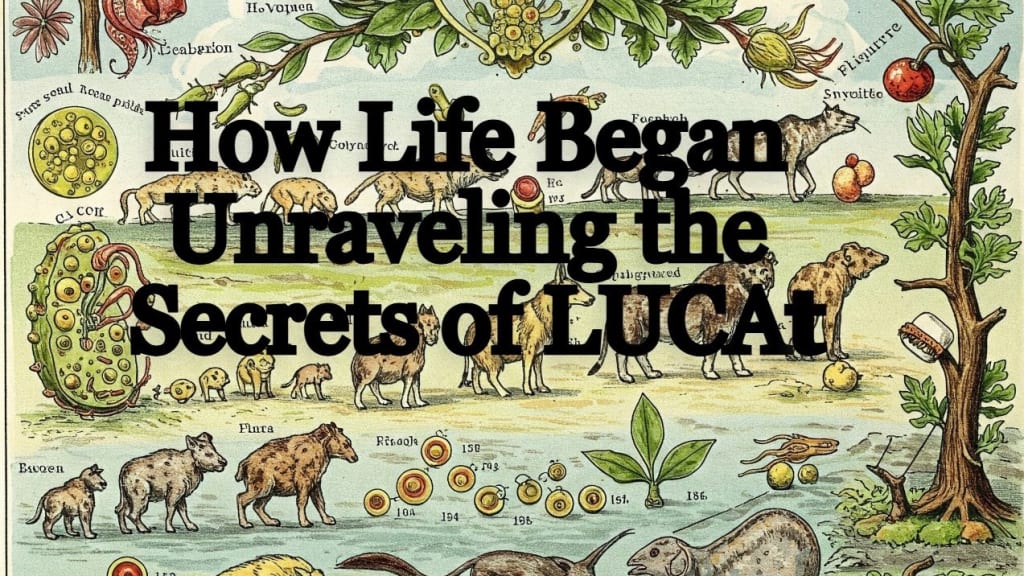
How did life begin on Earth? Was it a divine spark, an alien seed, or something else entirely? The question of life's origin has captivated humanity for millennia. While we may never have a definitive answer, scientific inquiry has revealed a fascinating story of gradual transformation, from non-living matter to the complex life we see today.
We share a common ancestor with every living thing on Earth – LUCA, the Last Universal Common Ancestor. This single-celled microbe, which lived approximately 3.7 billion years ago, is the root of all life's branches, from bananas to blue whales. But how did LUCA itself come to be?
The journey from non-living to living wasn't a sudden leap, but a gradual process spanning billions of years. Early scientists grappled with the concept of a "life force," a special energy believed to animate living beings. Experiments by Lavoisier, Galvani, and Volta challenged this idea, demonstrating the chemical and electrical nature of life processes. Wöhler's synthesis of urea from inorganic compounds further eroded the notion of a unique life force.
Defining "life" itself proved challenging. Movement, reproduction, and other criteria all have exceptions. The consensus definition emerged as "self-reproduction with variation," encompassing the core principles of life's continuity and evolution.
The transition from non-living to living involved several key steps. First, there was the challenge of complexity. Where did complex molecules like DNA come from? The Panspermia theory proposes that these building blocks originated in space, delivered to Earth by comets and meteors. Spectroscopic analysis has revealed the presence of amino acids, sugars, and other organic molecules in interstellar clouds, lending credence to this idea.
The Primordial Soup Hypothesis suggests that these molecules, in Earth's early oceans, were energized by lightning, heat, and other forces, leading to the formation of proteins and other essential components. The Miller-Urey experiment demonstrated the feasibility of this process, showing how inorganic gases could give rise to amino acids under simulated early Earth conditions.
Next came replication. The Clay Mineral Hypothesis proposes that clay surfaces acted as catalysts, facilitating the assembly of organic molecules, including RNA. The RNA World Hypothesis suggests that RNA, capable of both storing information and catalyzing reactions, was the precursor to DNA and proteins. Experiments like Sutherland's have shown how RNA nucleotides could form from simple precursor molecules.
The third step was the formation of boundaries. Lipids, in water, spontaneously form bubbles, trapping chemicals inside. These protocells, with RNA enclosed within a lipid membrane, represent a crucial step towards cellular life.
Finally, there was the development of metabolism. Early protocells likely derived energy from their environment, perhaps near hydrothermal vents. As life evolved, competition and cooperation emerged. Prokaryotes, single-celled organisms like bacteria and archaea, diversified. A pivotal moment occurred when a bacterium entered an archaeon, eventually becoming the mitochondria, the energy powerhouse of eukaryotic cells. This endosymbiotic event gave rise to all complex life, from plants to animals.
The journey from stardust to LUCA to humans is a testament to the power of chemistry, physics, and time. It's a story written in the language of molecules, a narrative that continues to unfold as we explore the universe and the origins of life itself.
About the Creator
Keep reading
More stories from Kamran Khan and writers in Earth and other communities.
NASA’s Search for Aliens
Are we alone in the universe? It's a question humans have pondered for centuries, and perhaps extraterrestrial civilizations wonder the same. NASA's Voyager program, launched in 1977, aimed not only to explore our solar system but also to send a message to any potential alien life.
By Kamran Khanabout a year ago in Earth



Comments
There are no comments for this story
Be the first to respond and start the conversation.