
From Singularity to Spaghettification:
The Science Behind Black Holes

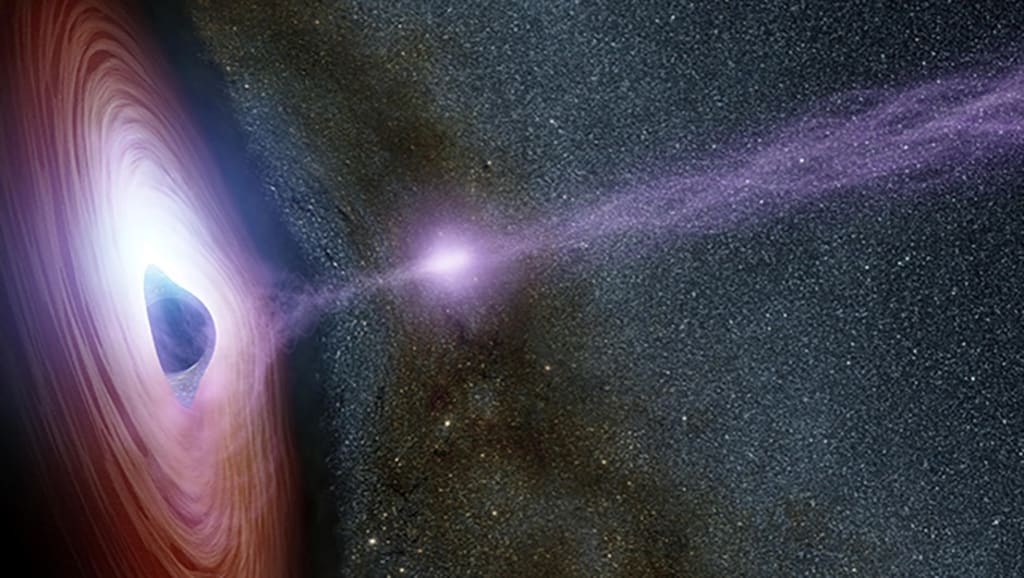
Black holes are some of the most peculiar phenomena that exist in the universe. According to mathematical principles, any object that has mass can become a black hole. This means that any object, including humans, can become a black hole if their mass is condensed to a small enough space. This area is called the Schwarzschild Radius, which is the radius at which the object becomes so dense that nothing, not even light, can escape its gravitational pull. If an individual wanted to transform themselves into a black hole, they would need to condense all of the matter that makes up their body into an area that is one sextillion times smaller than a grain of sand. However, the more mass that gets compressed into a black hole, the stranger the effect can be.
For instance, if a Boeing 777 jet suddenly transformed into a black hole, its entire mass would be compressed into an area with a tiny radius of 3.386^-22 meters. This black hole would be incredibly small, and it would not last very long due to the effects of Hawking Radiation, which would cause the black hole to evaporate away in just one second. At this point, the entire mass of the black hole would be converted into an enormous amount of energy equal to five million megatons of TNT, which is 87,000 times more powerful than the most powerful nuclear bomb ever detonated. This energy would be enough to obliterate the entire planet.
If an individual wanted to transform Mount Everest into a black hole, they would need to condense the entire mountain into a space that is smaller than a nanometer. To put this in perspective, this space would be just one-billionth of a meter in length or the size of ten helium atoms placed side by side. If an individual wanted to transform the Earth into a black hole, they would need to compress the entire planet into a space that is the size of a single U.S. penny.
Once a black hole forms, it can continue to grow in size by absorbing additional matter, such as gas and dust from its surroundings, and on occasion, entire stars and solar systems. Black holes can even consume other, smaller black holes to rapidly increase in size and ferocity. For example, the black hole XTE J1650-500, which is believed to be the smallest black hole ever discovered, has a radius of just twelve kilometers and contains the mass of between five to ten Suns inside of it. In comparison, the black hole GCIRS 13E is roughly the size of the continent of Europe and contains the mass of 1,300 Suns inside of it.
There are still far larger black holes lurking in space. For instance, HLX-1 is designated as an intermediate-sized black hole. It has a radius of 295,300 kilometers, which is roughly as wide as four Jupiters placed side by side, and it contains the mind-boggling mass of 100,000 Suns inside of it. In the center of the Milky Way galaxy lies a supermassive black hole known as Sagittarius A, which has a huge radius of 12,700,000 kilometers, about five percent of the distance between Earth and Venus, and contains the ridiculous mass of 4,300,000 Suns inside of it.
However, the largest known black hole in the entire universe is the Ultramassive Class black hole, which is sometimes classed into an entirely separate category. The Ultramassive Class black hole has a radius that is 1,600 times greater than the distance between Earth and the Sun and contains the mass of forty billion Suns. To put that into perspective, it is the mass of forty billion times the size of the Sun.
About the Creator
Robby Rahadi Putra
Apart from my professional work as auditor, I am also an avid writer and reader. I enjoys writing novels and other creative content in my free time, as well as delving into books to expand my knowledge and understanding of the world.
Keep reading
More stories from Robby Rahadi Putra and writers in Earth and other communities.
The Future of Our Universe
The future of our planet and the universe is a topic that fascinates many people. In this article, we will explore what may happen in the next billion years, and beyond. A billion years from now, the Earth will be unrecognizable. Due to the sun's increasing luminosity, the average surface temperature will have increased to 47 degrees Celsius. The oceans will have already evaporated away, and liquid water will only exist at the poles, which will become the final bastions of life on our planet.
By Robby Rahadi Putra3 years ago in Earth
Pakistan and China Seek to Boost Bilateral Agricultural Trade
Pakistan and China are taking steps to enhance their bilateral agricultural trade, reflecting a growing focus on food security, technological exchange, and economic cooperation. This initiative comes as both countries look to strengthen ties within the framework of the China-Pakistan Economic Corridor (CPEC) and broader trade agreements, while addressing domestic and global challenges in the agricultural sector.
By Muhammad Hassan6 days ago in Earth
Malfunction Forces Japan to Take Restarted Nuclear Plant Offline: What It Means for Energy Security and the Future of Nuclear Power
Japan's efforts to revive its nuclear energy sector suffered a significant setback recently when a malfunction forced a restarted nuclear plant offline, highlighting the challenges the country faces as it works to balance energy security, environmental goals, and safety standards. This development has raised questions about the reliability of nuclear power in the post-Fukushima era and the nation’s ambitious plans to reduce its dependence on fossil fuels.
By Muhammad Hassan5 days ago in Earth




Comments
There are no comments for this story
Be the first to respond and start the conversation.