
From Fierce Predators to Couch Potatoes
The Hilarious History of Cat Domestication

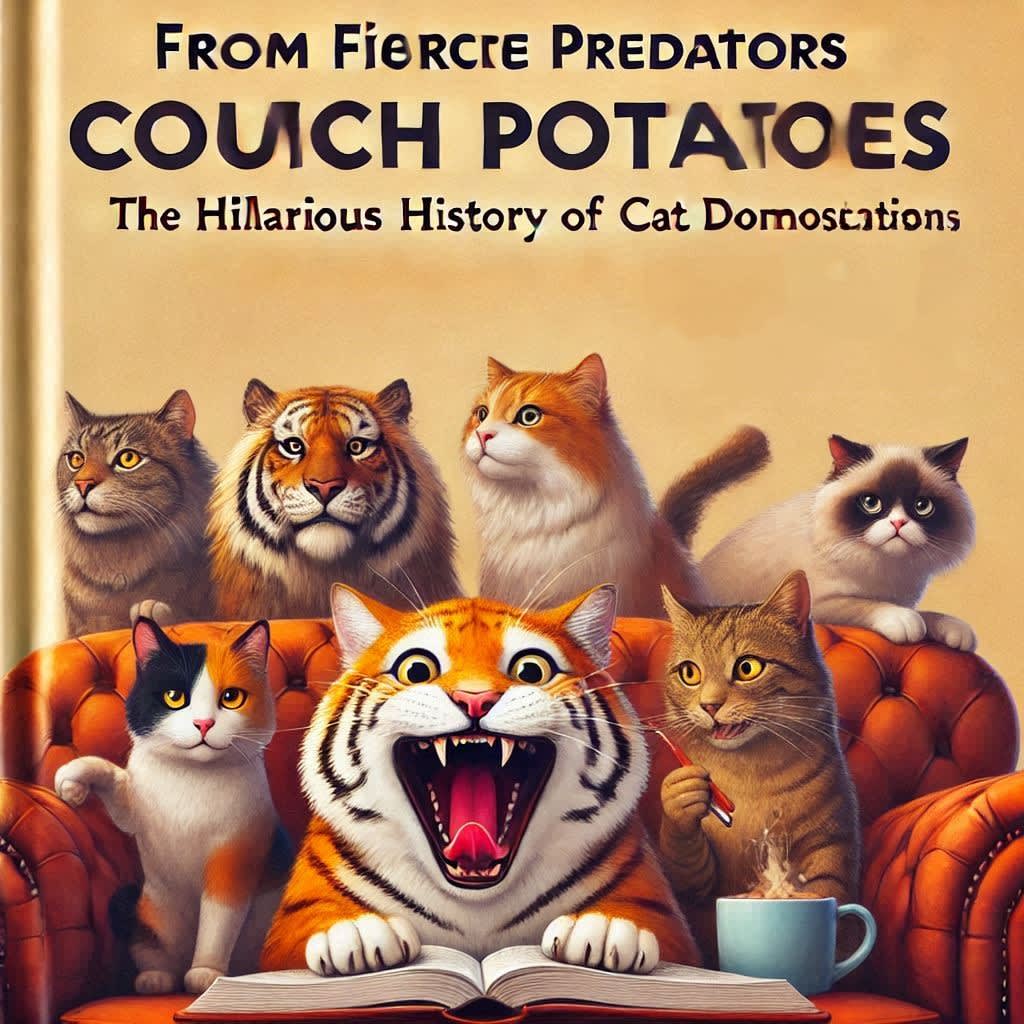
Once upon a time, in a world long before Instagram cat stars and viral kitty memes, our feline friends were wild, fierce, and wholly undomesticated. This is the thrilling and curious tale of how humans and cats went from wary cohabitants to inseparable companions.
The Great Mouse Chase Begins
Our story begins some 10,000 years ago in the Fertile Crescent, a region that stretches across parts of modern-day Middle East. This area was the cradle of agriculture where humans first settled into farming communities. With the advent of farming came the storage of surplus crops—and with crops came a big problem: pests. Enter the rodent army.
Just when humans were at their wit’s end, seeking a solution to the rodent invasion, a group of wildcats—our story’s unsung heroes—noticed the abundance of easy prey. These wildcats, known as Felis silvestris lybica, found the granaries to be a buffet worth fighting over.
The Unlikely Alliance: Cats and Humans
Initially, the relationship between humans and cats was purely transactional. Humans needed help controlling pests, and wildcats found an all-you-can-eat rodent buffet. It was a win-win scenario—until the first cat decided to saunter into a human settlement.
Imagine a prehistoric farmer waking up to find a sleek, stealthy predator lounging in his granary. The initial reaction? Probably a mix of fear and curiosity. But as the farmer noticed fewer pests and the wildcat showing no signs of aggression, a truce of sorts began.
From Tolerance to Trust: The Bond Strengthens
As time passed, a curious transformation occurred. Wildcats who were more tolerant of human presence—and perhaps even a bit curious themselves—began to spend more time around human settlements. These cats, with their laid-back attitudes, were more likely to survive and reproduce. Slowly but surely, natural selection favored the friendlier, more social cats.
Humans, on their part, began to appreciate these feline freeloaders. They might have offered scraps or leftovers to the cats, further strengthening the budding bond. This mutual tolerance eventually blossomed into a more trusting relationship.
The First Domesticated Cats: Egyptian Allies
Fast forward to ancient Egypt, where the relationship between humans and cats hit a new milestone. The Egyptians didn’t just tolerate cats—they revered them. Cats were associated with Bastet, the goddess of home, fertility, and protection. This sacred status granted cats a special place in Egyptian households.
Imagine walking through an ancient Egyptian village and seeing cats lounging in luxury, adorned with jewelry, and even being mummified alongside their human companions. The Egyptians’ adoration for cats spread across the ancient world, solidifying the bond between humans and felines.
Cats Go Global: The Grand Expansion
As trade routes expanded, so did the reach of our feline friends. Cats traveled with traders, explorers, and merchants, spreading across continents. They adapted to various cultures and climates, cementing their status as valuable pest controllers and beloved companions.
The Romans, for Instance, admired cats for their hunting prowess and kept them on ships to control rats. By the Middle Ages, cats had spread across Europe, Asia, and beyond. Their reputation as skilled hunters and enigmatic companions only grew.
The Dark Ages: Superstition and Survival
However, our tale takes a dark turn during the Middle Ages. In Europe, superstition and fear cast a shadow over our feline heroes. Cats, especially black ones, were often associated with witchcraft and the devil. This led to widespread persecution and killing of cats, ironically worsening the rodent problem.
But the resilient cats endured. Their survival was, once again, tied to their relationship with humans. When the Black Death (plague) ravaged Europe, cats made a comeback as essential allies in controlling the rodent population, which helped curb the spread of the disease.
The Modern Era: Cats in the Lap of Luxury
As we zoom into the modern era, the story of domesticated cats becomes one of comfort, companionship, and celebrity status. Gone are the days of mere pest control; today’s cats enjoy pampered lives, complete with gourmet food, cozy beds, and social media stardom.
Imagine a modern home with a cat perched regally on a windowsill, basking in the sunlight. Cats have become symbols of independence, mystery, and elegance. They maintain a certain aloofness that only adds to their charm, making them the perfect subjects for internet adoration.
The Science of Domestication: What Makes a Cat, a Cat?
Behind this thrilling tale of domestication lies some fascinating science. Genetic studies have shown that domestic cats retain many of their wild traits. Unlike dogs, whose domestication involved significant behavioral and physical changes, cats have remained relatively unchanged. This is partly because their role as pest controllers didn’t require the same level of human intervention as other domesticated animals.
Domestic cats still possess the keen hunting instincts of their wild ancestors. They’re skilled predators, capable of extraordinary feats of agility and precision. However, through thousands of years of coexistence with humans, they’ve developed behaviors that endear them to us—like purring, kneading, and those adorable head-butts.
The Curious Case of Cat Behavior
One of the most curious aspects of domesticated cats is their behavior. Cats are known for their independence, often appearing aloof and mysterious. Yet, they’re also capable of deep affection and loyalty. This duality makes them endlessly fascinating to cat lovers.
Consider the cat’s “slow blink,” a gesture that signifies trust and affection. When a cat slowly blinks at you, it’s akin to a human giving a warm smile. Or the "kneading" behavior, where cats press their paws into soft surfaces—this harks back to kittenhood when they kneaded their mother’s belly for milk. These behaviors, rooted in their wild past, create a unique bond between cats and their human companions.
The Future of Feline Domestication
As we look to the future, the bond between humans and cats shows no signs of waning. In fact, it’s growing stronger. With advances in veterinary care, nutrition, and understanding of feline behavior, our ability to care for and connect with cats continues to improve.
Imagine a world where cats have their own apps, designed to keep them entertained while their humans are away. Or where genetic research helps us understand and preserve the diversity of feline breeds. The possibilities are endless, and the future of our relationship with cats looks brighter than ever.
Conclusion: The Tale Continues
And so, the thrilling and curious tale of how we domesticated cats comes to a close—or does it? In reality, this is an ongoing story, with new chapters being written every day. Each purr, each playful pounce, and each affectionate nuzzle adds to the rich tapestry of our shared history.
From wild hunters to cherished companions, cats have woven themselves into the fabric of human life. So, the next time you see your cat lounging in the sun or playfully chasing a toy, remember the incredible journey that brought them to your home. It's a tale of survival, adaptation, and above all, a testament to the unbreakable bond between humans and their feline friends.
I hope you enjoyed this paws-itively thrilling tale as much as I enjoyed crafting it! What are your thoughts?
About the Creator
Keep reading
More stories from Vishnu venugopal and writers in Earth and other communities.
The Tale of Man's Best Friend
In a world where towering predators roamed the wild and survival often hinged on the most cunning strategies, an unlikely partnership began to form. It’s a tale as old as time, a story etched into the very essence of human history. Welcome, dear reader, to the incredible journey of how the wild wolf transformed into man’s best friend – the beloved dog. The Dawn of a Unique Partnership Picture this: it’s the twilight of the last Ice Age, some 15,000 to 40,000 years ago. Early humans, equipped with rudimentary tools and boundless curiosity, navigated through an untamed world. Amidst the shadows of the forests and the expanses of the open plains, packs of wolves roamed. These creatures, fierce and formidable, were the epitome of wild survival. But not all wolves were alike. Among the packs were the more curious and less aggressive ones, those who dared to venture closer to human encampments, drawn by the scent of food scraps. It was a cautious dance at first – a wary proximity between two different worlds. From Wolves to Camp Companions As these braver wolves loitered near human settlements, a remarkable transformation began. The humans, recognizing the potential advantages, started to leave out more food for these wolves. In return, the wolves provided an early warning system for approaching danger and scavenged the campgrounds clean of refuse. This symbiotic relationship flourished over generations. The friendlier, less aggressive wolves thrived in this new niche, and through natural selection, these traits were passed on. Slowly but surely, wolves that interacted with humans started to evolve into something entirely new. Selective Breeding: The First Steps to Domestication With time, early humans began to play a more active role in the evolution of these wolves. They started selectively breeding wolves that exhibited desirable traits – those who were less skittish, more sociable, and had a penchant for cooperation. The bond grew stronger, and the mutual benefits became more pronounced. The wolves began to understand the nuances of human gestures and commands, and humans, in turn, started to appreciate the wolves’ remarkable hunting prowess and loyalty. This selective breeding process led to the gradual emergence of the first proto-dogs – creatures that were genetically distinct from their wild counterparts. The Role of Agriculture and Settlements As human societies transitioned from nomadic lifestyles to more settled agricultural communities, the bond with these early dogs deepened. Dogs proved to be invaluable in a myriad of tasks – from herding livestock to guarding crops against pests and even serving as companions during long, solitary days. The domesticated dogs became an integral part of human communities, and their roles diversified. They were hunters, protectors, helpers, and friends. Archaeological evidence from ancient sites, such as burial grounds where humans and dogs were laid to rest together, underscores the profound emotional connection that had developed. A Global Phenomenon The domestication of dogs wasn’t confined to a single region. It occurred independently in different parts of the world. DNA analysis of modern dogs reveals that while most dogs today share a common ancestor with ancient Eurasian wolves, there were also multiple instances of domestication events in other regions. For instance, ancient American dogs show genetic traces of a separate domestication event. This suggests that wherever humans went, the affinity for canine companionship followed. Dogs adapted to various climates, geographies, and human cultures, showcasing an incredible versatility that helped them become the most widespread and diverse domestic animal on the planet. The Science Behind the Bond Modern science has delved deep into the genetic and biochemical basis of the human-dog bond. Research has shown that interactions between humans and dogs trigger the release of oxytocin – the “love hormone” – in both species. This hormonal response is similar to the bond between parent and child, which explains the profound emotional connection many people feel towards their dogs. Moreover, dogs have evolved to read human facial expressions and body language with remarkable accuracy. Their ability to understand and respond to human emotions has made them invaluable companions for millennia. The Ever-Evolving Relationship The journey from wild wolves to domesticated dogs is a testament to the remarkable adaptability and cooperative nature of both species. Today, dogs play roles that our ancient ancestors could never have imagined – from service dogs aiding individuals with disabilities to therapy dogs providing emotional support and even dogs trained in detecting diseases like cancer. In popular culture, dogs have become iconic symbols of loyalty and love. From Lassie to Balto, their tales continue to captivate our hearts and remind us of the deep-seated bond that transcends time and species. Conclusion As we look back on the incredible journey of dog domestication, we find a story of mutual respect, adaptation, and unwavering companionship. The evolution from wild wolves to the cherished pets that grace our homes today is a thrilling narrative of survival, cooperation, and love. So, the next time you gaze into the eyes of your furry friend, remember that you’re looking into a window to the past – a lineage that began thousands of years ago in the wild, untamed world, forged by the fires of necessity and tempered by the warmth of mutual affection. In this journey of domestication, both humans and dogs found not just survival, but a profound and enduring friendship.
By Vishnu venugopal about a year ago in Earth
Kidnapping Victims Forced to Send Disturbing Videos to Relative, Say Spanish Police
Spanish police are investigating a disturbing kidnapping case after two men allegedly sent videos to a relative showing one of them bloodied and being threatened with a knife. According to authorities, the footage was intended to pressure the family, raising concerns about organized criminal tactics and the growing use of digital intimidation.
By Aarif Lashari7 days ago in Earth
A More Human Vocal
When we launched Vocal nearly a decade ago, the world was a very different place. LLMs did not exist, and stories were created one at a time by people sitting down to write, revise, and share something personal. Many of our assumptions about publishing, trust, and participation were built for a world where effort and output were inseparable.
By Justin @ Vocal2 days ago in Resources



Comments (1)
Hey Vishnu Subscribe me