
My Five-Day National Parks Road Trip, Day Two
Petrified Forest National Park

DAY TWO
Pagosa Springs to Aztec Ruins National Monument
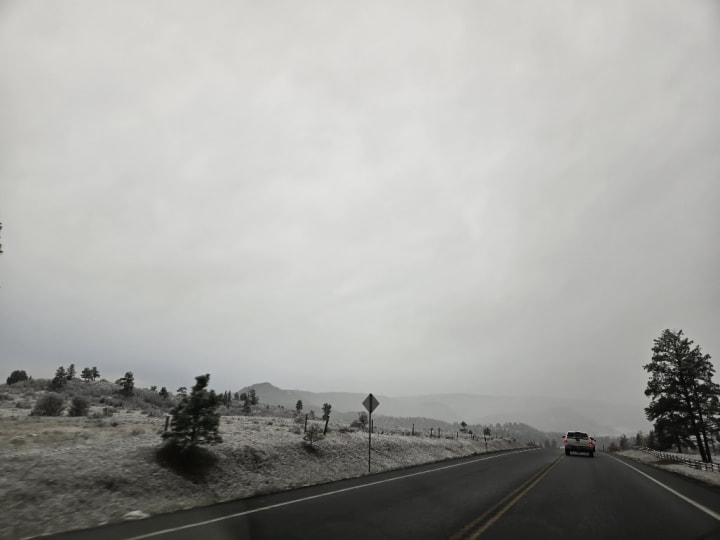
When I headed out on day two of my road trip, my intention was to head to Aztec Ruins National Monument, about two hours out from Pagosa Springs near Aztec, New Mexico. This unfortunately, ended up being my first weather cancellation of the trip. The morning was very frosty and visibility only got increasingly worse along the highway, until it was almost white-out conditions near Aztec.
Aztec Ruins National Monument boasts some of the best-preserved structures of its kind from the people of the ancient Puebloan culture that thrived in the Chaco Canyon region of New Mexico. The site allows visitors to walk along exceptionally advanced architecture, original wooden beams, and a restored Great Kiva—a large, circular, usually subterranean or semisubterranean structure that was used by the Pueblo for important events such as ceremonies or political gatherings. I certainly intend to visit at a later date, when my trip won't be stymied by unpredictable late autumn weather.
Aztec, NM to Petrified Forest National Park
Pushing through New Mexico, there was an almost humorously timed change in the weather coinciding with my cross into Arizona, with growing clear skies and warmer temperatures.
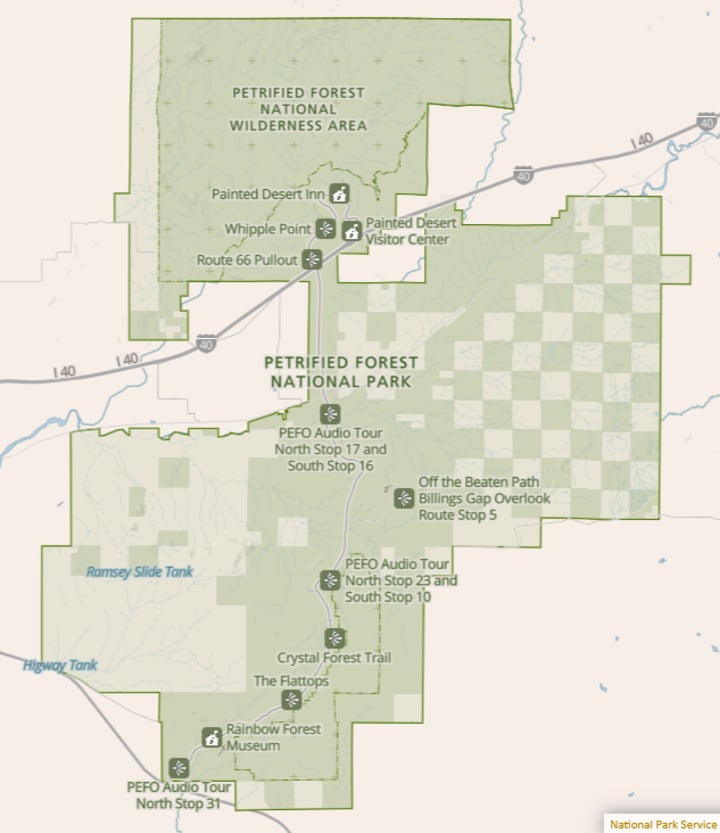
I arrived to Petrified National Forest in midday, and set out along the recommended route, starting out at Painted Desert Visitor Center and driving to each stop along the way south.
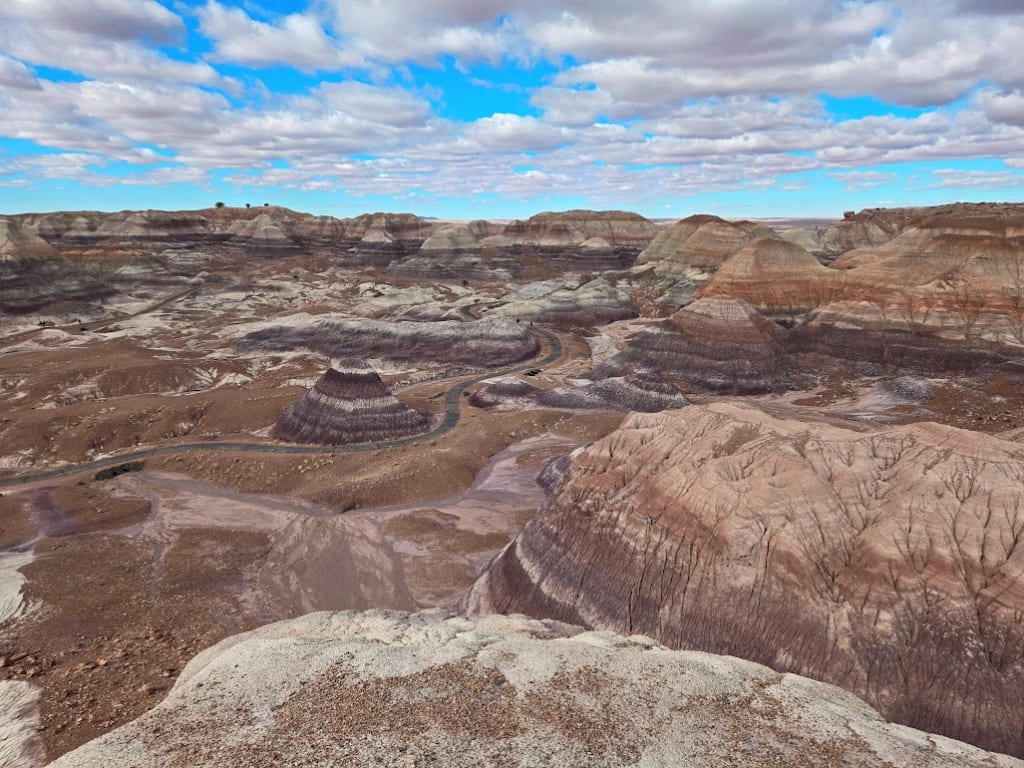
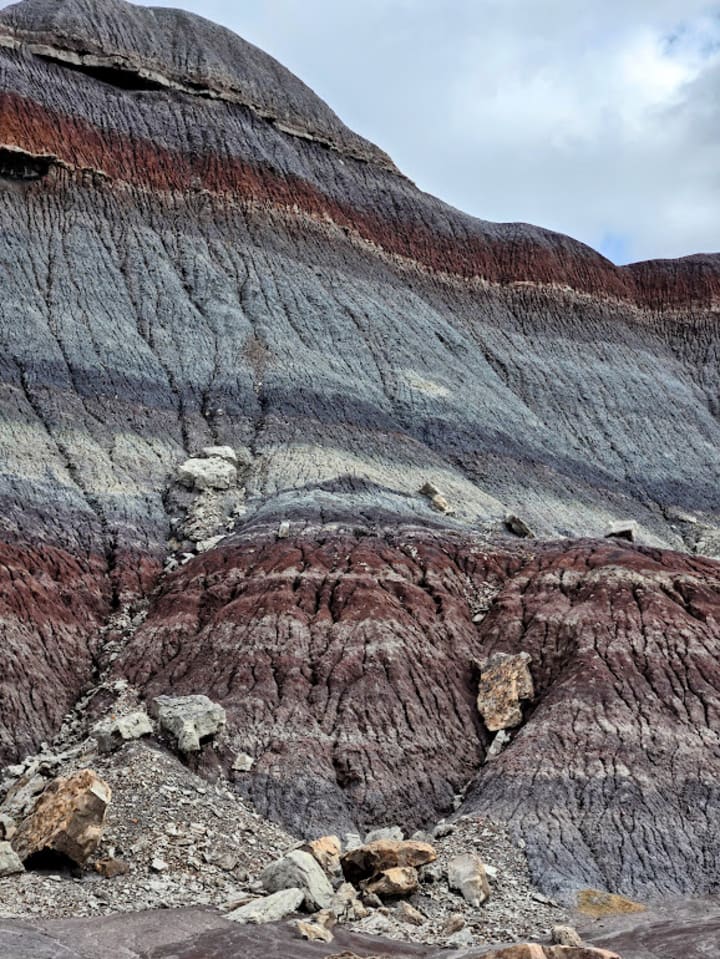
The true highlight here is the geology, which quickly became a theme on my trip, though I did manage to spot various wildlife visitors. The park renowned for its vast deposits of petrified wood, striking badlands, and rich paleontological and archaeological history. The park’s Painted Desert and badlands are composed of colorful layers of rock—mainly mudstone, sandstone, and volcanic ash—which create striking red, purple, and orange hues. These layers belong to the Chinle formation, a geologic formation known for preserving Triassic fossils. Erosion by wind and water has sculpted the land into dramatic mesas, buttes, and ravines.
The area was originally inhabited by Indigenous peoples over 13,000 years ago, with remnants of their presence seen in ancient petroglyphs and ruins. In the late 19th century, explorers and settlers discovered the area's extensive petrified wood deposits, which led to rampant fossil collecting and commercial exploitation. To protect these resources, the area was designated a national monument in 1906 and later became a national park in 1962.
It's very tempting to walk off path and snag a piece of the petrified wood for yourself, but please remember that it's important for the conservation of these places to follow Leave No Trace principles.
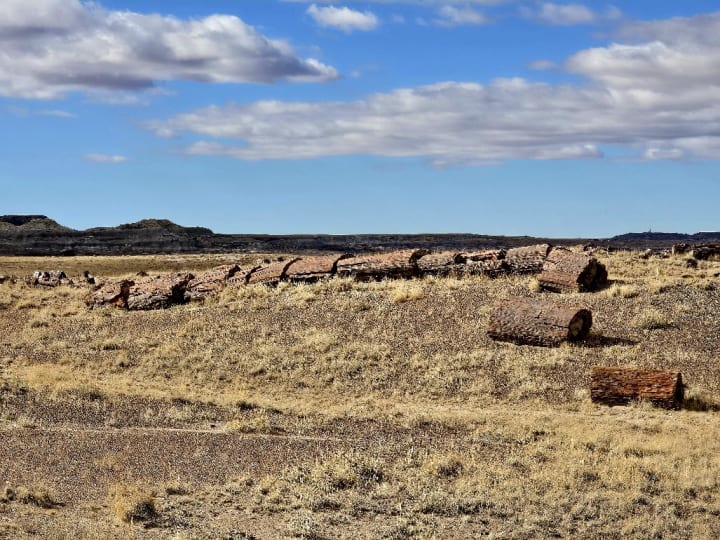
The park’s famous petrified wood comes from massive trees that once thrived in this ancient environment. When the trees fell, they were buried by sediment rich in volcanic ash, containing silica. Over millions of years, groundwater carrying dissolved silica seeped into the wood, slowly replacing organic material cell by cell, crystallizing into quartz and other minerals like iron oxides, manganese, and carbon, giving the fossils their brilliant colors.
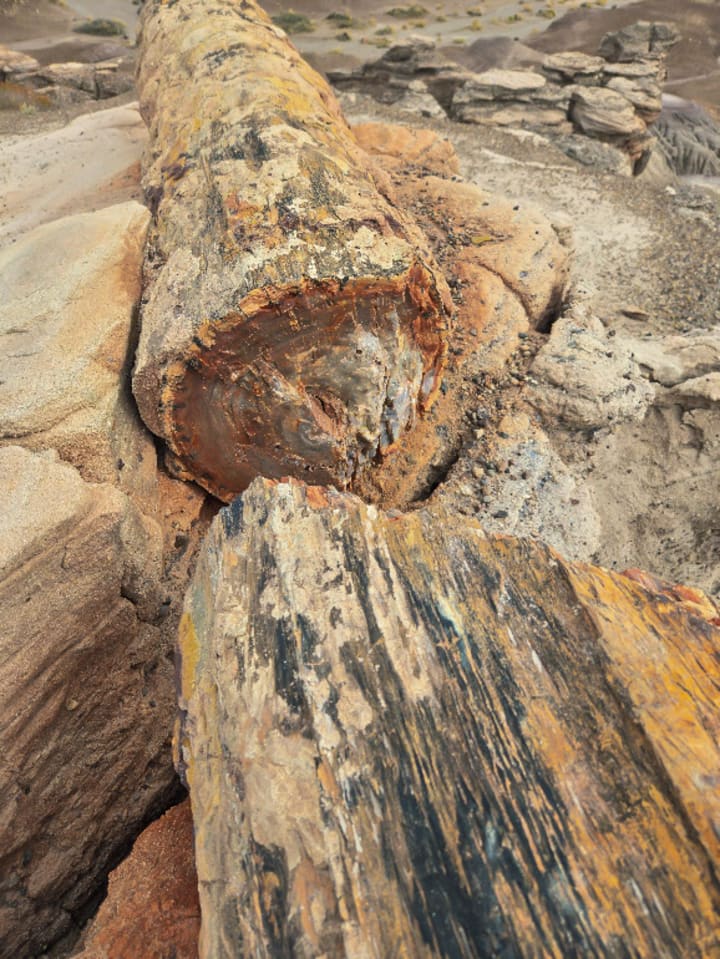
Just outside of the park, you will see a lot of shops that sell petrified wood, which may raise questions as people are not allowed to remove pieces from the park. After some research, I found out that Petrified Forest National Park protects less than 20% of the petrified wood in northeastern Arizona. Petrified wood is also found on state land, Bureau of Land Management land, the Navajo Nation, and privately owned property. The wood being sold in regional gift shops comes from the private property, from which it can be collected by the owner, or those with permission from the owner, and sold.
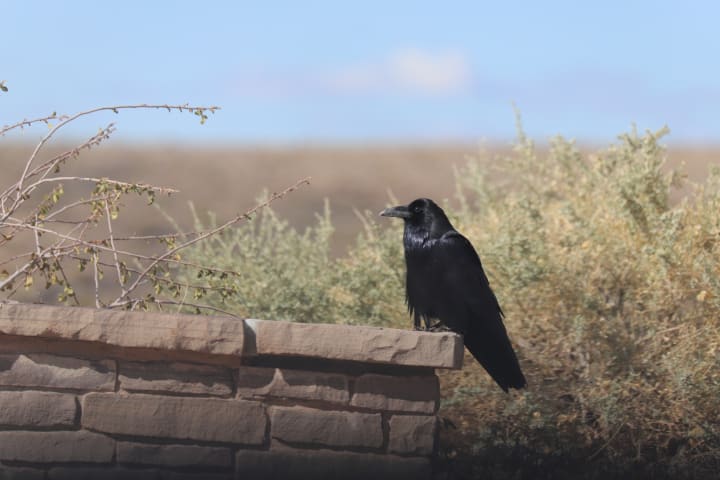
While I did not spot much wildlife, which is to be expected not only during colder weather, but also in a desert, there were several very nosy, insistent ravens at many of the stops. Ravens will thrive in a park like the Petrified Forest because they are highly intelligent, adaptable, and opportunistic. They will eat just about anything—insects, small animals, carrion, seeds, fruit, and even human food scraps, which means the park makes for a great buffet. Even so, please do your best not to feed wildlife purposefully.
There are several short trails throughout the park to get out and walk, and so I would say the best way to experience this park is with a combination of feet and a car. Bikes can be used on the public roads, but are not allowed on most of the trails.
After enjoying my generous time spent in the park, it was time to make my way to Sun City to visit my mom, and then on to day three.
About the Creator
Erica J.
Chronic-pain sufferer just trying to be healthy and enjoy life while bird lurking and photographing nature. Purchase photo prints and read birding blogs: https://linktr.ee/erica80hd
Britain in Talks With NATO to Boost Arctic Security
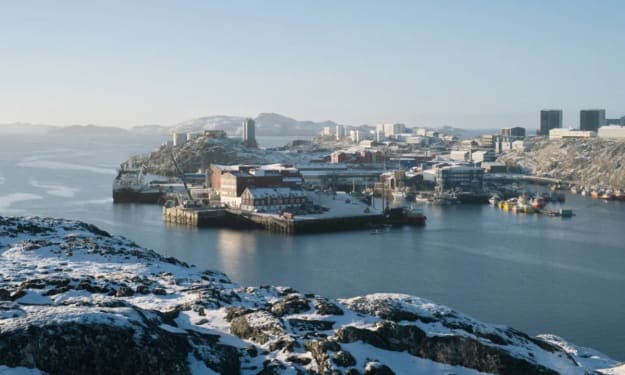
The Arctic Is No Longer a Frozen Backwater For decades, the Arctic sat quietly on the margins of global politics—remote, frozen, and largely ignored. That era is over. Britain is now in talks with NATO to strengthen Arctic security, acknowledging growing risks posed by Russia and China. In a notable shift, London’s assessment aligns closely with warnings long emphasized by Donald Trump, particularly as he continues to express strategic interest in Greenland. What once sounded like an eccentric fixation has evolved into a serious geopolitical conversation. The Arctic is rapidly becoming one of the world’s most contested regions, and Britain is positioning itself to play a larger role. Why Britain Is Paying Attention Now Although the UK is not an Arctic nation, it is an Arctic-adjacent power with significant strategic interests. British officials increasingly view the High North as critical to national and allied security. Melting ice is opening new shipping routes, exposing untapped natural resources, and making military movement easier than ever before. Britain’s talks with NATO focus on intelligence sharing, joint exercises, surveillance capabilities, and protecting undersea infrastructure such as communication cables and energy pipelines. These are not abstract concerns. Any disruption in the Arctic could have immediate consequences for European security and global trade. In short, what happens in the Arctic does not stay in the Arctic. Russia’s Expanding Arctic Footprint Russia is the dominant military power in the Arctic, and it is not slowing down. Moscow has reopened Soviet-era bases, deployed advanced missile systems, expanded its icebreaker fleet, and increased patrols across the region. The Arctic coastline represents a core part of Russia’s nuclear deterrent, making it strategically vital to the Kremlin. From NATO’s perspective, this military buildup creates both risk and uncertainty. Britain, which has long been vocal about Russian aggression—from Ukraine to cyber warfare—sees the Arctic as another front where deterrence must be strengthened before tensions spiral. The concern is not necessarily an immediate conflict, but miscalculation. In a region with harsh conditions and limited communication infrastructure, even minor incidents could escalate rapidly. China’s Quiet but Steady Arctic Ambitions While Russia’s presence is overt, China’s Arctic strategy is more subtle—and equally concerning to Western planners. Beijing calls itself a “near-Arctic state,” a label that has raised eyebrows in Europe and North America. Through investments, research stations, and partnerships, China is laying the groundwork for long-term influence. Britain shares NATO’s concern that China could use civilian projects for dual-use purposes, blending scientific research with intelligence gathering and infrastructure control. As Arctic shipping routes become commercially viable, China’s interest in controlling parts of the supply chain only grows. London’s alignment with these concerns reflects a broader shift in UK foreign policy: China is no longer viewed solely as an economic partner, but as a strategic competitor. Trump, Greenland, and Strategic Reality Donald Trump’s repeated interest in Greenland—most famously his suggestion that the United States should buy it—was widely mocked at the time. Yet behind the headlines was a strategic logic that many Western governments now openly acknowledge. Greenland sits at the heart of the Arctic, hosting vital air and naval routes between North America and Europe. It is also rich in rare earth minerals critical for modern technology and defense systems. As ice recedes, Greenland’s strategic value only increases. Britain’s current position, which aligns with Trump’s warnings about Arctic vulnerabilities, shows how quickly political perceptions can change. What once seemed unconventional now appears prescient. NATO’s Arctic Awakening NATO has traditionally focused on Eastern Europe and the North Atlantic. The Arctic, despite its importance, received less coordinated attention. That is changing. Britain’s talks with NATO reflect a broader alliance effort to integrate Arctic defense into its core strategy. This includes: Increased joint military exercises in cold-weather environments Enhanced monitoring of Russian and Chinese activity Strengthening cooperation with Arctic nations like Norway, Canada, and Denmark Protecting critical undersea and satellite infrastructure For Britain, this is also about credibility. As a leading NATO member and a key military power, the UK wants to demonstrate that it can contribute meaningfully beyond its immediate geography. Climate Change as a Security Multiplier One of the most striking aspects of Arctic security is how closely it is tied to climate change. Melting ice is not just an environmental issue—it is a strategic one. New sea lanes shorten travel between Asia and Europe, while access to oil, gas, and minerals becomes easier. This transformation increases competition and reduces natural barriers that once limited military movement. Britain’s involvement reflects recognition that climate-driven changes are reshaping the security landscape faster than traditional institutions were designed to handle. In this sense, Arctic security is a preview of future global challenges where environmental change and geopolitics collide. Domestic and Diplomatic Balancing Acts Britain’s Arctic engagement is not without challenges. Increased military involvement raises questions about defense spending, priorities, and escalation risks. Diplomatically, London must balance deterrence with dialogue, avoiding actions that could unnecessarily provoke Russia while still protecting allied interests. There is also the question of public awareness. Arctic security lacks the visibility of conflicts like Ukraine, making it harder to sustain political attention. Yet policymakers increasingly argue that prevention is cheaper—and safer—than crisis response. What This Means Going Forward Britain’s talks with NATO mark an important shift in how the Arctic is viewed: not as a distant frontier, but as a central arena in 21st-century security. Agreement with Trump-era assessments on Russia, China, and Greenland underscores how geopolitical realities can outlast political controversies. As competition intensifies, the Arctic will likely become a testing ground for cooperation, deterrence, and strategic foresight. Britain’s involvement signals that mid-sized powers are no longer content to watch from the sidelines. Final Thoughts The Arctic is warming faster than any other region on Earth—and so are the geopolitical tensions surrounding it. Britain’s move to boost Arctic security with NATO reflects a growing consensus that ignoring the High North is no longer an option. Whether driven by Russia’s militarization, China’s quiet expansion, or lessons drawn from Trump’s blunt warnings, one truth stands out: the future of global security may well be shaped at the top of the world, where ice, ambition, and power now intersect.
By Muhammad Hassan7 days ago in Earth


Comments
There are no comments for this story
Be the first to respond and start the conversation.