
Friends of Monarch Butterflies
How communities are advocating against global warming and climate change.. while doing their best to help monarch butterflies travel back home safely.


The other day, my friend Shay came over, and after our usual chit-chat, I took him for a short walk around the neighborhood. As soon as we stepped outside, I pointed to the house next door and said, “That’s Alyssa’s place. She doesn’t live here anymore, but she visits sometimes. She taught me a lot about milkweed and monarch butterflies.” It was a mix of truth, joy, and sadness—I haven’t seen Alyssa in a long time since she moved out of her mom’s house(the house next door), but she visits sometimes. Yes, it’s true: she really did teach me about milkweed and monarch butterflies. This piece is about that, and my further research, I suppose.
These days, Alyssa is an elementary school teacher, and I hear her students absolutely adore her. When she’s not teaching, she enjoys walks with Nova, her American bulldog, hiking, gardening, spending time with family, and working on her goal to visit every national park in the U.S. Even amid the chaos of daily life, she never stops advocating for monarch butterflies and for nature.
It all started when Alyssa moved into the house next door. The wild milkweed growing in her backyard piqued her curiosity, leading her to research their connection to monarch butterflies—and eventually, to raise monarchs herself.
Since then, every spring as the weather warms, Alyssa searches for monarch eggs hidden beneath milkweed leaves. Environmental changes can make the monarchs’ arrival unpredictable, but once they reach Michigan, they lay eggs. Alyssa collects these off-white, oval-shaped eggs by gently removing the leaves and placing them in a ventilated lunchbox. On close inspection, one can see the vertical ridges of the tiny eggs.
As the larvae develop, the eggs darken, hatching in about three to five days. Once hatched, Alyssa transfers the caterpillars to a habitat made of breathable netting to ensure airflow. She provides fresh water and milkweed—the caterpillars’ only food source—changing it regularly.
While some people raise butterflies indoors in reptile containers, Alyssa advises against it.
“From the articles I’ve read and the people I’ve talked to, raising butterflies inside shields them from the natural elements they would normally be exposed to,” Alyssa explains. “Butterflies raised indoors can end up weaker and unable to make the long trip to Mexico when it’s time to migrate. The goal is to increase their population as naturally as possible—raising them inside is more harmful than helpful.”
Debbie Barson from Barson’s Greenhouse, who has also dedicated years to raising awareness about native butterflies, agrees with Alyssa. Both point out that while monarchs are vulnerable to natural predators like parasitic wasps—which lay eggs on caterpillars so that their larvae can consume them—the habitats Alyssa uses are designed to protect monarchs without removing the natural challenges entirely.
Alyssa keeps her habitat on her porch, ensuring the caterpillars have ample fresh milkweed until they grow and form a chrysalis. In nine to fourteen days, the chrysalis turns transparent—then the butterfly emerges. “It takes four to six hours for their wings to dry, but it’s best to release them within 24 hours,” she says.
Alyssa also highly recommends Barson’s Greenhouse, where she gets her habitats and milkweed plants. This beloved local nursery has educated countless community members about the benefits of native plants, inspiring people like Alyssa to get involved.
Barson shares, “In 2012, a butterfly researcher named Brenda Dziedzic approached us about creating a butterfly house to educate the community.” Thus, Brenda’s Butterfly Habitat was born. Now, it educates elementary school children about Michigan’s native butterflies. The greenhouse also collects small donations for caterpillars to support Monarch Watch, a nonprofit based at the University of Kansas dedicated to monarch research and habitat preservation.
Another supporter, the Southeast Michigan Butterfly Association, helps with the Habitat’s mission. All of these efforts are driven by community volunteers who simply love butterflies.
Despite these initiatives, Alyssa worries about seeing fewer monarchs each year, likely due to environmental changes. At the University of Michigan Biological Station, researchers share similar concerns. They investigated whether higher atmospheric carbon dioxide could be harming monarch populations. In their experiments, they grew four species of milkweed under different CO2 levels. They discovered that elevated CO2 weakened the most protective milkweed species, reducing the cardenolide compounds that monarchs use to deter predators and parasites. Monarch caterpillars raised on these plants had shorter lifespans and were more vulnerable, suggesting a direct link between rising CO2 levels and monarch decline.
Environmental changes affect every part of our natural world, including these remarkable pollinators. Monarchs migrate up to 3,000 miles each year from the northeastern U.S. and southern Canada to the highlands of central Mexico, soaring at altitudes of 10,000 feet and speeds up to 12 mph. People like Alyssa are heroes, working behind the scenes to safeguard these amazing travelers.
If you live in Metro Detroit, you can help, too! Volunteer at Brenda’s Butterfly Habitat (6414 Merriman Rd, Westland, MI 48185), or consider starting your own journey of raising and protecting monarchs. Advocating for native milkweed growth and taking action against climate change are other meaningful ways to support these majestic butterflies.
For more information about Barson’s Greenhouse and tips on starting your own butterfly garden, visit https://www.barsons.com/butterflies.
About the Creator
Homayra Adiba
Homayra Adiba is a Bangladeshi American artist and student anthropologist, studying at the University of Michigan.
https://www.homayraadiba.com
Keep reading
More stories from Homayra Adiba and writers in Earth and other communities.
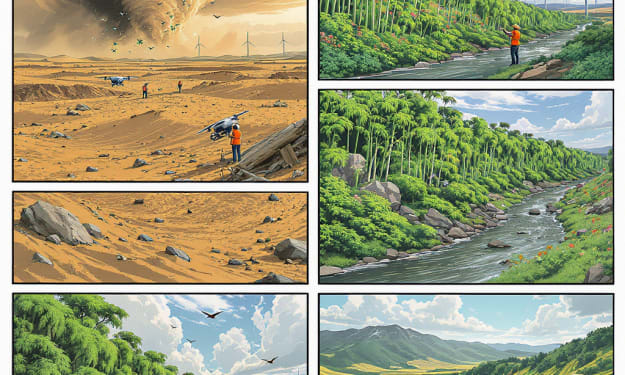
Chinese Planetary Engineering: The Great Green Wall and the Reclamation of Climate
There are junctures in history where a civilization no longer chooses between comfort and progress, but between adaptation and extinction. At the dawn of the new millennium, China hit one of those silent thresholds where geography ceases to be a backdrop and becomes an adversary. The desert was advancing, not as a metaphor for decay, but as a physical, methodical, and relentless force. Sand was devouring the horizon, winds grew heavy with dust, and the soil lost its fertile memory, taking with it the promise of social stability.
By Laurenceau Porte3 days ago in Earth




Comments
There are no comments for this story
Be the first to respond and start the conversation.