
Four Sources of Food to Take You Off The Grid
There are lots of reasons to be independent of grocery stores. Here are some ways to start.

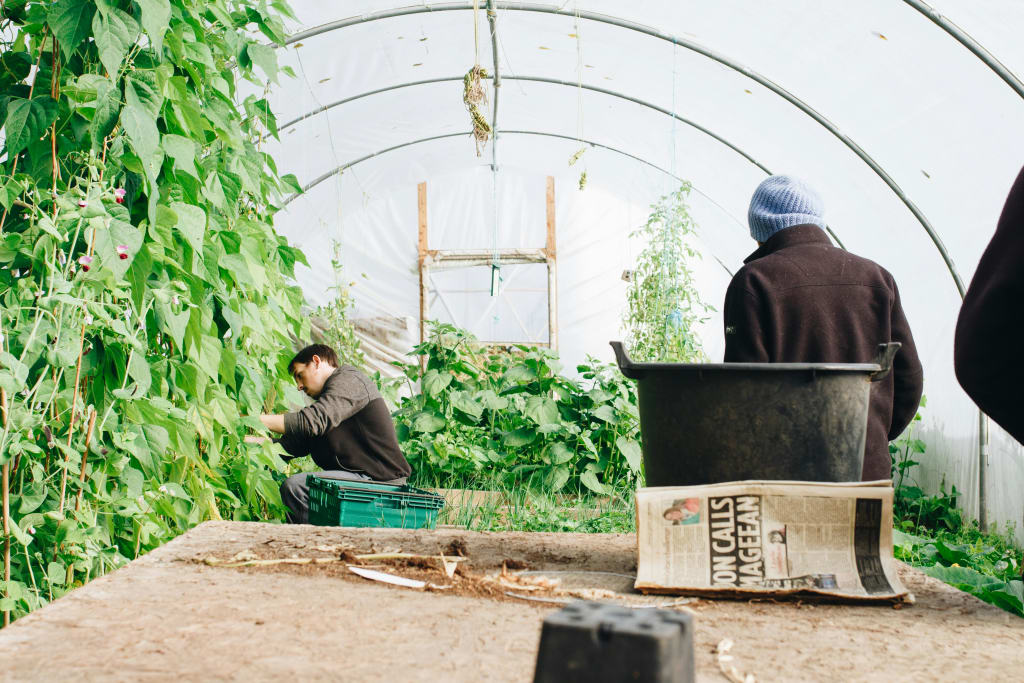
A lot of people are worried about surviving the end of the world. This has become an interest even among those who aren't looking for ways to survive the apocalypse; a lot of people are looking for ways to take more control over their own food sources. There are numerous sources for those looking to grow their own food, especially those with access to a lot of space. Even for those with limited space, there are some decent options.
Protein on Hoof and Vine
Protein is probably going to be the biggest problem when it comes to deciding on which one to work with. Fortunately, there are numerous options when it comes to both plant and animal proteins. For animals, the best options are goats, chickens, and tilapia. Tilapia is arguably the problem child of the trio, but there are ways to mitigate that (and we'll be looking at that later).
[While cows and pigs can be valuable animals, each has their unique issues. Cows can each sustain 1.5 people per year (assuming a half-ton animal), not including milk, but require an acre (.4 hectare) per animal; given that you would need a small herd for sustainability, there is the question of space. They also need to be shifted around each year so the old foraging grounds can regrow. Three pigs can do the same thing and only require only 9 to 60 square feet (1–5.5 square meters) per pig, but since they eat the same things people do there is the debate if they are worth the extra feed.]
A herd of goats (about 25 animals) can feed the same one or two people for a year (plus milk) and only require an acre (.4 hectare). Better yet, as they don't destroy plants the same way cows do, they can forage from the same area every year. For a family of four, this means 75 goats (and three acres (1.2 hectares) should be enough for sustainability. For the same family, you will need 208 chickens per year and roughly 800 square feet (50 square meters) of coop space as well as 6000 square feet (300 square meters) of outside space, but they should be sustainable.
[Another advantage to chickens is that they can help deal with some pests, especially bugs. However, there will be some times you want to limit your chickens' access to your crops, such as when pollinators (butterflies and bees) are busy during blooming season.]
Stressing yet? Don't. These figures ignore supplementary products (goat milk and chicken eggs) and assume you will be eating meat for every meal. Assuming you only eat meat once or twice a day, you could cut the numbers above by a half or even a third. You can also supplement that protein through a variety of plants; while the plants do require more water, they do require less space (50 to 100 square feet (4.5 to 9 square meters) per person. Of the best options, quinoa is arguably the best bet as it's the most robust plant and grows even in high heat with less water. Other options include (but are not limited to) hazelnuts, sunflowers, peanuts, beans, and corn.
So while you're going to need plenty of protein for energy, with a little bit of planning it should not be a problem to come up with all the protein you could ever need and leave some for barter.
The Vegetables Can Take Care of Themselves
Plants are not as problematic as they may seem from the beginning. The big problem is that they require a lot of water, as well as weeding, watching out for insects and other pests, and possible weather problems. You should include fruit trees as part of your farm. A few trees will not only provide all of the fruit you could ever need, but they will also provide valuable shade for you, your animals, and some of your plants. If you have the climate for it, include some olive trees, especially if you can arrange to acquire an oil press.
For crops, you're going to need 200 square feet (188.5 square meters)per person, although I would suggest upping that to at 250 square feet (24 square meters) to allow for protein plants. If you want to eliminate your dependence on store-bought fertilizer, add another 50% to these numbers. There are two systems you can use: The three sisters and the three-field rotation. The three sisters method is just planting seeds in bundles that include one bean seed, one corn seed, and one squash seed. If you want to give them some bonus fertilizer, bury a fish with them (yeah, we'll get to them soon enough!). This is a limited crop but keeps your field going for years.
Three-field rotation is more complicated but allows you a greater diversity of crops. First, divide your crops into nitrogen-fixing crops (like peanuts and beans) and everything else. Next, divide your fields into three different lots and then label them. When you first start planting, put all of the regular crops in the first field, your nitrogen-fixing crops into the second field, and leave the third field fallow (don't do anything with it!). The next planting season, your nitrogen fixers go in the first field, your second field is now the fallow one, and the third field is for regular crops. The next planting season, shift this one more time: The first field is fallow, the second is for regular crops, and the third is now for the nitrogen-fixers.
If you can maintain this cycle, you shouldn't need much in the way of fertilizer, especially if you throw your compost evenly over your fallow field.
Wheat and other grains are more labor intensive but are also needed for carbohydrates. An average person will eat about 150 pounds (68 kg) of flour (or about 2.5 bushels of wheat) a year. This means that you're going to need about 1500 square feet (140 square meters) per person. However, be advised that you may need to go through some hoops: Growing wheat is illegal in the US unless you have all of the proper permits.
Your Spare Room Can Produce Food
Star Trek fans are used to the term "hydroponics." The bad news is that you're going to need lights and some small motors (so a small solar generator may not be a bad idea), but this can convert a spare room into a food-producing center. At the simplest, you're going to need a central tank for mixing plant food and water, tubs, and shelves for the plants, and a system of tubes to get the mixture to the tubs. While the output of this may not be as great as the outside fields (a small room may only add enough for another person or two), this does allow more food diversity or one heck of a herb garden. For those dealing with shorter growing seasons (such as those in arctic climes) or too much inclement weather, this is an ideal way to add to your food stores, provided you can get enough plant food.
But What About The Fish?
Your inground pool can serve one of two functions: You can either use it for water or for more food production. A cistern and a series of water barrels backed by a decent river nearby can pretty much ensure your water supply, freeing up the pool for some aquaculture. Start with some plants that grow on the surface of water (watercress, wasabi, lotus). Then put some pallets across the surface of the pool and start feeding your chickens there; you want their droppings to hit the water and fertilize the plants. While you've got all of this going, use some frozen tilapia eggs to start a school of tilapia; each pound of tilapia needs one-half cubic foot (14 liters).
[Or you can just build your own tilapia pond.]
You will need to purify the tank every 5–9 months, so allow for that (the tilapia water is a good fertilizer). This gives you more food, another source of protein, and the tilapia is mercury-free, so there's no limit on how much you can eat.
But What About Limited Space?
If you have access to a few acres. You're good to go. However, if you're stuck in suburbia you're going to need some extra room. The best suggestion is to either buy several homes or to team up with other people nearby. Each lot then focuses on a different crop, allowing for all the space you need for each type of crop. Nonetheless, with a little planning (especially for getting the wheat permits) you will be independent of local stores and have some options in case of emergency.
About the Creator
Jamais Jochim
I'm the guy who knows every last fact about Spider-man and if I don't I'll track it down. I love bad movies, enjoy table-top gaming, and probably would drive you crazy if you weren't ready for it.
Keep reading
More stories from Jamais Jochim and writers in Earth and other communities.
Important Tradables In the Post-Apocalyptic Wasteland
In the case of an apocalypse, it will be useful to have access to items for barter. Money is unlikely to have any real power, at least for a few years, thus making trade items a necessity (eventually, some group is going to start up coins and then bills, but that's unlikely to happen for at least a few years after the apocalypse); after all, everyone is likely to need various items but have a surplus of other items. This means that we will be back to dealing with a barter economy, where goods and services are traded for other goods and services. Fortunately, it's possible to stock up on some items ahead of time.
By Jamais Jochimabout a year ago in Futurism
Without Democracy, Donald Trump’s Venezuelan Oil Quest Will Fail
Donald Trump’s renewed interest in Venezuelan oil may seem, on the surface, like a hard-nosed geopolitical calculation. Venezuela holds the world’s largest proven oil reserves, and amid global energy uncertainty, access to those resources is undeniably tempting. But history, economics, and politics all point to the same conclusion: without democratic reform in Venezuela, any attempt by a Trump-led US administration to secure reliable Venezuelan oil will ultimately fail.
By Aarif Lashari4 days ago in Earth




Comments
There are no comments for this story
Be the first to respond and start the conversation.